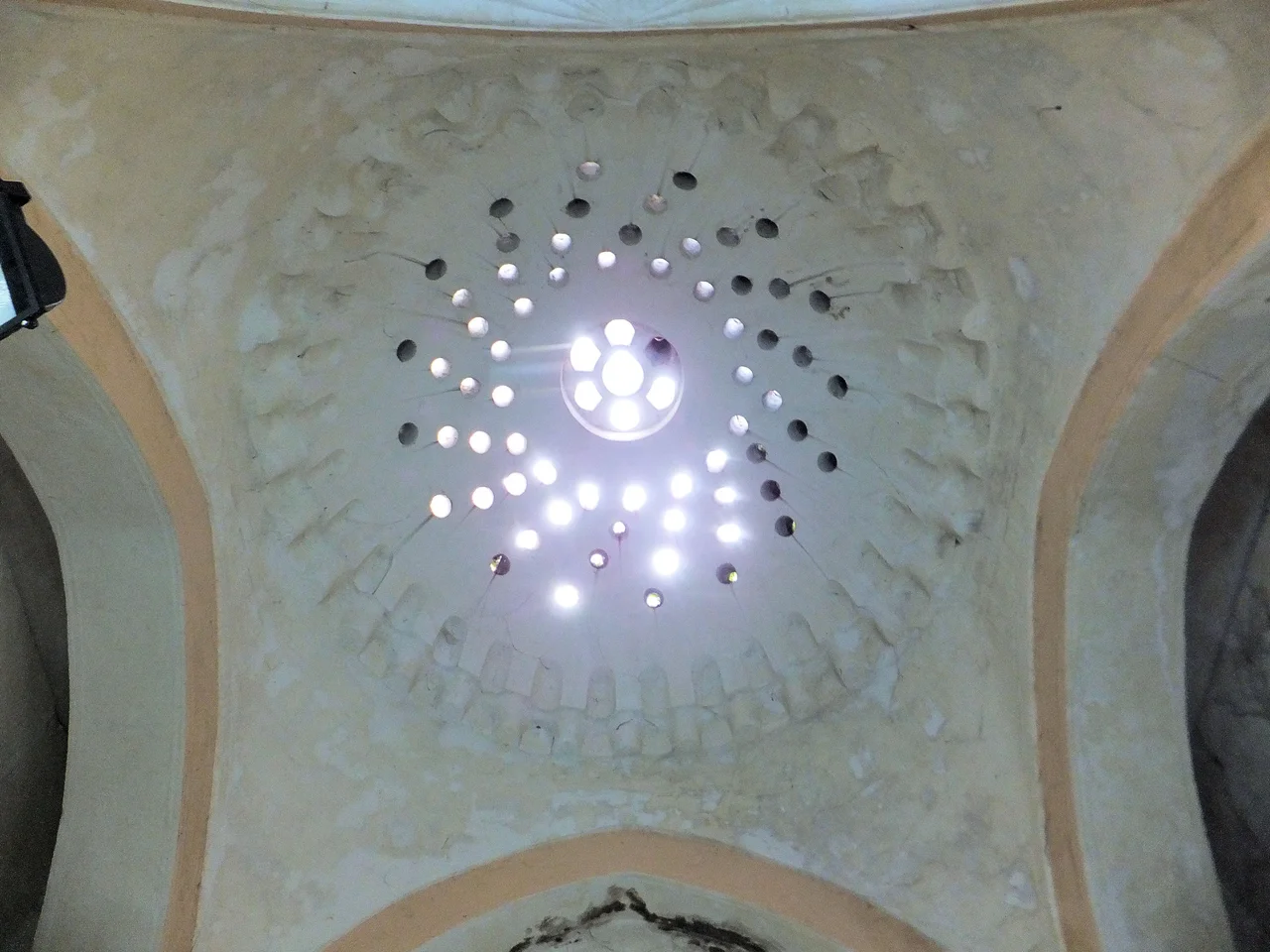

Mahmut Pasha Hamam
The oldest surviving mosque complex in Istanbul was not built for the sultan. It was built for his grand vizier. Mahmud Pasha Angelović — born into the Byzantine-Serbian nobility, brought to the Ottoman court, converted to Islam, and elevated to the highest administrative office in the empire — commissioned his külliye, his charitable complex, in the years just after Mehmet II's conquest. The hamam that served it was completed in 1466, two years after the mosque, and it stands today as one of the oldest bathhouses in the city. Walk inside and you will find something even older in spirit: a ribbed, scallop-shaped half-dome over the warm room, the earliest example of that architectural form to survive in Istanbul. It was a prototype for everything that came after.
The Vizier Who Built a District
Mahmud Pasha was not simply building a bathhouse. He was building a neighborhood. In the years immediately after the Ottoman conquest of 1453, the commercial heart of the new Istanbul was still taking shape, and Mehmet II appears to have entrusted Mahmud Pasha with developing the district between what would become the Grand Bazaar and the waterfront at Eminönü. The waqf — the Islamic religious endowment — attached to the Mahmut Pasha Mosque and its associated buildings was extensive, covering structures scattered across the surrounding area. The hamam was part of this larger project: a bathhouse that served the mosque's congregation and the working district around it, generating income that would sustain the charitable functions of the whole complex. In this sense, every visitor who paid to use the baths was contributing, however indirectly, to the religious and civic life of early Ottoman Istanbul.
Architecture of Firsts
The hamam was originally a double bathhouse — separate but adjacent facilities for men and women, each with its own changing room and steam chambers. The women's section was demolished at some later date, making room for other commercial construction, a loss that erased half the original building. What survives is the men's section, and it repays close attention. The entrance opens into the changing room beneath the largest dome in the complex, 17 meters in diameter, its corners decorated with muqarnas squinches — the stalactite-like honeycomb ornament characteristic of Islamic architecture. Beyond that lies the tepid room, and then the hot room, octagonal and domed, with four iwans cut into its walls for individual washing. At its center once stood the göbektaşı, the heated marble platform where bathers received massages. But the architectural moment that matters most is the warm room's half-dome: ribbed, scallop-shaped, and unprecedented. No earlier example of this form survives in Istanbul. It is a first — and looking at it, you can see the future of Ottoman architecture in embryo.
Damage, Restoration, and a New Life
The hamam survived fire, earthquake, and centuries of hard use, though not without damage. Like much of Istanbul's historic fabric, it suffered during the urban upheavals of the eighteenth and nineteenth centuries and fell into disrepair. A restoration in the twentieth century stabilized the structure, but the building's function shifted with the city around it. Today the Mahmut Pasha Hamam no longer operates as a bathhouse. It serves as a shopping center — part of the dense retail district that still fills the streets between the Grand Bazaar and Eminönü. The transition from communal bathing to commercial retail is jarring if you know the history, but it is also very Istanbul: a city that has never had much patience for nostalgia, and has always found ways to put old structures to new use. The domes still rise above the market stalls. The half-dome still curves in the warm room. The stone remembers what the function has forgotten.
A Building in Its Neighborhood
To understand the Mahmut Pasha Hamam fully, you have to stand in the street outside it and look around. The mosque is a short walk away, the bazaar street runs alongside, the Grand Bazaar is a few minutes on foot, and the Mahmutpaşa Bazaar — the open-air market street that carries the same name — runs downhill toward Eminönü. All of these structures belong to the same moment: the Ottoman refounding of Constantinople in the decade or two after 1453. Mahmud Pasha sat at the center of that refounding, and his külliye — mosque, hamam, türbe — was its most concentrated architectural expression. The hamam is the most intimate piece of that complex. A bathhouse is where a city breathes: where people gathered daily, in warmth and steam, not for prayer or commerce but simply to be clean. That the oldest example of such a space in Istanbul was built by a man who had been born Greek and died Ottoman says something precise about what this city has always been.
From the Air
The Mahmut Pasha Hamam sits at coordinates 41.0121°N, 28.9702°E in the Fatih district of Istanbul, within the dense historic fabric of the old city peninsula. From altitude, look for the Grand Bazaar's distinctive roofline — a cluster of domed market halls — and the hamam lies just to the northeast, in the maze of streets between the bazaar and the Golden Horn waterfront. The minarets of the nearby Mahmut Pasha Mosque provide a useful visual reference point. Nearest major airport: LTFM (Istanbul Airport), approximately 35 km to the northwest. On a clear approach from the north, the entire historic peninsula is visible with the old city's mosques and bazaars spread across the low hills between the Golden Horn and the Sea of Marmara.
Nearby Stories
- Kocaeli Peninsula 7.6 km away
- Second Battle of Çatalca 11 km away
- Istanbul's Rural Outskirts 14 km away
- MV Struma 20 km away
- HMAS AE2 36 km away
- Bursa 66 km away
- Sangarius Bridge 71 km away
- Januarius MacGahan 101 km away