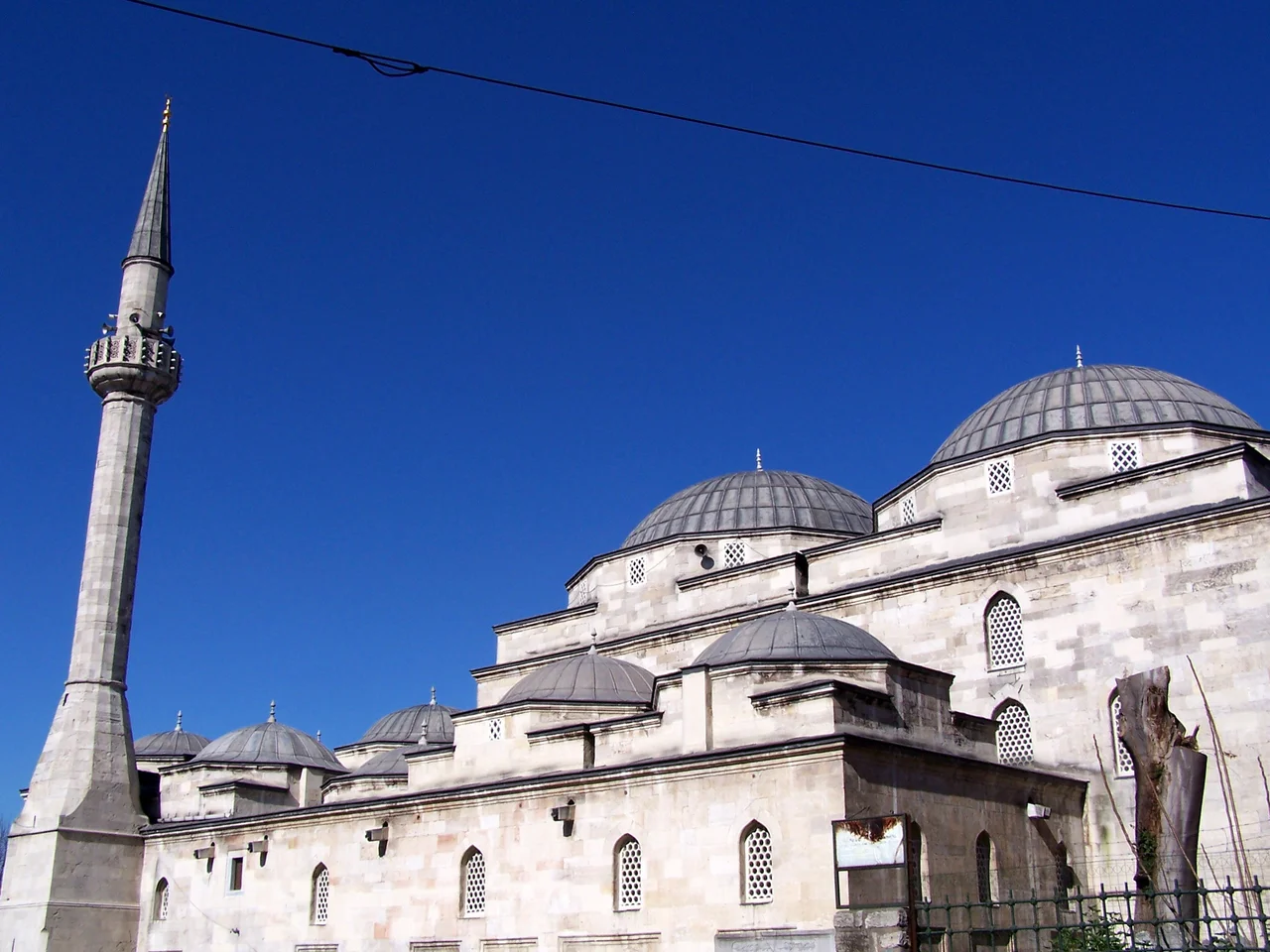

Mahmut Pasha Mosque, Eminönü
Most of the early mosques in Constantinople were not built — they were converted. The Byzantines had filled their city with churches, and when Mehmet II took the city in 1453, those churches became mosques by decree. The Mahmut Pasha Mosque, completed in 1464, was something different: one of the first structures built inside the city walls specifically as a mosque, from the ground up, for the new Ottoman Istanbul. Its patron was Mahmud Pasha Angelović, a man of Greek-Serbian birth who became grand vizier of the Ottoman Empire, converted to Islam, and built one of the earliest and most complete külliye complexes in the conquered city. The mosque he left behind is compact and quietly radical, and the turquoise-and-indigo tilework on his tomb outside is unlike anything else in Istanbul.
The First Builder of New Istanbul
To understand the Mahmut Pasha Mosque, you need to understand Mahmud Pasha himself. He was not Turkish by birth. His origins were in the Greek and Serbian nobility of the Balkans, and he came to the Ottoman court through the devshirme system — the practice by which talented boys from Christian families were taken, converted, educated, and integrated into the imperial administration. Mahmud Pasha rose to become grand vizier under Mehmet II, the highest administrative office in the empire after the sultan. When Mehmet decided that the area between the newly founded Grand Bazaar and the waterfront needed development, he gave the commission to Mahmud Pasha. The mosque — completed in 1464, a decade after the conquest — was the centerpiece of that development. To build a mosque rather than convert a church was an architectural statement: this was not Byzantium repurposed, but something genuinely new.
A Style on the Cusp of Change
The mosque is designed in what architects call the Bursa style, after the early Ottoman capital in northwestern Anatolia. The main prayer space is a rectangle, twice as long as it is wide, covered by two identical domes each 12.5 meters in diameter. The mihrab and minbar stand at the short end. This was the Ottoman aesthetic of the mid-fifteenth century — multiple equal domes rather than one dominant one — and it was already becoming obsolete by the time the building was finished. Within a generation, Ottoman architects would abandon this approach entirely, turning toward the single large dome with smaller subsidiary structures that culminates in the great mosques of Sinan a century later. The Mahmut Pasha Mosque stands at the pivot point: early enough to be built in the old way, late enough that the new way was already taking shape. The entrance portico is another architectural hybrid: an outer and inner porch covered by five small domes each, an arrangement that echoes the narthex system of Byzantine churches without copying it directly.
The Tomb That Stands Alone
In the grounds of the mosque, separate from the main building, stands the octagonal mausoleum of Mahmud Pasha. It is dated 878 in the Islamic calendar, corresponding to 1473-74 CE — the year Mahmud Pasha died. The exterior of the türbe is decorated with ceramic tiles forming geometric patterns in turquoise and indigo. This is extraordinary: no other Ottoman mausoleum in Istanbul uses this specific form of tilework decoration in this way. The tiles are not the famous Iznik tiles of the sixteenth century; they predate that tradition. They represent an earlier, rarer aesthetic that did not survive as a broader school of decorative art. The turquoise and indigo geometric patterns give the tomb a crystalline quality, abstract and precise, more mathematical than floral. Standing in front of it, in the middle of a busy commercial district, you are looking at something that exists nowhere else in the city.
Restored and Still in Use
Centuries of earthquakes, fires, and rebuildings left their mark on the mosque. The original marble columns of the outer porch were replaced with stone after earthquake damage in the eighteenth century. The mahfil — the raised platform for the muezzin — was added in the nineteenth century, and the mihrab and minbar were replaced at the same time, giving them a decorative style that does not match the fifteenth-century rest of the building. These layers of repair and modification are typical of Istanbul's historic mosques; very few have survived to the present in anything like their original state. The Mahmut Pasha Mosque was completely restored and reopened in 2021, work on the tomb continuing into 2022. The restoration has given the building fresh clarity — the proportions of the two domes read cleanly, the porch sequence works as its designers intended, and the congregation that gathers here is the latest in a line stretching back to 1464.
From the Air
The Mahmut Pasha Mosque stands at coordinates 41.0111°N, 28.9713°E in the Fatih district of Istanbul, a short distance northeast of the Grand Bazaar. From altitude, the mosque's twin domes and single minaret are visible within the tight grid of streets between the bazaar complex and the Golden Horn. The octagonal tilework türbe of Mahmud Pasha is in the mosque's grounds but not easily distinguished from the air. Nearest major airport: LTFM (Istanbul Airport), approximately 35 km to the northwest. A clear-day approach from the northwest presents the historic peninsula in panorama: the land walls on the western edge, the mosques and bazaars across the middle hills, and the waters of the Bosphorus, Golden Horn, and Sea of Marmara surrounding three sides.
Nearby Stories
- Kocaeli Peninsula 7.6 km away
- Second Battle of Çatalca 11 km away
- Istanbul's Rural Outskirts 14 km away
- MV Struma 20 km away
- HMAS AE2 36 km away
- Bursa 66 km away
- Sangarius Bridge 71 km away
- Januarius MacGahan 101 km away