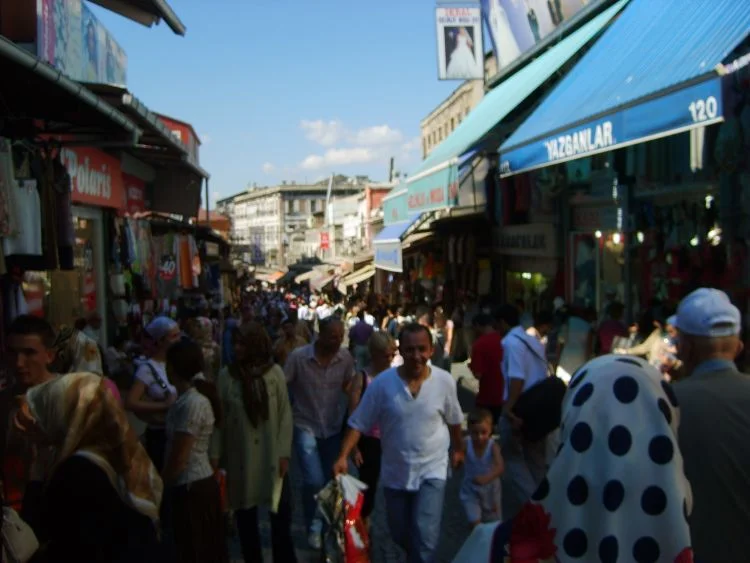

Mahmutpasha Bazaar, Istanbul
The Grand Bazaar gets the tourists. Mahmutpaşa Bazaar gets the city. The open-air market street that runs downhill from the Grand Bazaar toward the Eminönü waterfront is not an attraction in the conventional sense — there are no guided tours, no entry gates, no audio devices. There are just shops: 256 of them, packed on both sides of a sloping street, selling fabric and hardware and clothing and household goods at prices calibrated for residents rather than visitors. On a busy afternoon the street is a slow current of bodies, bags, and noise, the smell of roasting nuts mixing with diesel fumes and the tang of new synthetic fabric. Mahmutpaşa Bazaar is what a market looks like when it exists to serve a city rather than to show it off.
Named for a Grand Vizier
The bazaar takes its name from the street it occupies, which takes its name from the nearby Mahmut Pasha Mosque — and that mosque was commissioned in 1462 by Mahmud Pasha Angelović, grand vizier to Sultan Mehmed II in the decade after the Ottoman conquest of Constantinople. Mahmud Pasha was one of the key figures in the rebuilding of the conquered city, charged with developing the commercial district between the new Grand Bazaar and the waterfront. The mosque, hamam, türbe, sebils, and fountains he left behind formed the core of a neighborhood that organized itself around that complex for centuries. The bazaar street grew up in this environment: a natural arterial route connecting the covered bazaar uphill to the port below, lined with merchants who wanted to catch the foot traffic moving between the two. The name stuck, and the commercial logic that created it never went away.
The Street Between Two Worlds
Mahmutpaşa Bazaar occupies a specific and important geographic position in Istanbul's commercial geography. The Grand Bazaar — the vast covered market that is one of the largest and oldest covered markets in the world — sits at the top of the hill. Eminönü, the historic waterfront district where ferries cross the Golden Horn and the Galata Bridge links the old city to the new, sits at the bottom. Mahmutpaşa Bazaar is the street between them, and for five centuries it has caught everything moving in both directions: merchants bringing goods up from the docks, shoppers coming down from the bazaar, traders moving between the two. The Mahmutpaşa neighborhood of the Fatih district built up around this commercial artery, and the street became the district's spine. Today, as in the Ottoman period, what you find here is not the luxury end of Istanbul's retail economy but its workaday middle: the kind of shopping where negotiation is expected and the emphasis is on practicality and price.
256 Shops and the Logic of the Open Bazaar
The 256 shops of Mahmutpaşa Bazaar are not organized in any formal sense — there is no management company, no unifying theme, no attempt at curation. The market evolved organically over centuries and has the characteristic logic of organic markets: clusters of similar trades, stretches of mixed goods, the occasional surprising specialist tucked between two fabric sellers. Textiles have always dominated here, and fabric — bolts of it in every weight and color — remains the street's primary product. Hardware, clothing, shoes, and household goods share the space. The physical form is simplicity itself: a sloping street, shops opening directly onto it, awnings and overhangs providing shade. There are no grand architectural flourishes. The architecture is the function.
What a City Market Looks Like
Istanbul has no shortage of famous markets. The Grand Bazaar is famous, the Spice Bazaar near Eminönü is famous, the Arasta Bazaar near the Blue Mosque is famous. Mahmutpaşa Bazaar is different from all of them: it is famous in the sense that every Istanbulite knows it, but not in the sense that requires international recognition. It is a working market for a working city. The shopkeepers who run these 256 establishments are not selling to tourists primarily; they are selling to the Fatih district, to the Sultanahmet garment trade, to the small manufacturers and wholesalers who use this corridor as a supply route. Visiting it as a traveler means entering a space that is not performing for you. The haggling, the noise, the compressed energy of the street — these are not attractions. They are how business gets done. That difference is, for many visitors, the most interesting thing about Mahmutpaşa Bazaar: the chance to see Istanbul shopping for itself.
From the Air
Mahmutpaşa Bazaar runs along the street at coordinates approximately 41.0112°N, 28.9698°E in the Fatih district of Istanbul, between the Grand Bazaar uphill to the southwest and the Eminönü waterfront to the northeast. From altitude, the area appears as dense, tightly packed urban fabric on the lower slopes of one of the old city's hills, between the Grand Bazaar's distinctive domed roofline and the shimmering waters of the Golden Horn. The Galata Bridge spanning the Golden Horn is a useful landmark to the north. Nearest major airport: LTFM (Istanbul Airport), approximately 35 km to the northwest. On approach from the northwest in good visibility, the historic peninsula's layered topography — hills rising from the water, mosques on the crests, bazaars in the valleys between — is one of the more striking urban panoramas in the world.
Nearby Stories
- Kocaeli Peninsula 7.6 km away
- Second Battle of Çatalca 11 km away
- Istanbul's Rural Outskirts 14 km away
- MV Struma 20 km away
- HMAS AE2 36 km away
- Bursa 66 km away
- Sangarius Bridge 71 km away
- Januarius MacGahan 101 km away