
Malta Kiosk
Somewhere between a pleasure pavilion and a political stage, the Malta Kiosk sits in the forest of Yıldız Park as if it has been keeping secrets since the day it was built. Sultan Abdülaziz commissioned it in the 1860s as a hunting lodge — a retreat from the pressures of ruling a fraying empire — and architect Sarkis Balyan gave him something far grander than a hunting cabin. Two storeys of neo-baroque ornament rise above the garden paths, and the waters of the Bosphorus glitter through the trees below.
A Lodge Dressed for a Sultan
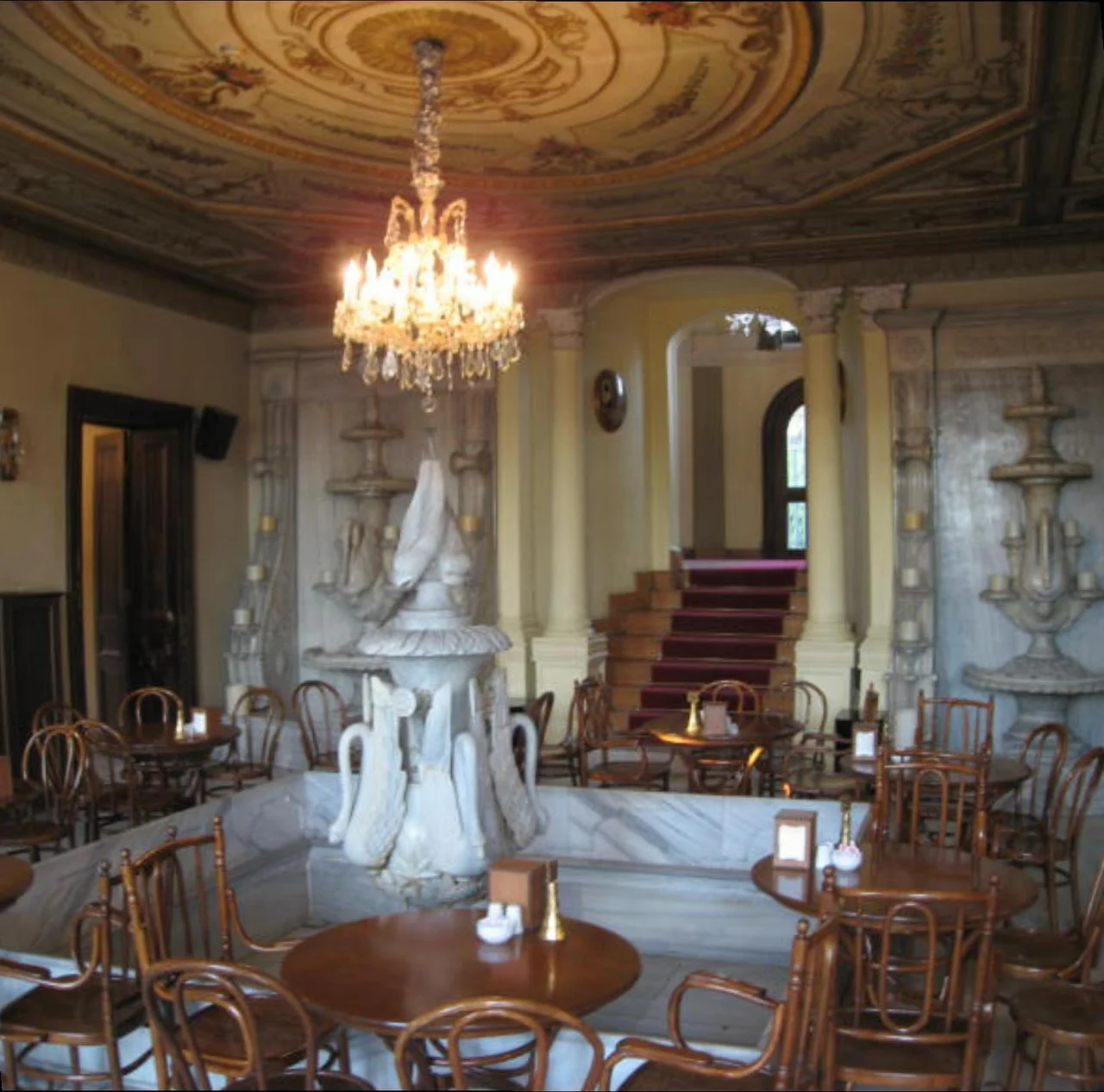
Balyan's design flatters the eye at every turn. The entrance opens onto a large hall where two sweeping staircases climb to the upper floor, framing a space generous enough to host not merely hunts, but audiences and ceremonies. Above the hall hangs a great chandelier from a dome-shaped ceiling decked with curving branches and clusters of flower motifs — the kind of ornament that signals imperial seriousness beneath its prettiness. In the lower salon, a marble fountain and pool occupy the center of the room, carved with swan and fish figures that ripple with motion even in stone. Green exterior walls trimmed in white give the pavilion the quality of something half-emerged from its wooded setting, as though the forest were slowly claiming it back.
The Trial Behind the Tent
The Kiosk's most charged moment came not in its gilded interiors but in its shadow. In 1881, Sultan Abdülhamid II ordered the arrest of Midhat Pasha — the great reforming grand vizier, father of the first Ottoman constitution of 1876 — for the second time. Midhat had been exiled in 1877 after promulgating the constitution, then allowed to return as a provincial governor — trusting that his rehabilitation was genuine. The trial was staged in the nearby Çadır (Tent) Pavilion, just behind the Malta Kiosk. Whatever fairness Midhat expected did not materialize. He was convicted, sentenced to death (commuted to life imprisonment), and died in 1884 in Taif, Arabia — most likely murdered on the sultan's orders. The pleasant surroundings made the injustice no less sharp. Power in the late Ottoman court wore decorative clothes.
Neglect, Then Revival
After the Republic of Turkey was founded in 1923, the Malta Pavilion shared the fate of most imperial buildings — it stood empty, its chandeliers gathering dust, its marble pools dry. Decades passed. Then in 1979, the Touring and Automobile Club of Turkey (TTOK) under the energetic leadership of Çelik Gülersoy signed an agreement with the City of Istanbul to restore a cluster of historic imperial residences and open them to the public. The Malta Pavilion was the first restoration project completed under this agreement. Workers repainted the exterior in its signature green with white trim. Inside, period furnishings, paintings, and chandeliers were sourced and installed to recreate the atmosphere of the neo-baroque original. The building reopened as a café and gathering place, giving the former hunting lodge a kind of democratic second life.
Yıldız Park and the View Below
The Malta Kiosk cannot really be separated from its setting. Yıldız Park — once part of the private imperial grounds of Yıldız Palace — spreads across the hillside above the Beşiktaş waterfront in Istanbul's European quarter. Trees that were planted for sultans still provide shade over paths now walked by families, joggers, and visitors with cameras. From the terraces and viewpoints of the park, the Bosphorus reveals itself between the branches: the slow procession of tankers, the ferries crossing to the Asian shore, the minarets pricking the skyline to the south. The Kiosk sits high enough to catch the breeze that comes off the water on summer afternoons, which was, presumably, precisely the point.
Imperial Ornament, Public Inheritance
What strikes visitors today is how completely the Malta Kiosk has shed its exclusivity without losing its character. The baroque flourishes and carved marble remain; so do the chandeliers and the graceful proportions of the rooms. But the lodge that once stood behind palace walls and witnessed political theatre now welcomes anyone who climbs the wooded paths of Yıldız Park. It is a reminder that the most lasting things an empire builds are sometimes its smallest and least strategic ones — a place to rest, to look at swans carved in marble, and to listen to the forest.
From the Air
The Malta Kiosk sits at approximately 41.0513°N, 29.0159°E on the wooded hillside above the Beşiktaş waterfront, roughly 4 km north-northeast of the Sultanahmet historic core. At 1,500 feet AGL on approach from the Marmara Sea, Yıldız Park appears as a dense forested ridge above the Bosphorus shoreline, contrasting sharply with the urban density below. The nearest major airport is Istanbul Airport (LTFM), approximately 35 km to the northwest. Pilots transitioning through the Istanbul TMA should note the busy Bosphorus corridor below and maintain coordination with Istanbul Approach.
Nearby Stories
- Kocaeli Peninsula 7.6 km away
- Second Battle of Çatalca 11 km away
- Istanbul's Rural Outskirts 14 km away
- MV Struma 20 km away
- HMAS AE2 36 km away
- Bursa 66 km away
- Sangarius Bridge 71 km away
- Januarius MacGahan 101 km away