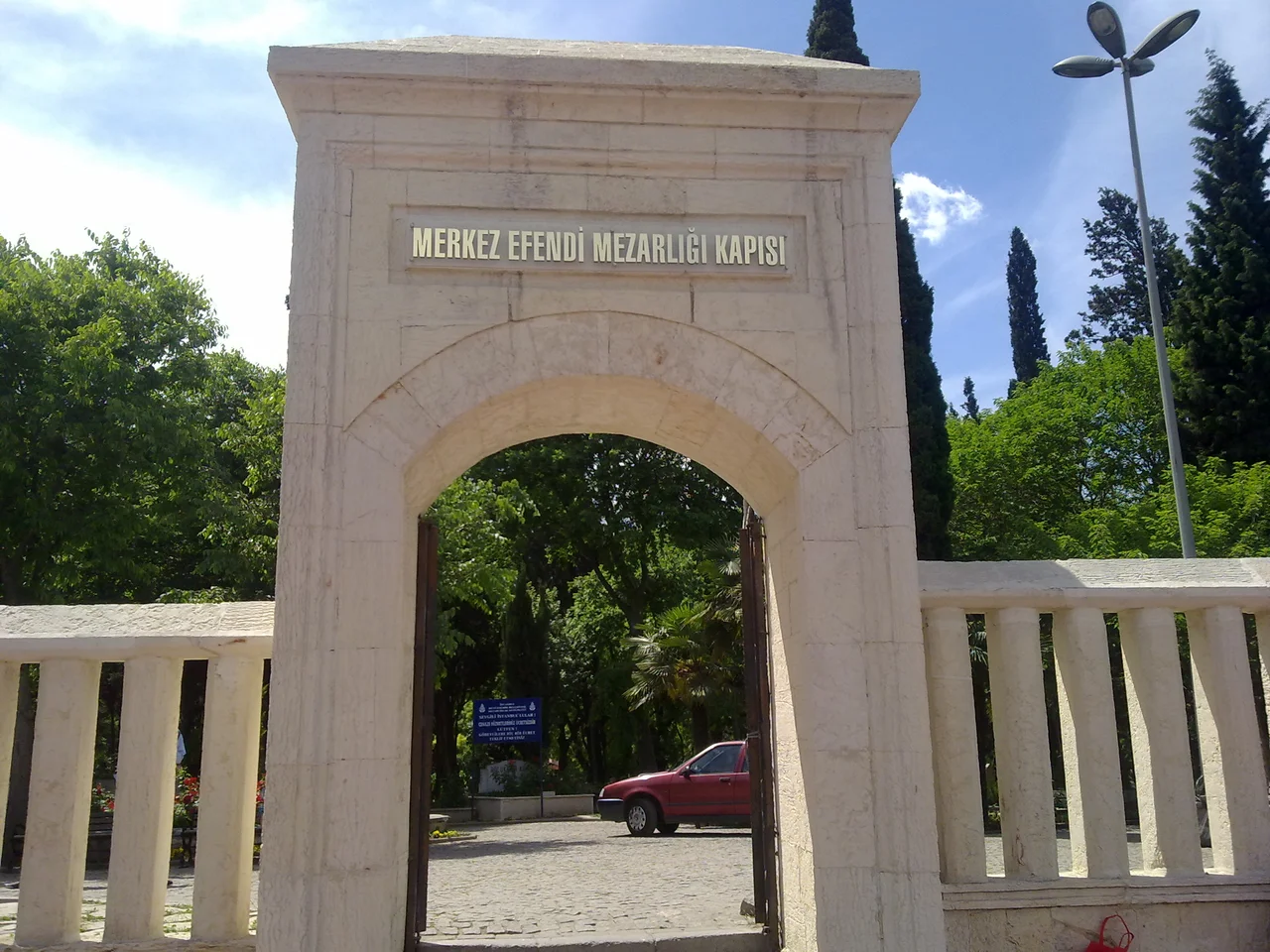

Merkezefendi Cemetery
Merkez Efendi was born in 1463 and spent his long life moving between the worlds of Ottoman scholarship and Sufi mysticism. When he died in 1552 at nearly ninety years old, he was buried on the European edge of what was still a young imperial city. His tomb became the seed of a cemetery, and that cemetery became the quiet custodian of five centuries of Istanbul's intellectual life. Today, the Merkezefendi Cemetery covers 27,800 square meters of Zeytinburnu district — a name that itself honors the man at its heart.
The Mystic Who Named a Neighborhood
Merkez Efendi was an Ottoman Islamic scholar and Sufi, a practitioner of the inner spiritual dimension of Islam that flourished alongside the empire's outward power. Sufism in the Ottoman world was not marginal — its lodges, or tekkes, were centers of education, charity, and music. Merkez Efendi belonged to the Halveti order, one of the most prominent Sufi brotherhoods of the era. His tomb, constructed in the 16th century as the founding anchor of this cemetery, drew pilgrims and mourners alike for generations. The neighborhood that grew around it took his name. Even the sign on the cemetery gate today carries it, a quiet persistence of devotion across half a millennium.
A Garden of Intellectuals
What makes this cemetery remarkable is the richness of the lives buried within it. Halide Edip Adıvar (1884–1964) rests here — one of Turkey's first feminist politicians, a novelist whose work shaped modern Turkish literature, and a woman who addressed troops during the War of Independence at Sultanahmet Square. Abdullah Cevdet (1869–1932), poet and radical freethinker, ideologist of the Young Turks, lies nearby. Sadettin Kaynak (1895–1961), whose compositions became some of the most beloved in Turkish classical music, occupies another corner. The composer and the revolutionary, the novelist and the Sufi — they all ended here, in the same 27,800 square meters of ground, under the same Istanbul sky.
Layers Added Over Centuries
The cemetery began with a single tomb and grew outward. It was extended significantly in the 1950s, when a second burial ground, the Kozlu Cemetery, was established 100 meters away to absorb the overflow of the expanding city. A full renovation in 2007 refreshed the grounds, and again in 2011 maintenance work was carried out in the lead-up to the burial of former Prime Minister Necmettin Erbakan (1926–2011). Erbakan — engineer, politician, and founder of several Islamist parties — was the last major public figure interred here. Since then, the cemetery has been closed to new burials except for family members of those already laid to rest, preserving its population as a finite archive of Ottoman and Republican lives.
Quiet in the City
Zeytinburnu today is a dense, working-class district on the western edge of Istanbul's historic peninsula, wedged between highways and the Sea of Marmara. The cemetery sits within this urban fabric without fanfare. Cypress trees — the traditional Ottoman grave-marker, their slender forms pointing skyward — shade the old tombstones. The Ottoman headstones bear calligraphy and turbans carved in stone, indicating rank and allegiance. Some stones have sunk at angles from centuries of Istanbul's seismic tremors. Walking among them is walking through the republic's formation: the novelists who imagined a new Turkey, the politicians who built and argued over it, and beneath them all, the Sufi mystic who gave this ground its name long before any of them were born.
From the Air
The Merkezefendi Cemetery lies at approximately 41.015°N, 28.921°E in the Zeytinburnu district on the European side of Istanbul. Flying into Istanbul Airport (LTFM) from the west, the historic peninsula is visible to your southeast — the dense cityscape of Fatih and Zeytinburnu stretching from the old Theodosian Walls down toward the Marmara coast. Approach at 3,000–5,000 feet for a clear view of the layered urban fabric of European Istanbul. The cemetery is not individually visible from altitude, but the Zeytinburnu district sits just inside the old walls, between the coast road and the inland neighborhoods.
Nearby Stories
- Kocaeli Peninsula 7.6 km away
- Second Battle of Çatalca 11 km away
- Istanbul's Rural Outskirts 14 km away
- MV Struma 20 km away
- HMAS AE2 36 km away
- Bursa 66 km away
- Sangarius Bridge 71 km away
- Januarius MacGahan 101 km away