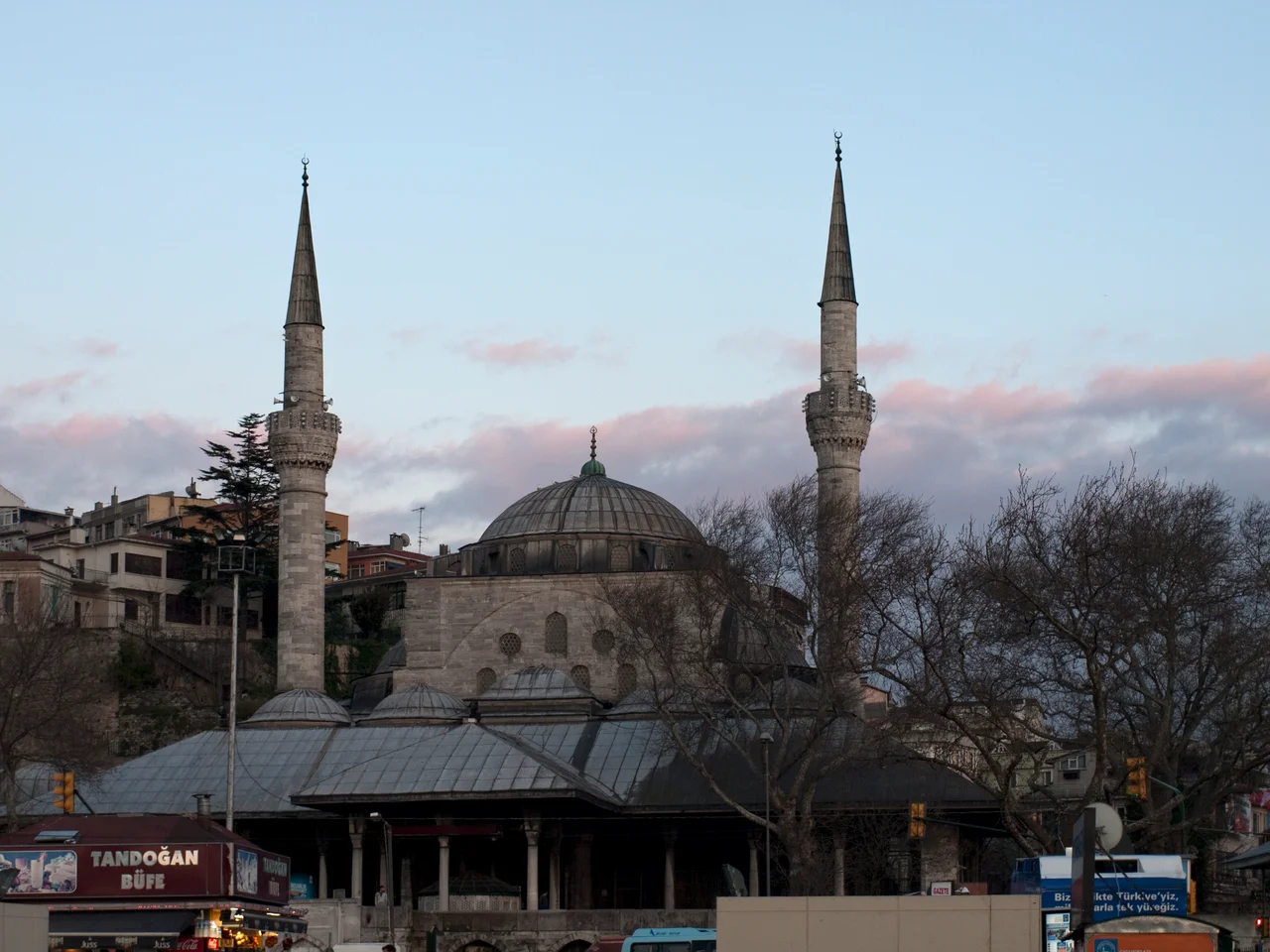

Mihrimah Sultan Mosque, Üsküdar
Before the coast road was built, this mosque stood at the water's edge. Ferries from the Asian hinterland — from Anatolia, from Persia, from pilgrims en route to Mecca — would arrive at Üsküdar's jetty and find it waiting there, its single dome and slender minarets framed against the Istanbul skyline across the strait. It is still called the İskele Camii, the Jetty Mosque, because that relationship with the water was the defining fact of its existence. Mimar Sinan designed it in the years 1543 to 1548 for Mihrimah Sultan, the only surviving daughter of Suleiman the Magnificent and one of the most powerful women of the Ottoman Empire.
A Princess Commissions Two Mosques
Mihrimah Sultan held unusual power for a woman of the 16th-century Ottoman court. As daughter of the reigning sultan and wife of Grand Vizier Rüstem Pasha, she wielded political influence and substantial personal wealth. She used that wealth to commission two Friday mosques in Istanbul — the earlier one here in Üsküdar on the Asian shore, completed around 1548, and a second on the European side at Edirnekapı. The two mosques, on different continents, face one another across the city. It is a piece of spatial poetry that Mimar Sinan almost certainly understood when he accepted both commissions.
Raised Above the Shore
The mosque does not sit at street level. It stands on a raised platform — a practical necessity on a waterfront site, and an architectural choice that gives the building presence and elevation. A broad double portico fronts the entrance, containing a fine marble ablutions fountain whose carved detail reflects the quality of imperial patronage. Inside, the structure demonstrates what Sinan's mature style had become by the 1540s: a spacious, high-vaulted interior where a central dome is flanked by three semi-domes, each of which terminates in three smaller exedrae. The basement below is vaulted and generous. The minarets are slender — the adjective appears in every description of this mosque — giving the silhouette a vertical lightness that plays against the horizontal weight of the platform below.
Stone, Marble, and Sundials
The exterior is clad in ashlar — dressed stone running from gray to cream, the palette of imperial Ottoman construction. Inside, the mimber (pulpit) and wall surrounds are marble, much of it imported. Islamic calligraphy fills the interior surfaces, as do flower mosaics on the window glass that filter Bosphorus light into the prayer hall in colors. One surviving detail is particularly rare: a carved sundial survives on the mosque wall near the courtyard, a practical instrument from an era when the five daily prayers were calculated by solar position. It is easy to pass by without noticing it. It rewards the visitor who looks.
A Landmark That Holds Its Ground
The mosque was originally part of a larger complex — a külliye — that included a medrese, a primary school, and other charitable foundations. Some of those structures survive, though with different purposes now. The coast road that eventually separated the mosque from the actual waterline changed the experience of arrival, but not the mosque's presence. It remains one of Üsküdar's most recognizable landmarks, visible from the ferries that still cross between the European and Asian sides of the city. Travelers arriving from the Asian shore see its profile against the sky in exactly the way that pilgrims and merchants saw it five hundred years ago — a fixed point in a city that has never stopped changing.
From the Air
The Mihrimah Sultan Mosque in Üsküdar sits at approximately 41.027°N, 29.016°E on the Asian shore of Istanbul. The nearest airport is Sabiha Gökçen International (LTFJ), approximately 35 kilometers to the east. Approaching LTFJ from the west, the Bosphorus strait comes into view with Üsküdar's waterfront clearly visible on the Asian bank — the mosque's dome and minarets recognizable above the ferry terminal. From 3,000–4,000 feet, the geometric contrast between the Asian and European skylines of Istanbul is striking, with the historic peninsula's clustered mosque silhouettes visible across the water to the west.
Nearby Stories
- Kocaeli Peninsula 7.6 km away
- Second Battle of Çatalca 11 km away
- Istanbul's Rural Outskirts 14 km away
- MV Struma 20 km away
- HMAS AE2 36 km away
- Bursa 66 km away
- Sangarius Bridge 71 km away
- Januarius MacGahan 101 km away