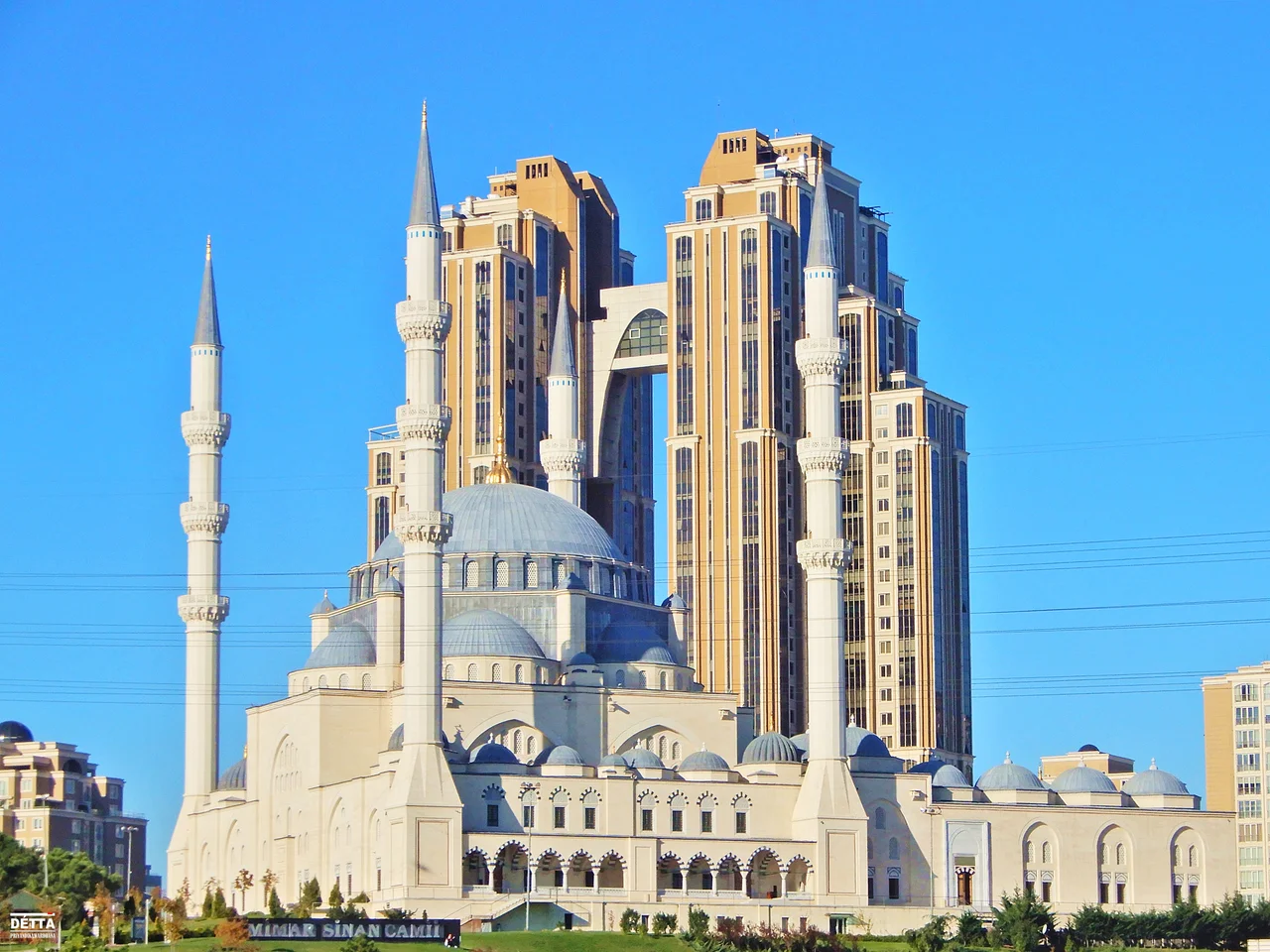

Mimar Sinan Mosque
For centuries, Istanbul's grandest mosques looked west. The Süleymaniye rose above the Golden Horn; the Blue Mosque commanded the old peninsula. The Anatolian shore — the Asian side, the side that technically sits on a different continent — had nothing to match them. That changed in 2012, when a new mosque opened in Ataşehir: not named for a reigning sultan or a living official, but for a man who had been dead for four hundred years. Calling it the Mimar Sinan Mosque was an act of architectural deference, a modern city acknowledging that some names carry more weight than any living patron could.
A Name Worth Borrowing
Mimar Sinan, the imperial architect of the sixteenth century, designed more than 350 buildings across the Ottoman Empire, including the Süleymaniye Mosque and the Selimiye in Edirne — works that set the standard for Ottoman architecture for generations. When architect Hilmi Şenalp's new mosque was commissioned by the Turkish government, it was originally slated to bear a geographical name: the Anatolian Great Mosque. Prime Minister Recep Tayyip Erdoğan changed that. He wanted the mosque to carry Sinan's name, and at the inauguration he noted a gap that had long existed: the Anatolian side of Istanbul had never had a selatin mosque — a mosque of imperial scale, the kind historically commissioned by sultans. The new mosque was meant to fill that absence, and the name was meant to signal its ambition.
Scale in Stone and Steel
The numbers tell part of the story. The central dome rises 42 meters, and the minarets climb to 72 meters — visible from considerable distance across the Anatolian skyline. On any given Friday, the mosque can hold between ten and twelve thousand worshippers. Beneath the prayer halls, the complex descends into a substantial underground world: a library, classrooms, conference halls, retail spaces, a parking garage, and a VIP lounge. This is mosque architecture conceived not just as devotional space but as civic infrastructure, a destination that holds a congregation and a community simultaneously. Walking toward it from the surrounding Ataşehir streets, the scale becomes apparent gradually, the domes resolving from suggestion into solidity.
The Ritual of the Replica
At the inauguration ceremony in 2012, Erdoğan distributed something to visiting dignitaries: miniature replicas of the mosque. The gesture was deliberate and historically freighted. Ottoman sultans had once done the same — presenting scale models of newly completed mosques as gifts to honored guests, a way of sharing the act of patronage, of drawing others into the moment of dedication. Whether the echo was consciously theatrical or simply felt right, the effect was the same: a modern leader placing his project in a long line of Ottoman imperial building, reaching back across centuries to a tradition that the mosque's very name invokes.
The Anatolian Shore Finds Its Skyline
Ataşehir sits in the newer, more residential Istanbul — the city that expanded east across the Bosphorus as population grew and the old peninsula filled. It is a district of apartment towers and ring roads rather than Byzantine walls and domed bazaars. The Mimar Sinan Mosque does not look out of place; it gives the neighborhood something to orient around. Standing at its forecourt with the city spreading in all directions, it becomes easy to understand why the selatin designation mattered. A mosque of this ambition is not only a place of prayer. It is a claim — that the Asian shore belongs to the same grand tradition as the European one, that the Ottoman legacy is not confined to one side of a strait.
From the Air
The Mimar Sinan Mosque is located at 40.9957°N, 29.1123°E in the Ataşehir district on Istanbul's Anatolian (Asian) side. Its twin 72-meter minarets and 42-meter central dome are visible from the air against the residential tower blocks of eastern Istanbul. The Bosphorus strait lies roughly 8 kilometers to the west, and the Sea of Marmara is visible to the southwest on clear days. The nearest major airport is Istanbul Airport (LTFM), approximately 35 kilometers to the northwest on the European shore. Approach the area from the east at 3,000–5,000 feet for the best view of the dome complex against the urban grid.
Nearby Stories
- Kocaeli Peninsula 7.6 km away
- Second Battle of Çatalca 11 km away
- Istanbul's Rural Outskirts 14 km away
- MV Struma 20 km away
- HMAS AE2 36 km away
- Bursa 66 km away
- Sangarius Bridge 71 km away
- Januarius MacGahan 101 km away