_Monastery.jpg)
Monastery of Stoudios
A Roman consul named Flavius Studius built a monastery in Constantinople in 462, consecrating it to Saint John the Baptist. He could not have imagined what would happen inside its walls over the following millennium: the persecution of abbots, the exile of monks, the production of some of the most beautiful illuminated manuscripts in the Christian world, the taking of monastic vows by three Byzantine emperors. The monks who lived here were called Stoudites. Their laws and customs were so influential that the monasteries of Mount Athos and many others across the Orthodox world adopted them as models. Those laws still have influence today. The monastery itself, meanwhile, has been a ruin for five hundred years.
The Oldest Walls
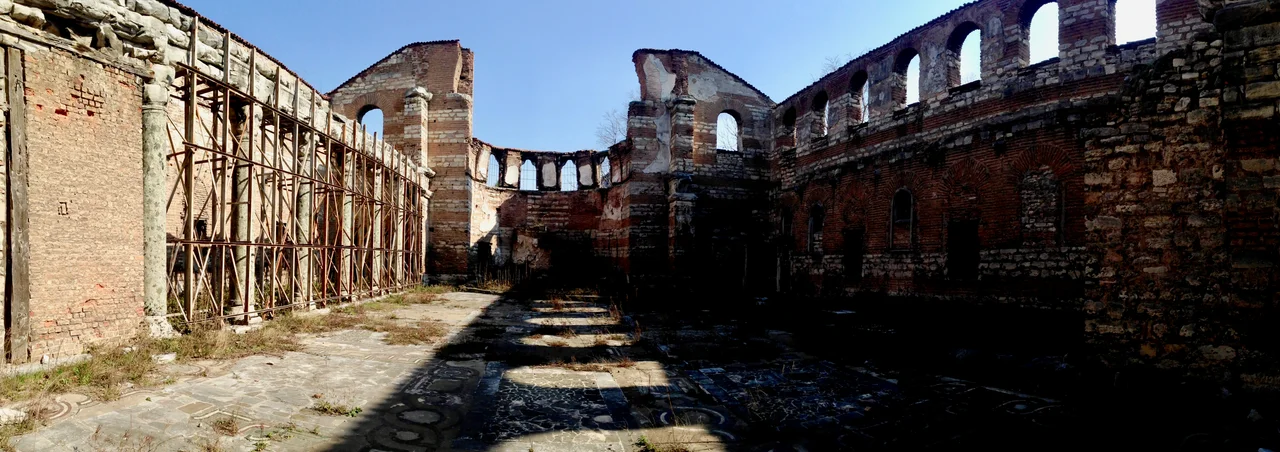
The church of the Stoudios monastery is the oldest surviving church building in Istanbul. That single fact carries extraordinary weight in a city whose history runs so deep that the Byzantine, Ottoman, and modern layers all compete for attention. Built as a three-aisled basilica in the fifth century, the structure outlasted the empire that created it, surviving the fall of Constantinople to the Ottomans in 1453 and conversion into a mosque by Bayezid II's Albanian equerry, Ilias Bey — who gave the mosque its current name, İmrahor Camii, literally the Mosque of the Equerry. The ancient walls still stand. The roof does not. The fire of 1782 and the earthquake of 1894 completed what centuries of neglect had begun, and today visitors walk among the columns and the open sky.
Monks Who Defied Emperors
The history of the Stoudion is largely a history of principled resistance. During the iconoclastic controversies of the eighth and ninth centuries — the great theological dispute over whether religious images could be venerated — the Stoudites sided firmly with the image-keepers. Emperor Constantine V drove them from the monastery and from the city; after his death some returned. Abbot Sabas went to the Second Ecumenical Council at Nicaea in 787 to defend Orthodox doctrine. His successor, Theodore the Studite, reorganized the monastery entirely, drawing on the spiritual traditions of Basil the Great and the ascetics of the Gazan desert. Under Theodore's administration, the monks were harassed repeatedly and driven into exile more than once. Some were put to death. The community kept returning.
A Scriptorium's Legacy
Theodore the Studite established a school of calligraphy at the monastery, and what emerged from its scriptorium over the following centuries ranks among the great achievements of Byzantine manuscript culture. Illuminated manuscripts produced at the Stoudion now reside in Venice, the Vatican Library, and Moscow. The Chludov Psalter, one of the finest examples of Byzantine book art, came from this tradition. The Theodore Psalter, created here in 1066 in the eleventh century, is held by the British Library. In the eighth and eleventh centuries the monastery was also a center of Byzantine religious poetry; several of the hymns composed here remain in liturgical use in the Orthodox Church today. Three monks of the Stoudion rose to become Ecumenical Patriarchs of Constantinople. Three emperors — Michael V, Michael VII Doukas, and Isaac I Komnenos — ended their lives here, taking monastic vows in the Stoudion.
Crusaders, Conquerors, and a Slow Vanishing
The monastery was destroyed by the Crusaders in 1204, during the catastrophic Fourth Crusade that sacked Constantinople. It was not fully restored until 1290, by Constantine Palaiologos. The Russian pilgrims Anthony and Stephen, visiting around 1200 and 1350 respectively, were astonished by the scale of the monastic grounds; it is estimated the cloister held as many as 700 monks at its peak. The Ottoman conquest of 1453 destroyed much of what remained. After the earthquake of 1894, a group of Russian Byzantine scholars opened an archaeological institute on the grounds, but the institute closed following the Russian Revolution of 1917. In the decades after, local inhabitants carried away stones from the ruins to repair their own homes. The magnificent thirteenth-century pavement, one of the few decorative elements still in place, lies open to the Istanbul weather — and disappears, slowly but steadily, year by year. As of early 2024, a restoration was reportedly underway.
From the Air
The Monastery of Stoudios is located at 40.9961°N, 28.9286°E in the Koca Mustafa Paşa neighborhood (historically known as Psamathia) in Istanbul's Fatih district, not far from the Sea of Marmara. The historic Theodosian land walls of Constantinople are a few hundred meters to the west — from the air, these walls are the dominant navigational landmark in this part of the city, running roughly north-to-south. The monastery ruins lie just east of the walls, close to the Marmara shoreline. Istanbul Airport (LTFM) is approximately 25 kilometers to the northwest. Approach from the Sea of Marmara at 1,500–3,000 feet for the best view of the ancient walls and surrounding neighborhood.
Nearby Stories
- Kocaeli Peninsula 7.6 km away
- Second Battle of Çatalca 11 km away
- Istanbul's Rural Outskirts 14 km away
- MV Struma 20 km away
- HMAS AE2 36 km away
- Bursa 66 km away
- Sangarius Bridge 71 km away
- Januarius MacGahan 101 km away