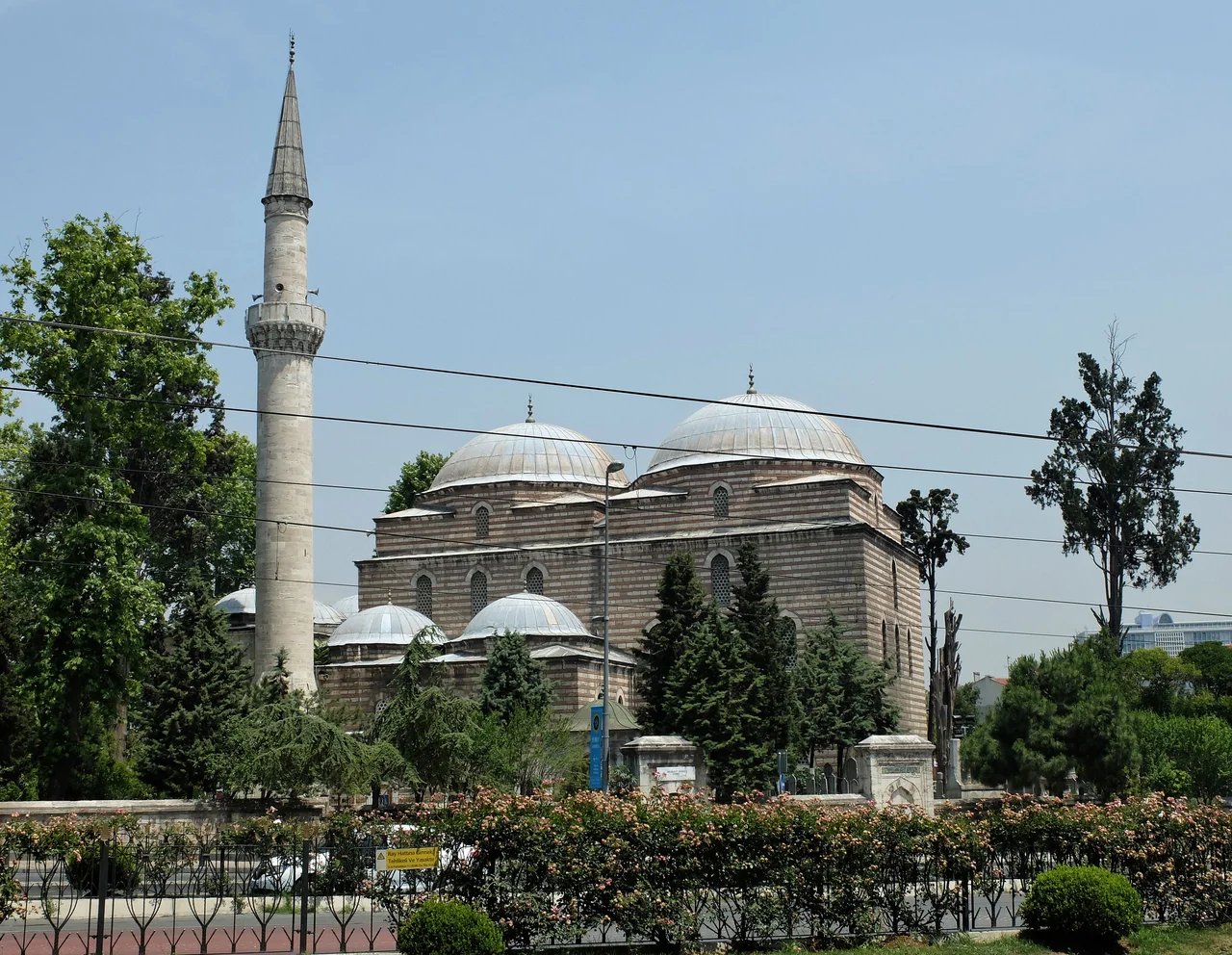

Murat Pasha Mosque, Aksaray
Two busy roads converge at Aksaray, one of Istanbul's oldest transit hubs, where trams and pedestrians and traffic have pressed against each other for centuries. Squeezed between these roads, almost hidden by the pace of the surrounding city, stands a mosque that predates them all. The Murat Pasha Mosque was commissioned in 1465–66, just over a decade after Mehmed II conquered Constantinople and made it the Ottoman capital. It is one of the earliest mosques built in what was then a new Istanbul, and it carries in its stones the particular character of a city and an empire still working out what they would become.
A Pasha's Commission, A Brother's Completion
The mosque was built on the order of Hass Murad Pasha — known in modern Turkish as Has Murat Paşa — a high official in the early Ottoman court. He commissioned the building in 1465 or 1466, during the reign of Mehmed the Conqueror. Murad Pasha did not live to see it finished; the work was completed by his brother Mesih Pasha, who was subsequently buried here. That sequence — one brother beginning what another completed, the survivor interred in the building he finished — gives the mosque a quiet biographical weight that its modest exterior does not announce. Mesih Pasha's tomb within the complex connects the building to a specific family history, a reminder that behind the abstract language of Ottoman patronage were real individuals making real decisions about where they wanted to leave their mark.
The Bursa Style Arrives in Istanbul
Architecturally, the Murat Pasha Mosque belongs to the early Ottoman tradition perfected in Bursa, the dynasty's first major capital. Its plan is straightforward: a two-by-one rectangular prayer hall covered by two identical domes, each the same height and diameter, set side by side. The mihrab — the niche indicating the direction of Mecca — and the minbar, the pulpit from which the sermon is delivered, are positioned together on the short wall at the far end. Walking in from the street, you pass through a portico, then into a narthex — a transitional covered space that Ottoman architects borrowed directly from Byzantine church architecture. This detail is not coincidental. In 1465, Constantinople's Byzantine buildings were everywhere, and the craftsmen shaping the new city had grown up building in that tradition. The narthex in an early Ottoman mosque is a living trace of that inheritance.
Two Domes, Two Worlds
The twin-dome form that defines this mosque's interior is worth pausing over. In the great imperial mosques that came later — the Blue Mosque, the Süleymaniye — a single vast dome would dominate, filling the space with a sense of divine immensity. Here, the effect is different. Two domes of equal size divide the prayer hall into balanced halves, creating a more intimate, proportioned space. Light enters differently under two domes than under one: there is a rhythm to it, a sense of alternation. The stone and tile work of the period is relatively restrained compared to later Ottoman decoration, which gives the interior a clarity that later buildings, for all their brilliance, sometimes sacrifice. Standing inside, the scale feels human. It was built for a neighborhood, not an empire.
Aksaray Then and Now
The Aksaray neighborhood where the mosque stands has always been a place of movement. In the Byzantine period it was already a significant urban intersection; in the Ottoman centuries it became a hub connecting the city's commercial and residential districts. Today it sits within Fatih, the district that encompasses much of Istanbul's historic peninsula, and the mosque finds itself on a traffic island between lanes of cars and trams — still standing, still in use, but surrounded by a city that has largely forgotten to notice it. That tension between the ancient and the perpetually busy is one of Istanbul's defining qualities. The Murat Pasha Mosque does not ask for attention. It simply remains, five and a half centuries after Hass Murad Pasha first imagined it, offering the same covered space it always has.
From the Air
The Murat Pasha Mosque sits at 41.0103°N, 28.9490°E in the Aksaray neighborhood of Fatih district, on Istanbul's historic European peninsula. Approaching Istanbul Airport (LTFM) from the west, the old city's skyline is visible on the southern horizon — the great domes of the Süleymaniye and the Blue Mosque rising above the rooftops. Aksaray lies roughly 1.5 kilometers west of Hagia Sophia, in the lower interior of the peninsula. At low altitude over the European shore, the density of the historic city becomes apparent: mosques, minarets, and Byzantine-era walls all compressed within a few square kilometers. Recommended viewing altitude is 3,000 to 5,000 feet for the full context of the old city's topography.
Nearby Stories
- Kocaeli Peninsula 7.6 km away
- Second Battle of Çatalca 11 km away
- Istanbul's Rural Outskirts 14 km away
- MV Struma 20 km away
- HMAS AE2 36 km away
- Bursa 66 km away
- Sangarius Bridge 71 km away
- Januarius MacGahan 101 km away