.jpg)
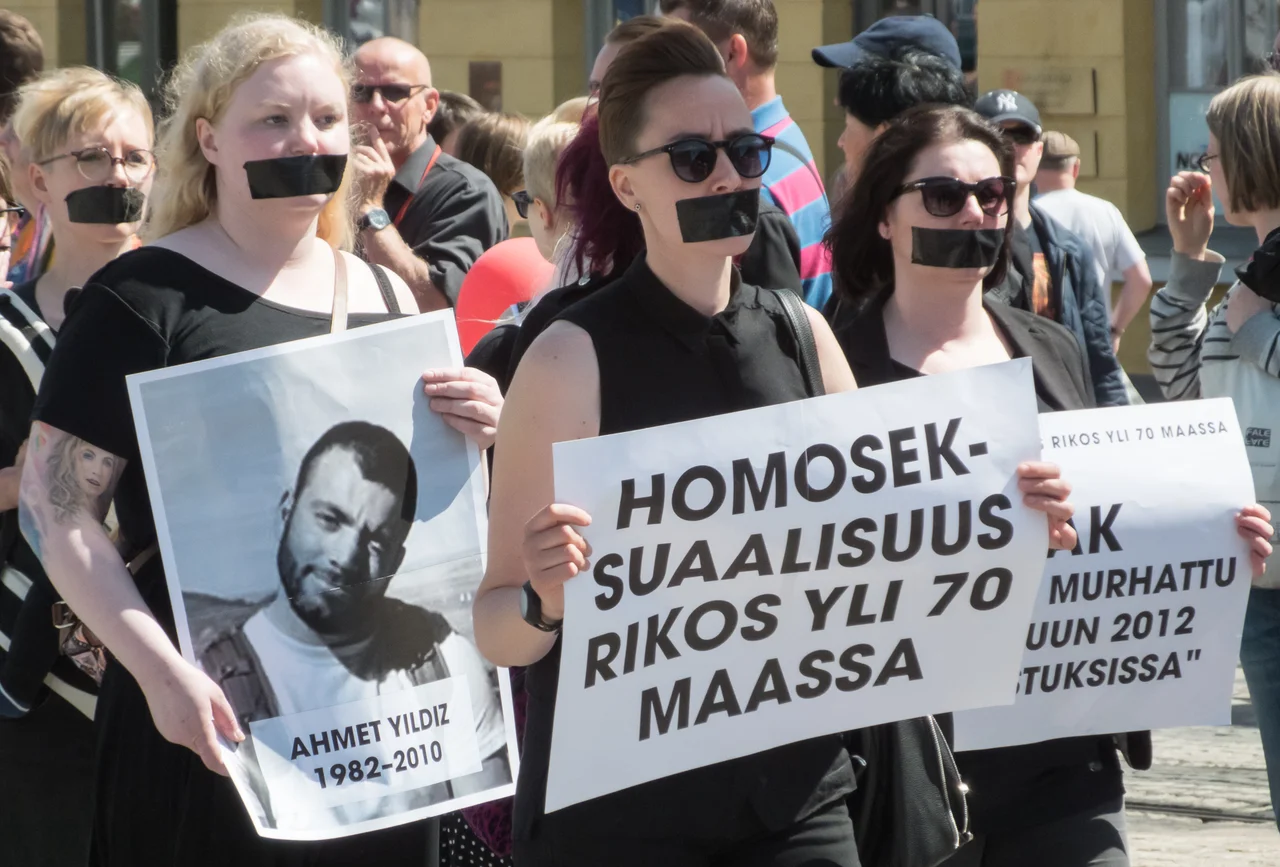
Murder of Ahmet Yıldız
Ahmet Yıldız was 26 years old and studying physics at Marmara University when he was killed. He had been open about being gay. He had tried to protect himself — going to the district attorney's office roughly three months before his death to report death threats from members of his own family, and filing a formal criminal complaint approximately a year earlier. The prosecutor's office declined to investigate or provide him protection. On the night of 15 July 2008, Yıldız stepped out of his car near a cafe in Üsküdar, on Istanbul's Asian shore, and was shot three times in the chest. He died from his injuries. His alleged killer, his father Yahya Yıldız, fled and has not been brought to trial. The case has been described as Turkey's first widely reported anti-gay honor killing.
A Life and Its Threats
Ahmet Yıldız came from a wealthy, deeply conservative Kurdish family in Şanlıurfa, in southeastern Turkey. He was the family's only son. After leaving home and coming out as gay, he built a life in Istanbul: his studies, his partner İbrahim Can, an apartment of his own. He also carried a documented fear. He had reported to authorities that his family was threatening him. The paper trail exists — the complaints he filed, the office that declined to act on them. That institutional failure sits at the center of this story. Yıldız did not ignore what was happening to him. He sought protection through official channels, and the system that should have responded did not. What followed was not unpredictable to him, or to those close to him.
The Night of July 15
The shooting happened outside a cafe in Üsküdar. Yıldız had gone to the cafe that evening; on his way back to his car, he encountered his attacker. He tried to run. He was shot five times; three bullets struck his chest. One stray bullet wounded Ümmühan Daraca, a parliamentary nominee, who was nearby. Yıldız died from his wounds. His cousin, speaking afterward, described him as the only son of an extremely religious and wealthy family — words that sketch the particular pressures that shaped his life without reducing it to them. His partner, İbrahim Can, would later give testimony that speaks to both the grief and the clarity of someone who had watched this unfold and understood exactly what had happened: 'I think we're experiencing gay discrimination,' Can said. 'That wouldn't be the case if my lover was a woman.'
Justice Deferred
The trial for Ahmet Yıldız's murder began on 8 September 2009. His father, Yahya Yıldız — the primary suspect — was not in the courtroom. He had fled, and the proceedings continued with him tried in absentia as a fugitive. An Interpol red notice was eventually issued in 2012. He was reportedly spotted in Zakho, Iraq, at one point during the investigation. Sixteen years after the killing, the defendant's dock has remained empty. İbrahim Can pressed for the case repeatedly, calling for an international arrest warrant, calling out what he described as the court's reluctance to pursue a case that implicated a father for killing a gay son. 'This has now become a political cause,' he said. 'The court does not show the will, determination and effort to arrest the father.' That the system has not delivered justice is, for many observers, itself a form of verdict on the system.
What the Case Made Visible
The murder of Ahmet Yıldız received wide coverage in Turkey and internationally. Organizations including Lambda Istanbul and KAOS GL — Turkish LGBTQ advocacy groups — drew attention to the pattern that Yıldız's death exemplified: the combination of family threats, institutional indifference, and the particular vulnerability of gay men from conservative families. Amnesty International cited the case in its reporting on LGBTQ rights in Turkey. British newspaper The Independent covered it, noting that honor killings were not limited to Turkey. The case became a reference point in Turkish LGBTQ rights discourse — not because it was the only such case, but because it was documented, because Yıldız had sought help, and because the failure to protect him and subsequently to bring his killer to justice was so thoroughly on the record. A film, Zenne, drew on his story in 2012.
Üsküdar and the Memory of a Young Man
Üsküdar occupies Istanbul's Asian shore, across the Bosphorus from the historic peninsula. It is an old neighborhood, quieter in character than the European side, its waterfront facing the Golden Horn and the minarets of Sultanahmet across the water. Ahmet Yıldız was killed on an ordinary summer night in an ordinary street in this city. He was 26 years old. He wanted to study physics, to live as himself, to be safe. His partner remembered him. Organizations carried his name forward. That his father has not been tried is a fact, not a conclusion: the record of what Ahmet Yıldız asked for, and what he was denied, is already fully written.
From the Air
The Üsküdar neighborhood where Ahmet Yıldız was killed lies at approximately 41.02°N, 29.02°E on Istanbul's Asian shore, directly across the Bosphorus from the historic European peninsula. The nearest major airport is Sabiha Gökçen International (LTFJ), approximately 35 kilometers to the southeast on the Asian side. Approaching from the north, the Bosphorus Bridge is visible connecting the two continents; Üsküdar's waterfront stretches south from the bridge approach. At low altitude over the strait, the proximity of the two shores — and the density of the city on both banks — is striking. The Haydarpaşa train terminal and the Üsküdar ferry docks are prominent navigation landmarks at the waterline.
Nearby Stories
- Kocaeli Peninsula 7.6 km away
- Second Battle of Çatalca 11 km away
- Istanbul's Rural Outskirts 14 km away
- MV Struma 20 km away
- HMAS AE2 36 km away
- Bursa 66 km away
- Sangarius Bridge 71 km away
- Januarius MacGahan 101 km away