
Museum of the Ancient Orient
Before Greece. Before Rome. Before the Byzantine Empire that once ruled this very ground. The Museum of the Ancient Orient in Istanbul holds objects from a layer of human history even deeper than the city's famously deep past. Tucked inside the Istanbul Archaeology Museums complex near Topkapı Palace, in a building that began its life as an art school, the museum keeps company with Mesopotamian kings, Egyptian pharaohs, and Anatolian kingdoms whose names most visitors would struggle to place. The artifacts here — cuneiform tablets, royal statues, carved stone reliefs — represent civilizations that were already ancient when Babylon was flourishing.
The Building Before the Museum
The museum's home has its own layered history. The building was designed by Alexandre Vallaury in 1883 and commissioned by Osman Hamdi Bey — the Ottoman painter and archaeologist who also founded the Istanbul Archaeology Museums and argued passionately that Ottoman antiquities should stay in Ottoman hands. The building originally housed the Sanâyi-i Nefîse Mektebi, the Ottoman College of Fine Arts, which trained a generation of artists in both Western and Ottoman traditions. The college moved out in 1916. For nearly two decades the building stood repurposed, until 1935, when the Museum of the Ancient Orient was formally established there. That history — a school of art becoming a house of ancient objects — gives the building an interesting double life: form made here, and form preserved here.
What the Tablets Say
The collection's anchors are objects that reward patience and context. Cuneiform tablets are perhaps the most important: small clay rectangles inscribed with wedge-shaped marks that constitute the world's earliest writing system, developed in Mesopotamia around 3100 BCE. Among the museum's holdings is a terracotta tablet recording the year formulae of Shulgi, a king of the Third Dynasty of Ur who ruled around 2094–2047 BCE and compiled an extraordinary administrative record of his reign. These tablets are not decorative objects; they are documents — lists, contracts, hymns, measurements — the administrative infrastructure of civilizations that had to invent the tools of record-keeping from scratch. Reading them, even at a remove through translation, is to touch the moment when human societies first began to write things down.
Kings in Stone
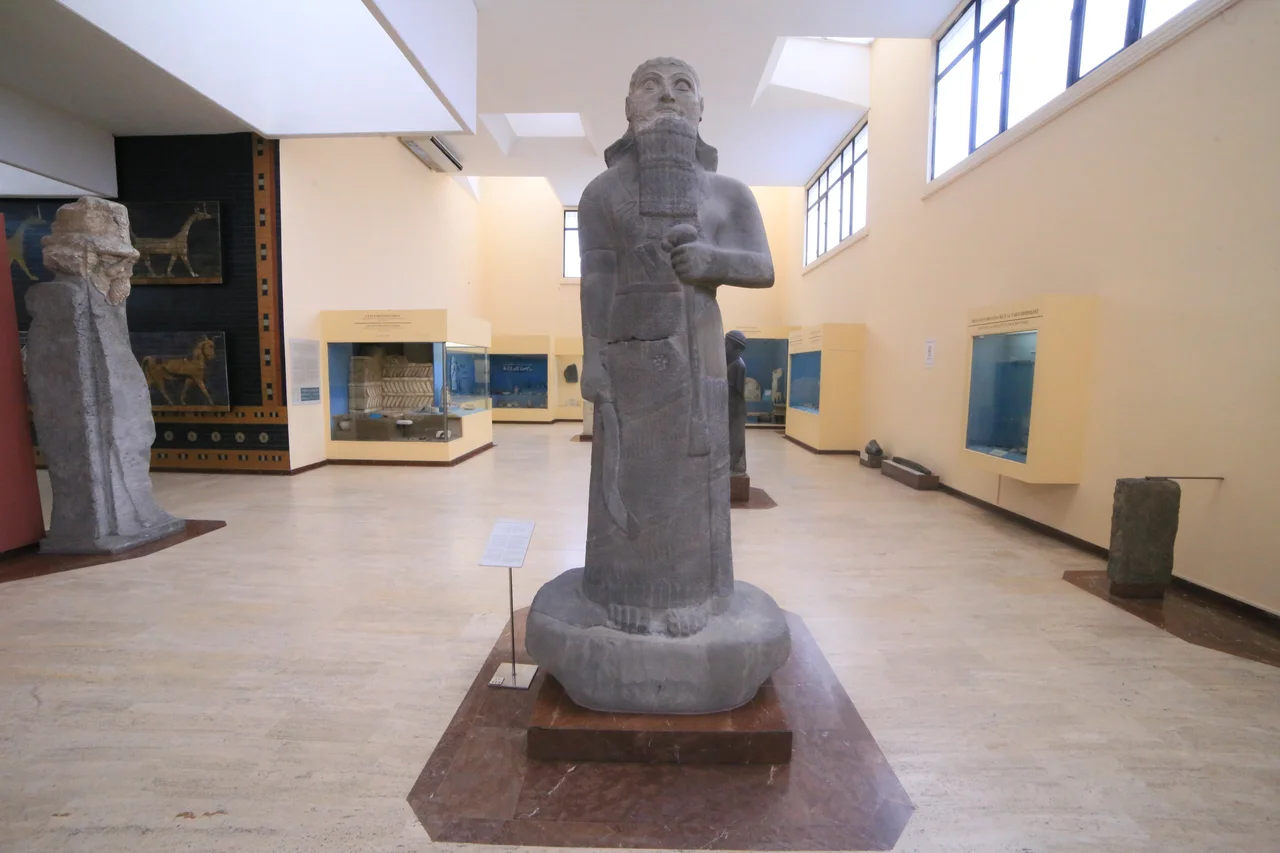
Alongside the tablets stand figures in stone: statues of Lugal-dalu, king of Adab — a Sumerian city-state — and Puzur-Ishtar, who served as governor of Mari at the end of the third millennium BCE. The statue of Shalmaneser III, the Assyrian king who reigned 858–824 BCE and conducted extensive military campaigns across the Near East, is among the more imposing pieces. These are not idealized portrait sculptures in the Greek sense; they carry the formal conventions of their own traditions — the rigid frontality, the symbolic scale, the inscriptions that declare the subject's titles and deeds. They were made to last and to assert authority. That they have outlasted the kingdoms they served by three and four thousand years is itself a kind of argument for the ambitions of their makers.
Istanbul as Keeper of Ancient Worlds
The Museum of the Ancient Orient exists because Istanbul has been, at various points in history, the center of empires that controlled or claimed access to the ancient Near East. The Ottoman Empire governed Mesopotamia, the Levant, and Egypt for centuries, and the artifacts that flowed into Ottoman collections during that period now form the core of what is displayed here. Osman Hamdi Bey understood that this inheritance needed protection and proper context; his advocacy for keeping Ottoman archaeological finds within Ottoman borders was a genuine intellectual and political position, not merely institutional self-interest. The museum he helped create holds objects that might otherwise have ended up scattered across European collections. That they are in Istanbul — a city that bridges the ancient world and the modern one in ways almost no other city can — feels like appropriate geography.
From the Air
The Museum of the Ancient Orient sits at 41.0113°N, 28.9804°E within the Archaeology Museums complex on the first hill of Istanbul's historic European peninsula, just below Topkapı Palace. Approaching Istanbul Airport (LTFM) from the west, the palace's distinctive silhouette — the Imperial Gate, the towers, the domed kitchens — is visible above the Sarayburnu promontory where the peninsula meets the Bosphorus. The museum is a few hundred meters southwest of Topkapı's main entrance. At 3,000 to 5,000 feet over the old city, the density of ancient Istanbul becomes legible: the palace complex, Hagia Sophia, the Blue Mosque, and the grand bazaar district are all within a single visual sweep.
Nearby Stories
- Kocaeli Peninsula 7.6 km away
- Second Battle of Çatalca 11 km away
- Istanbul's Rural Outskirts 14 km away
- MV Struma 20 km away
- HMAS AE2 36 km away
- Bursa 66 km away
- Sangarius Bridge 71 km away
- Januarius MacGahan 101 km away