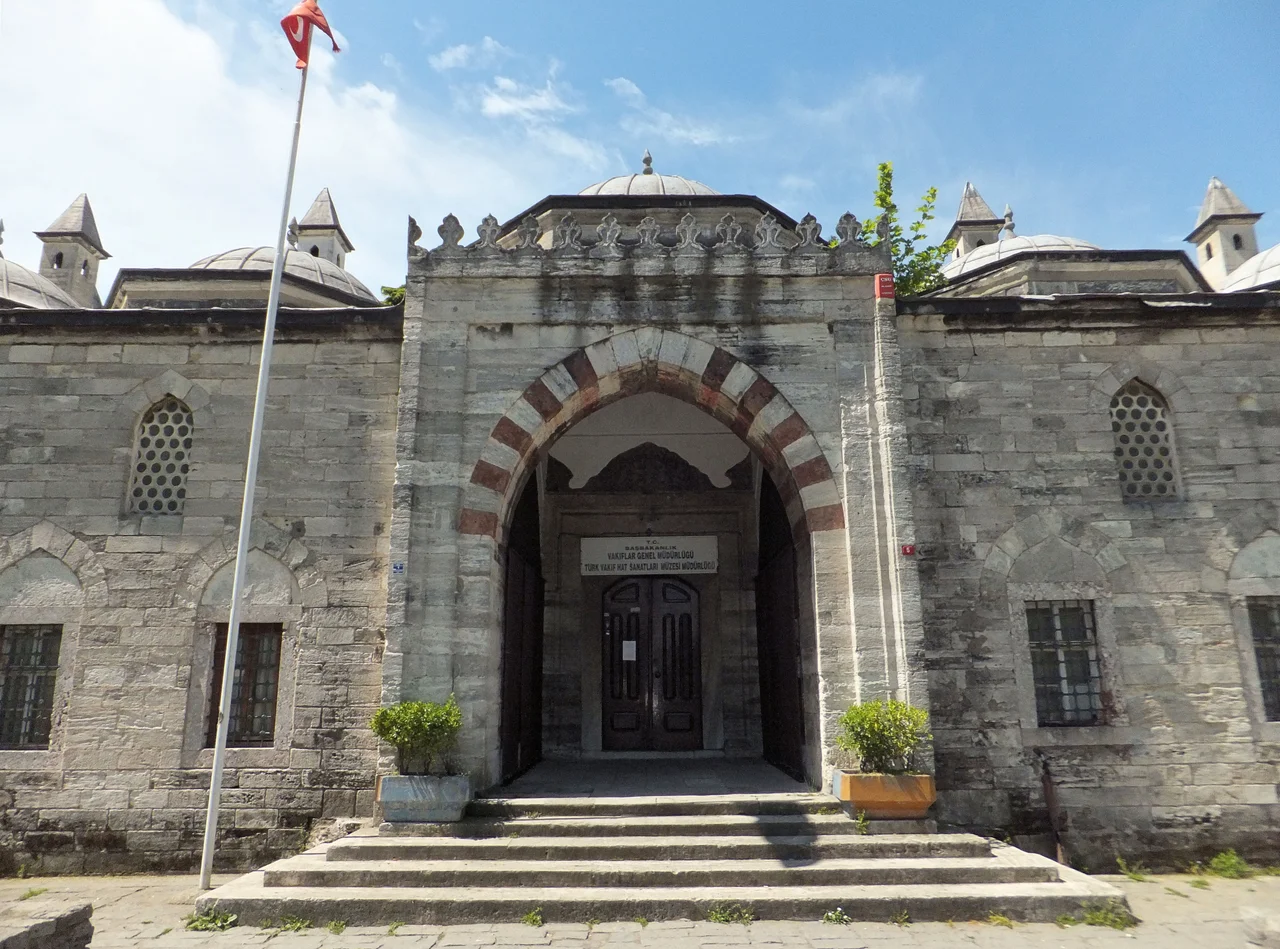

Museum of Turkish Calligraphy Art
There is an argument embedded in the existence of this museum: that writing is not just communication, but art — that the way a letter curves, the weight a brushstroke carries, the proportion of ink to emptiness on a page, can be as meaningful as what the words say. The Museum of Turkish Calligraphy Art in Beyazıt Square makes that argument quietly, housed in a building that was itself a place of learning long before it became a museum. The madrasa beside the Bayezid II Mosque has stood since 1507. For centuries it trained scholars in religious sciences. Since 1984 it has housed 3,121 pieces of Islamic calligraphic art — works made by hands that understood the written letter as a form of prayer.
The Madrasa and Its Sultan
The building that houses the museum was constructed on the order of Sultan Bayezid II, son of Mehmed the Conqueror, as part of the Bayezid II Mosque complex. The mosque itself was completed in 1505 — one of the great early Ottoman mosques of Istanbul, its design a direct precursor to the later imperial style. The madrasa followed immediately afterward, its construction begun after the mosque's completion and finished by 1507. A madrasa was a school of religious and legal learning, attached to mosques throughout the Islamic world; the students who studied here would have learned Quranic sciences, law, and the arts of the book. That the building now displays the calligraphic art those students would have practiced and revered is a pleasing continuity, five centuries collapsed into a single courtyard.
The Art of the Letter
Islamic calligraphy developed over more than a millennium into one of the world's most refined visual traditions. The Arabic script — used not just for Arabic but for Persian, Ottoman Turkish, and other languages across a vast geographic range — offered calligraphers an extraordinary range of forms to work with: scripts that could be compressed or elongated, angular or flowing, monumental or intimate. The major styles — Naskh, Thuluth, Diwani, Nastaliq, among others — each have their own conventions and aesthetic registers, their own appropriate contexts and characteristic moods. The museum's collection of 3,121 pieces spans this range. Some works are large, designed to hang above a mosque's entrance or doorway; others are intimate, made for private devotion or contemplation. What unites them is the conviction that the word, properly written, is a form of beauty.
From Writing Museum to Calligraphy Museum
The institution has not always had its current home or its current name. It was first opened in 1968 as the 'Writing Museum,' established in the madrasa of the Yavuz Selim Complex — another Ottoman imperial site, on the ridge above the Golden Horn. For sixteen years it operated there, before being moved in 1984 to its present location in the Bayezid madrasa and renamed the Museum of Turkish Calligraphy Art. The move brought it to Beyazıt Square, one of Istanbul's most historically charged public spaces — the site of the Byzantine Forum of Theodosius, now anchored by the great mosque and the gatehouse of Istanbul University. For a museum dedicated to the art of Ottoman letters, the setting could hardly be more fitting.
Closure and Continuity
In 2015, the museum closed for restoration. As of 2020, it had not yet reopened — a reflection of both the scale of the work required and the slower rhythms with which historic buildings are sometimes cared for. The closure means visitors arriving at Beyazıt Square in search of the collection may find the madrasa shuttered, its courtyard quiet. But the building itself remains visible, its Ottoman stonework and domed cells facing the square as they have for more than five hundred years. Restoration, when it is complete, will return the collection to public view — 3,121 works of calligraphic art waiting in the kind of patient silence that suits them. The Beyazıt Mosque still calls the faithful to prayer next door, as it has since 1505. Some continuities in Istanbul feel entirely natural.
From the Air
The Museum of Turkish Calligraphy Art is located at 41.0100°N, 28.9632°E in Beyazıt Square, on Istanbul's historic European peninsula in the Fatih district. Istanbul Airport (LTFM) serves the European side; the old city lies roughly 35 kilometers to the southeast of the airport, visible on approach as a dense cluster of domes and minarets above the Marmara waterfront. Beyazıt Square is approximately 1.5 kilometers west of the Grand Bazaar and visible from the air through the gap between the Bayezid Mosque's twin minarets and the dome of Istanbul University's main building. At 3,000 to 5,000 feet on a clear day, the full sweep of the old city peninsula is legible, with the university's grounds and the mosque complex forming a distinct cluster near the city's geographic center.
Nearby Stories
- Kocaeli Peninsula 7.6 km away
- Second Battle of Çatalca 11 km away
- Istanbul's Rural Outskirts 14 km away
- MV Struma 20 km away
- HMAS AE2 36 km away
- Bursa 66 km away
- Sangarius Bridge 71 km away
- Januarius MacGahan 101 km away