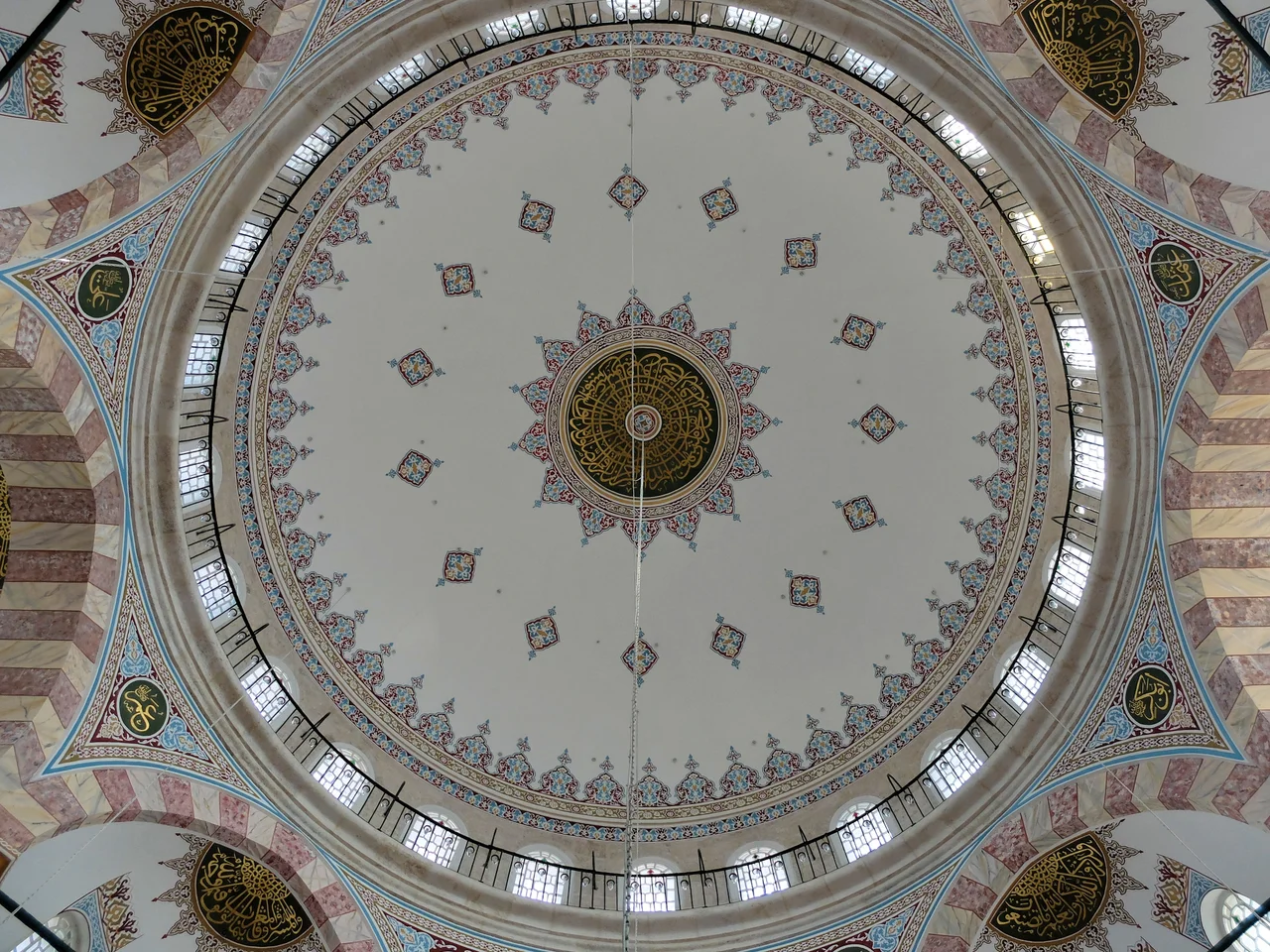

Nışançı Mehmed Pasha Mosque
The man who built this mosque spent his career wielding a very particular kind of power: the sultan's monogram. As the imperial chancellor — nışançı in Ottoman Turkish — Nışançı Mehmed Pasha was the official who stamped the tughra, that ornate calligraphic seal, onto every royal decree. It seems fitting, then, that his mosque bears an exceptionally fine tughra above its entrance portal, possibly designed by Pasha himself. Built between 1584 and 1589 in Istanbul's Atikali quarter, the Nışançı Mehmed Pasha Mosque stands as one of the last works of the Sinan school — and an uncommonly inventive one at that.
A Chancellor's Ambition in Stone
Nışançı Mehmed Pasha climbed the Ottoman bureaucratic ladder with quiet persistence. He joined the imperial chancery, rose to chief secretary, then to chancellor, then governor of Aleppo, then vizier under Sultan Murad III in 1580. The mosque he commissioned reflects that career arc: it is not a showy royal foundation but a work of careful refinement, built by a man who understood the levers of imperial power without ever holding the very top one. Construction ran from 1584 to 1589. The two madrasas of the complex were completed by 1592–93. Pasha died in 1594, his tomb already finished and waiting for him on the northeastern side of the courtyard — a small octagonal structure, domed and plain inside, befitting someone more interested in craft than ostentation.
The Sinan Question
Who actually designed this mosque is a matter of genuine scholarly debate. The building dates to the final years of Mimar Sinan's tenure as chief imperial architect — he was very old by then, likely in his late nineties — and it does not appear in the Tezkiretü'l-ebniye, the major inventory of his acknowledged works, though it does appear in a second document, the Tuhfetü'l-mi'marin. Art historian Godfrey Goodwin believed the design came from one of Sinan's accomplished assistants, either Davud Agha or Mehmed Agha. Architectural historian Doğan Kuban attributed it specifically to Davud Agha. Other scholars hold that Sinan, even in old age, remained responsible for the design. The ambiguity only deepens the mosque's fascination: it represents either the master's last statement or his most gifted student's finest hour.
Light and the Octagon
Step inside and the first sensation is light. The prayer hall is pierced with many windows, filling the interior with what one architectural account describes as a feeling of "height and lightness" — an effect the architects achieved through deliberate structural choices. The dome, 14.2 meters in diameter, rests on eight pillars arranged in an octagonal configuration, a system Sinan had used before. But here the execution is different. On the qibla wall — the southeastern side facing Mecca — the pillars are integrated directly into the outer walls rather than standing free, creating a stepped profile that no other Ottoman mosque shares. The transition from dome to octagon is managed through four squinches at the corners and four half-domes on the sides. Above the supporting pillars, muqarnas carving fans out in those honeycomb stalactite forms that Anatolian craftsmen had perfected over centuries. The dome itself is the second-largest ever built for a non-royal Ottoman mosque in Istanbul, surpassed only by the Rüstem Pasha Mosque.
A Garden Courtyard and Chevron Columns
The exterior rewards close attention. The courtyard, fronting the prayer hall to the northwest, is planted with trees — possibly the first garden courtyard of this kind in an Istanbul mosque. At its center stands a simple shadirvan, a ritual ablution fountain. The arcade galleries surrounding the courtyard are supported by columns of Bosphorus and Marmara marble, their capitals carved into chevron patterns: assemblies of triangles and lozenges that catch the light differently depending on the hour. The entrance portal carries that beautifully executed tughra of Sultan Murad III — the sultan's calligraphic signature, rendered in thuluth script — and inscription panels above the windows cite the 99 names of God. Above the main mihrab, a Qur'anic verse. In the lunettes, more scripture. The building is a text as much as a structure.
What Remains, What Was Lost
Four and a half centuries have not been entirely kind to the complex. The two madrasas that completed the original külliye are gone, and the tekke — the Sufi lodge that was probably added in the early 17th century — has likewise disappeared. What survives is the mosque itself, the founder's tomb, several small cemeteries, and an 18th-century ornamental fountain near the southeast gate, donated in 1793–94 by a benefactor named Ebûbekir Ağa. The neighborhood around it has changed entirely; the street cuts into the courtyard's northeast corner, a reminder of how cities grow. Yet the prayer hall still fills with that calculated light, the muqarnas still throw their shadows across the pillar capitals, and the tughra above the door still carries the invisible weight of all those imperial decrees.
From the Air
The Nışançı Mehmed Pasha Mosque sits in Istanbul's Atikali quarter on the European side, at approximately 41.024°N, 28.945°E, roughly 2 kilometers west of the historic Fatih district's ridge. At 2,000–3,000 feet altitude on a clear day, the single minaret rising behind the front portico is visible among the dense urban fabric of the old city. The Golden Horn waterway provides a strong north-south navigation reference. Nearest major airport is Istanbul Airport (LTFM), approximately 35 kilometers to the northwest. Approach from the Bosphorus side offers the best light for identifying the dome silhouette against the peninsula skyline.
Nearby Stories
- Kocaeli Peninsula 7.6 km away
- Second Battle of Çatalca 11 km away
- Istanbul's Rural Outskirts 14 km away
- MV Struma 20 km away
- HMAS AE2 36 km away
- Bursa 66 km away
- Sangarius Bridge 71 km away
- Januarius MacGahan 101 km away