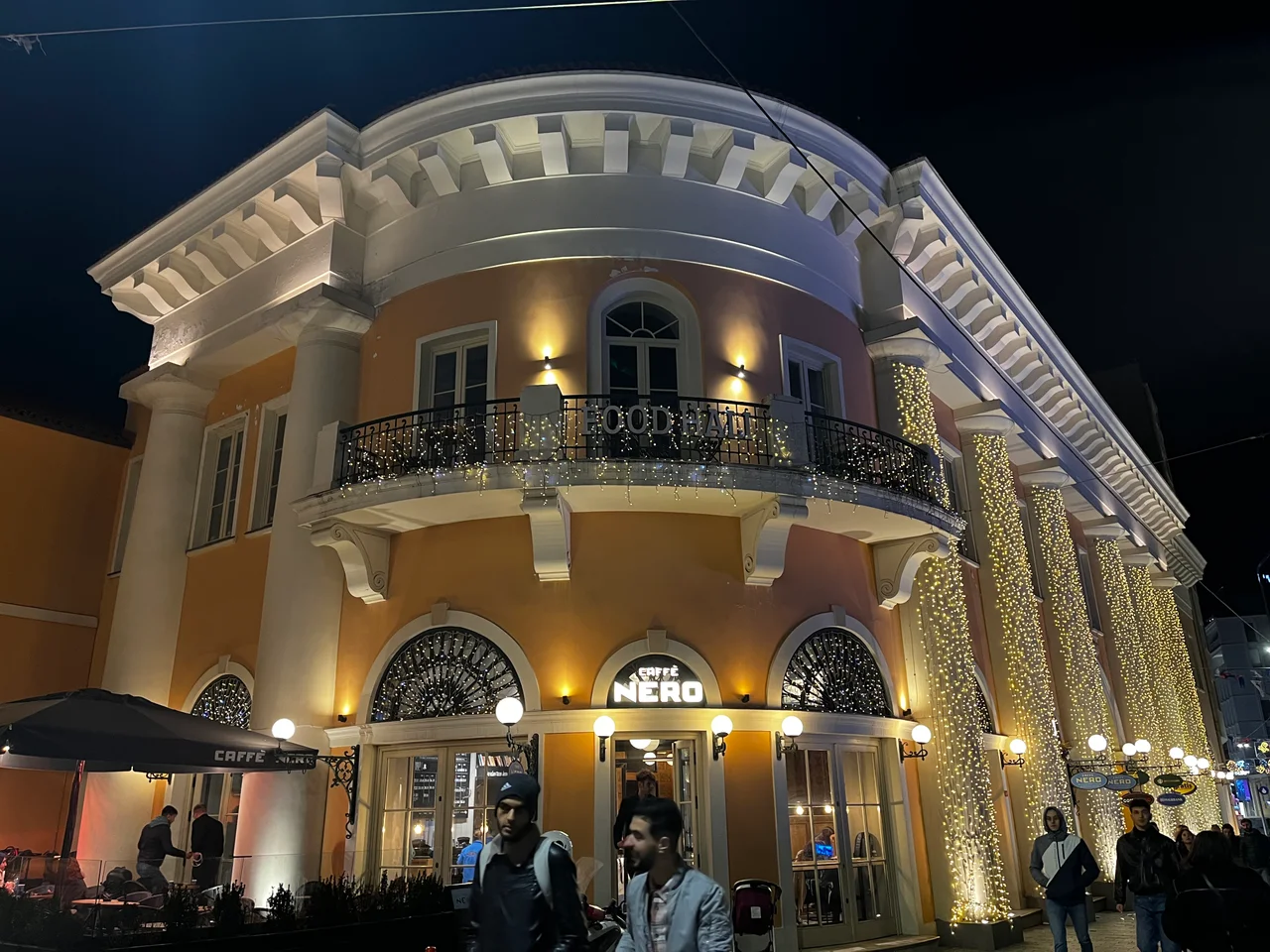

Narmanlı Han
Gustave Flaubert watched an opera at the Naum Theatre here in 1850. A few decades later, the Armenian newspaper Jamanak set up its presses in a building just steps away. Ahmet Hamdi Tanpınar — one of Turkey's most celebrated novelists — wrote from an apartment in that same building while the scent of paint drifted up from the studios below. The building was Narmanlı Han, and for well over a century it absorbed every stray current of cosmopolitan Pera: Russian diplomacy, imperial imprisonment, modernist art, Armenian journalism, cheap rent, and slow decay. That it still stands at all on İstiklal Avenue in Beyoğlu is something of a minor miracle.
Built for the Tsar's Envoys
Narmanlı Han was constructed in 1831 to serve as the Russian Embassy — a grand arcaded building in the heart of Pera, the European quarter of Constantinople. Its designer was Giuseppe Fossati, a Swiss-Italian architect who had been brought to Istanbul by Ottoman Sultan Abdülmecit to restore Hagia Sophia. Fossati gave the building the solid neoclassical gravitas appropriate for an imperial diplomatic mission: covered arcades on the ground floor, a courtyard centered on a historic fountain, and the kind of proportions that announced Russia's ambitions in Ottoman territory without quite shouting. The embassy functioned here until 1880, when the Russian diplomatic mission relocated to İstiklal Avenue proper. After that, the building served as a Russian prison until 1914, housing detainees affiliated with the consulate. When World War I severed relations, the Russians left and the building sat vacant.
Merchants from Narman, Artists from Everywhere
In 1933, Avni and Sıtkı Narmanlı — sons of Narmanlı Mustafa Efendi, a trader from Erzurum's Narman district who had made good through commerce and real estate — purchased the empty building from what remained of Russian ownership. The family name stuck, and the building became Narmanlı Han. The new owners faced a practical problem: the worn-out units fetched little rent. Their solution inadvertently created something remarkable. They offered the apartments and studios to artists at low rates, and Istanbul's creative community moved in. Painter and poet Bedri Rahmi Eyüboğlu settled here. So did painter Aliye Berger. Ahmet Hamdi Tanpınar, whose novel The Time Regulation Institute would become one of the defining works of Turkish literature, wrote within these walls. The sculptor Firsek Karol worked nearby. In the ground-floor shops, the André Bookstore and the Jamanak newspaper — one of the significant publications of the Armenian press in Turkey — established themselves. The D Grubu, a collective of five painters and a sculptor who brought modernist European influences into Turkish art, held their first exhibition in 1933 at the Mimoza hat shop on the ground floor.
Long Years of Neglect
What an artist colony creates, time and indecision can dissolve. By the late 20th century, Narmanlı Han had emptied out and fallen into serious disrepair. Plans to convert it into a hotel circulated from the early 1990s onward, but the building had eleven different owners and agreement among them proved impossible. One by one, the occupants left; eventually only a single notary office remained, and that moved out in 2010. The building stood abandoned on one of Istanbul's most walked streets, its arcades faded, its courtyard fountain quiet. Demolition was discussed. The structure that had sheltered Flaubert's operatic neighborhood, Russia's consular prisoners, and Turkey's modernist painters faced the prospect of being cleared for development.
A Careful Return
Restoration work began in earnest after the Esen and Erkul families purchased the building in December 2013 for $57 million USD. Architect Sinan Genim led the project, which received approval from the Istanbul Regional Cultural Heritage Preservation Board No. II in 2015 and broke ground in February 2016. The restoration returned the arcaded courtyard to something like its original character, with the historic fountain at its center once again a focal point. Nine shops now occupy the ground floor. The building reopened as one of Istanbul's significant restored historical monuments — the kind of place where the layers of a complicated city are legible in the stone, if you know what you're looking for.
From the Air
Narmanlı Han stands in the Beyoğlu district on the European side of Istanbul, at approximately 41.029°N, 28.975°E along İstiklal Avenue — the famous pedestrian thoroughfare stretching from Taksim Square toward the Galata Tower. At 2,000–3,000 feet altitude, the Taksim Square area and the Galata Tower (visible at the southern end of the avenue) provide strong visual anchors. The Bosphorus waterway lies immediately to the east. Nearest major airport is Istanbul Airport (LTFM), approximately 30 kilometers to the northwest.
Nearby Stories
- Kocaeli Peninsula 7.6 km away
- Second Battle of Çatalca 11 km away
- Istanbul's Rural Outskirts 14 km away
- MV Struma 20 km away
- HMAS AE2 36 km away
- Bursa 66 km away
- Sangarius Bridge 71 km away
- Januarius MacGahan 101 km away