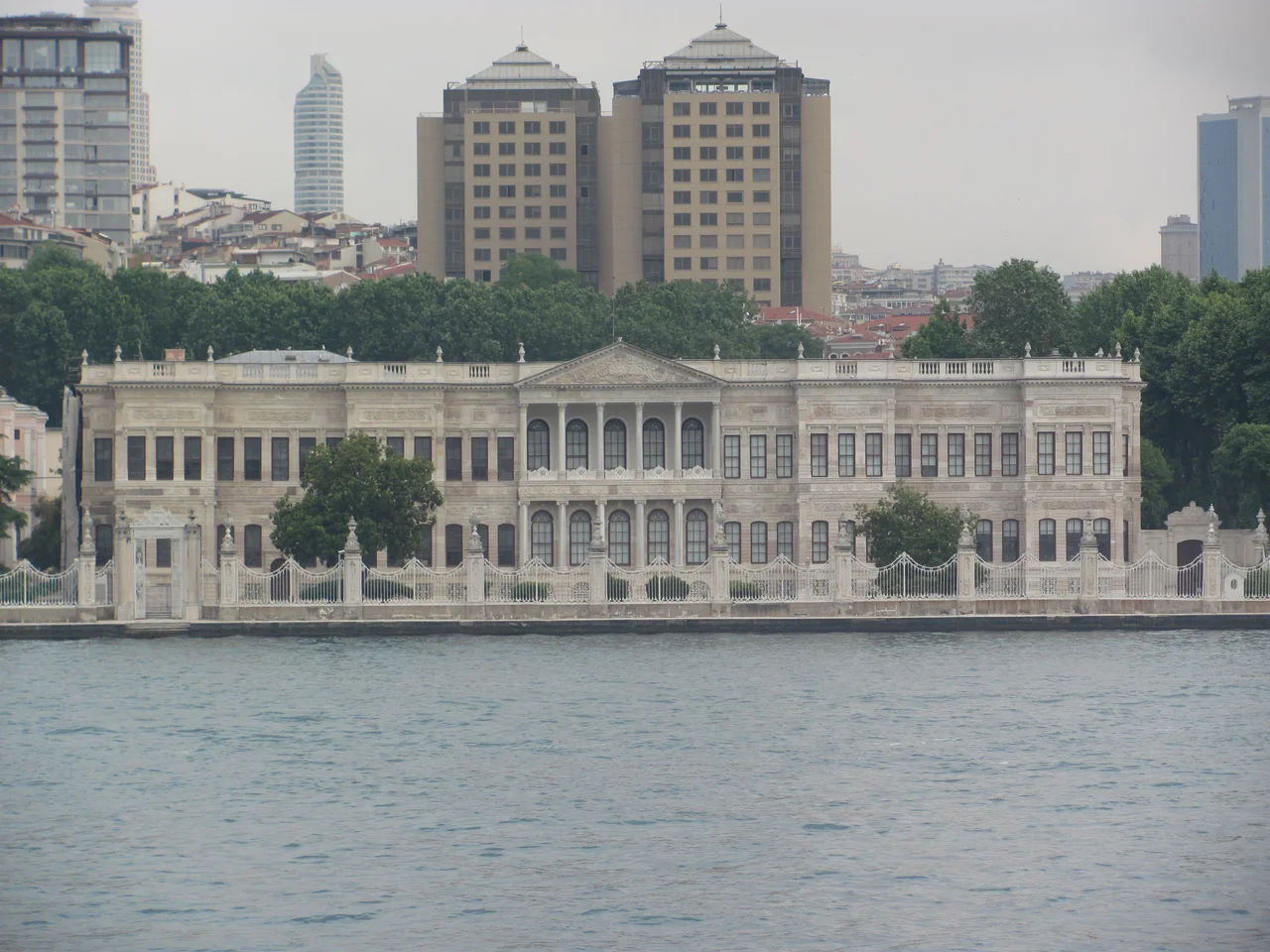

National Palaces Painting Museum
The last caliph of the Ottoman dynasty was also a painter. Abdülmecid II — born to become the final crown prince and, briefly, the last holder of one of Islam's most ancient titles — cared deeply about art, calligraphy, and music. His personal library, in the building that would eventually become the National Palaces Painting Museum, was later converted into a gallery displaying his own paintings. That room is one of the more quietly extraordinary spaces in Istanbul: a place where dynastic ending and artistic persistence share the same walls.
A Palace Annex Becomes a Museum
The Crown Prince Residence stands on the Bosphorus waterfront as part of the Dolmabahçe Palace complex in the Beşiktaş district. For decades after the founding of the Turkish Republic, the building housed the Istanbul Art and Sculpture Museum, established in 1937 under the order of Mustafa Kemal Atatürk and operated as part of Mimar Sinan Fine Arts University. A renovation running from 2010 to 2014 transformed the space entirely. When it reopened in 2014 as the National Palaces Painting Museum — Milli Saraylar Resim Müzesi in Turkish, funded by the Grand National Assembly of Turkey — its mission had shifted: to display the paintings that had once hung in Ottoman palace rooms, gathered back together from storage and dispersed collections into eleven exhibition halls.
Sultans Who Shopped in Paris
One of the more unexpected stories the museum tells is of Ottoman taste. During the reign of Sultan Abdulaziz, two sections' worth of paintings were purchased directly from the Goupil Gallery in Paris — the same prestigious dealer who handled works by Millet, Bouguereau, and later Van Gogh. Abdulaziz was guided in these acquisitions by Şeker Ahmed Pasha, an artist and courtier with a keen eye for European academic painting. The canvases they brought back to Dolmabahçe represent the first time a Western-style collection was assembled at the palace: landscapes, portraits, allegorical scenes rendered in the style that dominated European salons of the 1860s and 1870s. What had once been the decoration of imperial apartments is now the museum's record of a dynasty looking outward.
The Court Painters and Their Canvases
The museum's collection of court paintings offers a different angle on the same story. Stanisław Chlebowski, a Polish painter, served as court artist to Sultan Abdulaziz and produced ambitious historical canvases. Fausto Zonaro, an Italian painter, held the same position under Sultan Abdülhamid II and is represented here by some of his most dramatic works — including his famous depiction of Mehmed II entering Constantinople in 1453 and a scene of Mehmed II at the siege itself. These are not documentary records; they are imperial myth-making in oil paint, commissioned to shape how the dynasty saw itself. Seeing them now in a museum hall rather than hanging in a throne room changes their register entirely.
Turkish Painters in Western Light
The museum traces the arc of Ottoman and early Turkish painting in the Western tradition across several rooms. Works by Osman Hamdi Bey — the painter-archaeologist who was also founding director of Istanbul's archaeological museum — hang alongside pieces by Hüseyin Zekai Pasha and Hodja Ali Rıza. These artists represent what historians of Turkish art call the second, third, and fourth generations of Turkish painting in the Western mode: a long process of adoption, adaptation, and eventual transformation that began in the mid-19th century. One entire hall is devoted to Ivan Aivazovsky, the Russian marine painter who visited Constantinople several times and left canvases that capture the Bosphorus with an outsider's awe. The Ceremony Hall that holds his work — stucco-lined walls, composite-headed pilasters — remains the most architecturally striking room in the museum.
From the Air
The National Palaces Painting Museum occupies the Crown Prince Residence of Dolmabahçe Palace on the Bosphorus waterfront at approximately 41.040°N, 29.003°E in the Beşiktaş district of Istanbul's European side. The white neoclassical facade of the Dolmabahçe Palace complex is one of the most recognizable landmarks visible from the Bosphorus strait at low altitude. From 1,500–2,500 feet, the palace frontage stretching along the shoreline is clearly identifiable, with the Bosphorus Bridge visible to the northeast and the Topkapı Peninsula to the south. Nearest major airport is Istanbul Airport (LTFM), approximately 28 kilometers to the northwest.
Nearby Stories
- Kocaeli Peninsula 7.6 km away
- Second Battle of Çatalca 11 km away
- Istanbul's Rural Outskirts 14 km away
- MV Struma 20 km away
- HMAS AE2 36 km away
- Bursa 66 km away
- Sangarius Bridge 71 km away
- Januarius MacGahan 101 km away