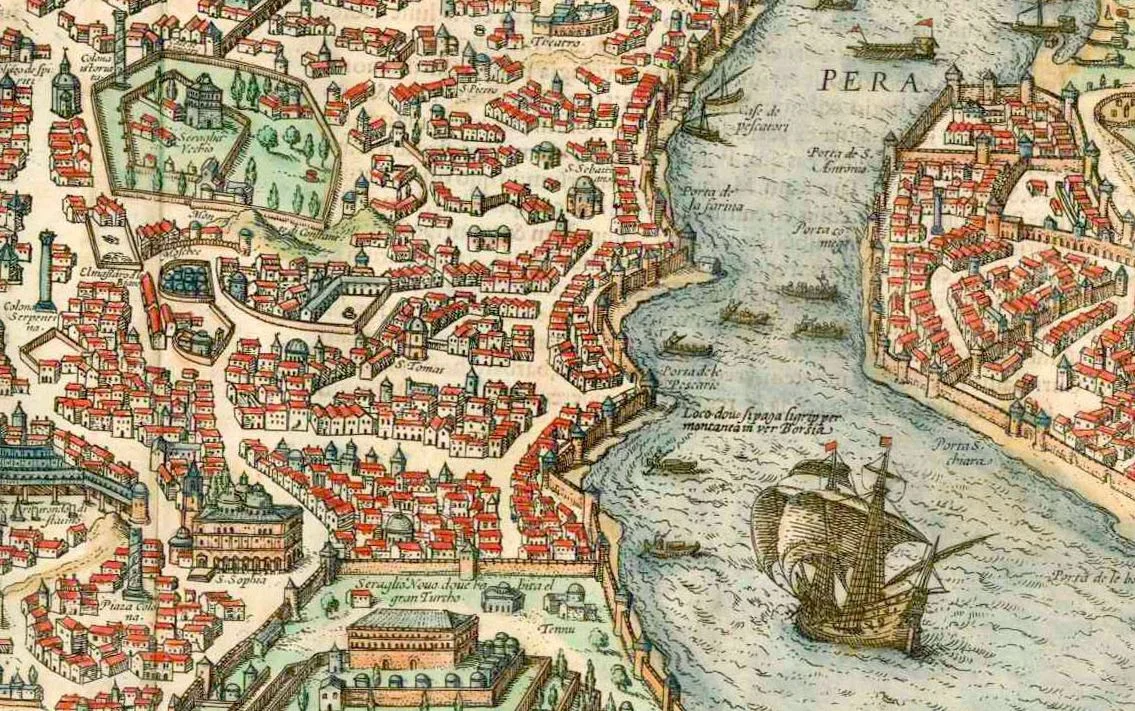

Neorion Harbour
An ox once bellowed here once a year, so the story goes, and its metallic cry so unnerved the neighborhood that Emperor Maurice ordered the statue thrown into the sea sometime around 590 CE. Whether the ox was bronze or marble, real or mythical, the tale captures something essential about the Neorion Harbour: this was a place where the practical and the legendary coexisted for more than a thousand years, side by side along the southern shore of Istanbul's Golden Horn.
Where Byzantium Began to Trade
Before Constantinople existed, there was Byzantion — a Megarian colony planted on this narrow peninsula where the Bosphorus meets the Golden Horn around 657 BCE. When Constantine the Great refounded the city as his imperial capital between 326 and 330 CE, he needed a working port immediately. The Neorion was his answer. It became the first harbour built in Constantinople after its refoundation, occupying the sixth region of the city on the Golden Horn's southern shore, just east of where the Galata Bridge crosses today.
The Neorion wasn't starting from scratch. It was the second harbour in this area, following the older Prosphorion, which had served ancient Byzantium. But the Neorion quickly became the dominant commercial port, absorbing the city's ambitions along with its trade. Ships from across the Mediterranean tied up at its quays; grain and timber and luxury goods moved through its warehouses. For the capital of the Eastern Roman Empire, this waterfront was a lifeline.
Ships, Oars, and Fire
The Neorion wore two faces. On one side it was a commercial port; on the other, a shipyard. A factory producing oars operated here — a detail that hints at how military and commercial functions were woven together in Byzantine Constantinople. The emperor's navy needed those oars; so did the merchantmen that kept the capital fed.
Fire was the Neorion's recurring curse. In 433, all the storehouses burned. In 465, a fire that started at the harbour consumed eight entire regions of the city — a conflagration so vast that it reshaped the urban fabric of Constantinople. In 559, the warehouses burned again. Three major fires across little more than a century speak to the density of timber, pitch, rope, and oil packed into this working waterfront. Each time, the city rebuilt. The harbour was too vital to abandon.
One section of the Neorion was known as 'the old equipment,' and housed a dedicated shipyard. Nearby stood the church of Saint Euphemia, a reminder that even the most industrial quarters of Byzantine Constantinople were never far from the sacred.
Centuries of Use
The Neorion outlasted empires. It remained active from the 4th century through the late Ottoman period — a span of roughly 1,400 years during which the city around it changed its name, its rulers, its religion, and its language, while the harbour kept doing what harbours do: receiving ships, moving goods, sheltering hulls from the Bosphorus current.
By the time the Ottomans reshaped Istanbul after 1453, the Neorion had long since been absorbed into a broader system of ports and naval facilities along the Golden Horn. The shoreline that Constantine's engineers first developed became, over the centuries, one of the most intensively used waterfronts in the world. Today, the Galata Bridge crosses not far from where those first Byzantine quays were laid, and the ferries that thread between the European and Asian shores follow routes that the Neorion's sailors would have recognized.
What the Water Remembers
Nothing remains of the Neorion above ground. No quay walls, no warehouse foundations visible to the casual visitor, no marker pointing to the exact spot where Constantine's first port opened for business. The Golden Horn has been reshaped by a thousand years of landfill, dredging, and urban pressure. The shoreline Constantine's engineers chose is now buried beneath layers of Ottoman and modern Istanbul.
Yet the logic of the place endures. The Golden Horn remains a sheltered inlet, calmer than the Bosphorus, the same natural harbor that drew Megarian colonists in the 7th century BCE and Constantine in the 4th century CE. The water remembers even when the stones do not. Standing on the Galata Bridge today, looking toward the old city, you are standing at the edge of where the Neorion once hummed with oars and commerce — the founding port of a city that remade the world.
From the Air
The Neorion Harbour site lies at approximately 41.017°N, 28.975°E, on the southern shore of the Golden Horn in the Fatih district of Istanbul. Approaching from Istanbul Airport (LTFM) to the northwest, the Golden Horn is clearly visible as the curved inlet dividing the European city — the Neorion occupied its eastern end, near the mouth into the Bosphorus. At 3,000 feet on approach, the Galata Bridge crossing the Horn marks the approximate location of the ancient harbour. The Topkapı Palace promontory and the minarets of the Blue Mosque define the skyline to the south; the Galata Tower on the north shore provides a fixed visual reference. Best viewed in clear morning light when the Horn's water reflects the old city's silhouette.
Nearby Stories
- Kocaeli Peninsula 7.6 km away
- Second Battle of Çatalca 11 km away
- Istanbul's Rural Outskirts 14 km away
- MV Struma 20 km away
- HMAS AE2 36 km away
- Bursa 66 km away
- Sangarius Bridge 71 km away
- Januarius MacGahan 101 km away