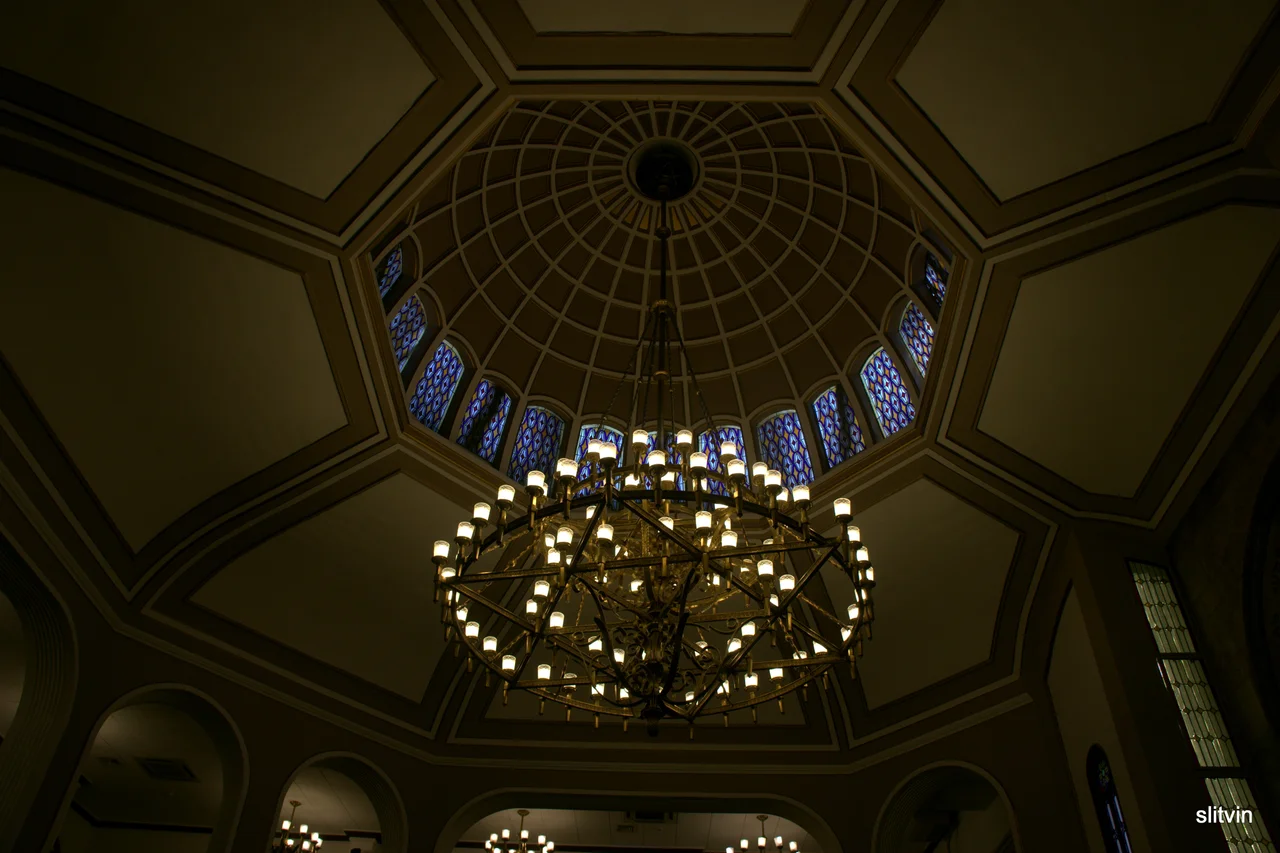

Neve Shalom Synagogue
In 1492, tens of thousands of Jews expelled from Spain found refuge in the Ottoman Empire, welcomed by a sultan who recognized what the Spanish monarchs were throwing away. The descendants of those refugees built a Jewish community in Istanbul that lasted five centuries and more. The Neve Shalom Synagogue, completed in 1951 in the Galata neighborhood, is the heart of that community today — the largest Sephardic synagogue in Istanbul, a place of Shabbat prayers and High Holidays, of weddings and bar mitzvahs and funerals. It is also a building that has been attacked three times, and that stands still.
Built on a Foundation of Community
The Neve Shalom — 'Oasis of Peace' in Hebrew — was built because Istanbul's Jewish population in the old Galata neighborhood had grown beyond what existing congregations could accommodate. The decision to build was made in the late 1930s; a Jewish primary school was demolished in 1949 to clear the site at Büyük Hendek Caddesi 61 in what is now the Karaköy quarter of Beyoğlu.
The architects were Elyo Ventura and Bernar Motola, young Turkish Jews who designed a building suited to the rhythms of Sephardic religious life. Construction finished in 1951. The inauguration was held on Sunday, March 25, 1951 — the 17th of Adar in the Hebrew calendar, 5711 — in the presence of Chief Rabbi Rafael David Saban, the Hahambaşı of Turkey. The synagogue opened not as a grand gesture but as a functional house of worship: a place for Shabbats, the High Holidays of Rosh Hashanah and Yom Kippur, bar mitzvahs, weddings, and the quiet weight of funerals.
September 6, 1986
The Neve Shalom had been closed for repairs and was reopening on a Shabbat morning in early September 1986 when two gunmen entered, posing as television cameramen covering the event. They opened fire on the congregation with machine guns, then poured gasoline on the dead and wounded and set them alight. Both attackers detonated grenades that killed them and burned the building for several hours.
Twenty-two worshippers were killed. Around two dozen more were wounded. The attack was attributed to the Abu Nidal Organization. Prime Minister Turgut Özal condemned it as 'heinous,' and the Turkish government convened an emergency cabinet session. President Ronald Reagan wrote personally to the Jewish community of Istanbul. Israeli Prime Minister Shimon Peres called it 'beastly.'
The synagogue was repaired. The community returned.
1992 and 2003: Attacked Again
On March 1, 1992, two men carried out a bomb attack on the Neve Shalom. No casualties resulted, though the attack demonstrated that the synagogue remained a target. The Great Eastern Islamic Raiders' Front claimed responsibility; Turkish police expressed doubt that the attack was solely a domestic operation, with Israeli officials suggesting international coordination.
The gravest blow came on November 15, 2003, when a truck bomb was detonated in front of the Neve Shalom as part of a coordinated series of four suicide attacks across Istanbul that day. The 2003 bombings killed 57 people in total and wounded hundreds. At the Neve Shalom itself, the explosion killed people and caused severe structural damage; most of the casualties in the vicinity were Muslim Turkish passersby rather than congregants inside, who were shielded in part by the building's walls. The attacks were attributed to al-Qaeda-linked networks.
Three attacks in seventeen years. Each time, the building was repaired. Each time, the community endured.
A Community That Has Persisted
Istanbul's Jewish community has been part of this city for more than 500 years. At its peak in the early 20th century, it numbered in the tens of thousands; emigration, primarily to Israel and the United States, reduced those numbers significantly over the following decades. Those who remained built institutions — schools, newspapers, synagogues — that sustained a community life.
The Neve Shalom stands at Büyük Hendek Caddesi 61 today, still functioning as the principal Sephardic congregation of Istanbul, still marking Shabbat, still hosting the life-cycle moments that define a Jewish community. Security is visible and serious, a permanent feature of the building's reality. But within, the prayers continue in Ladino and Hebrew, in a tradition that connects this congregation to the Spain of five centuries ago, to the Ottoman welcome that followed, and to the Turkish city that has been their home ever since.
From the Air
The Neve Shalom Synagogue is located at 41.027°N, 28.972°E in the Karaköy quarter of Beyoğlu, on the northern hillside above the Golden Horn in Istanbul. From Istanbul Airport (LTFM) approaching from the northwest, the Golden Horn's distinctive curved inlet becomes visible at around 4,000 feet — Beyoğlu rises steeply on its northern bank, and the Galata Tower's cylindrical stone silhouette is a clear landmark a short distance from the synagogue. The dense fabric of late Ottoman and early Republican apartment buildings surrounds the site on all sides. For the clearest view of Galata and the Golden Horn together, approach from the west at 2,500 feet on a clear day.
Nearby Stories
- Kocaeli Peninsula 7.6 km away
- Second Battle of Çatalca 11 km away
- Istanbul's Rural Outskirts 14 km away
- MV Struma 20 km away
- HMAS AE2 36 km away
- Bursa 66 km away
- Sangarius Bridge 71 km away
- Januarius MacGahan 101 km away