
New Tavern Fort
In April 1778, an American privateer named John Paul Jones slipped into the harbour of Whitehaven, Cumbria, in the middle of the night and tried to burn the British coal fleet at its moorings. He partly succeeded. He sailed away. He returned the following year to terrorise the east coast. He was, in the official British view, an outrage, and in a more honest view, proof that the British coastal defences were in poor shape. A government survey followed. Thirty new batteries were proposed along the southern and eastern English coast. One of them rose, between 1780 and 1783, on the south bank of the Thames at Gravesend, on a piece of riverbank previously occupied by an inn called the New Tavern. The fort took the inn's name. Two and a half centuries later, it still has it.
An Earthen Zig-zag
New Tavern Fort is not a stone castle. It is a broad earthen rampart in a zig-zag pattern, fronted by a deep ditch, designed to absorb the punishment of cannon fire rather than break under it. Inside the ramparts lies what was once a parade ground and is now a lawn with flowerbeds, a bandstand, ornamental shrubs. Eight gun emplacements are cut into the rampart - six in brick from the nineteenth century, two in concrete from the early twentieth - with magazines tunnelled underneath. The fort sits 250 metres east of the lost Gravesend Blockhouse, the Tudor work it was built to replace, and faces Tilbury Fort directly across the river. Its purpose was to cross fire with Tilbury and make this narrow neck of the Thames impassable to anything that floated.
The Engineer's Eye
The Thames survey was carried out by Thomas Hyde Page, the engineer who had also condemned old Gravesend Blockhouse as too cramped to fire downriver. Page proposed refurbishing Tudor Tilbury Fort across the water and replacing the blockhouse entirely with a new work to its east, at the New Tavern Inn, where the bend of the river would give it greater reach. The land belonged to a Mr Houghton; Parliament passed an act in 1780 to take it. Construction began at once. The first fort was an irregular unrevetted earthwork, two batteries linked by a rampart - more functional than handsome - and it was watching the river by 1783, the year the war that prompted its construction came to an end. The fort had been built against the United States. By the time it was finished, the United States existed.
The Ironclad Arms Race
Through the first half of the nineteenth century the fort accepted upgrades: new platforms for traversing guns in 1848, more magazines, then in 1859 a battery of ten 68-pounder smoothbores that could throw shot 3,500 yards. But by then Britain and France were chasing each other into a new era of warship design. The launch of HMS Warrior in Britain and La Gloire in France introduced iron-armoured ships against which existing coastal artillery was painfully outclassed. A Royal Commission convened. Its 1860 report called for two lines of Thames defence: an outer line of three new forts at Shornemead, Cliffe, and Coalhouse, and an inner line at Tilbury and New Tavern. From 1868, New Tavern Fort was largely rebuilt around ten 9-inch and one 12-inch rifled muzzle-loaders, with seven of the emplacements shielded behind heavy iron plate.
Below the Ramparts
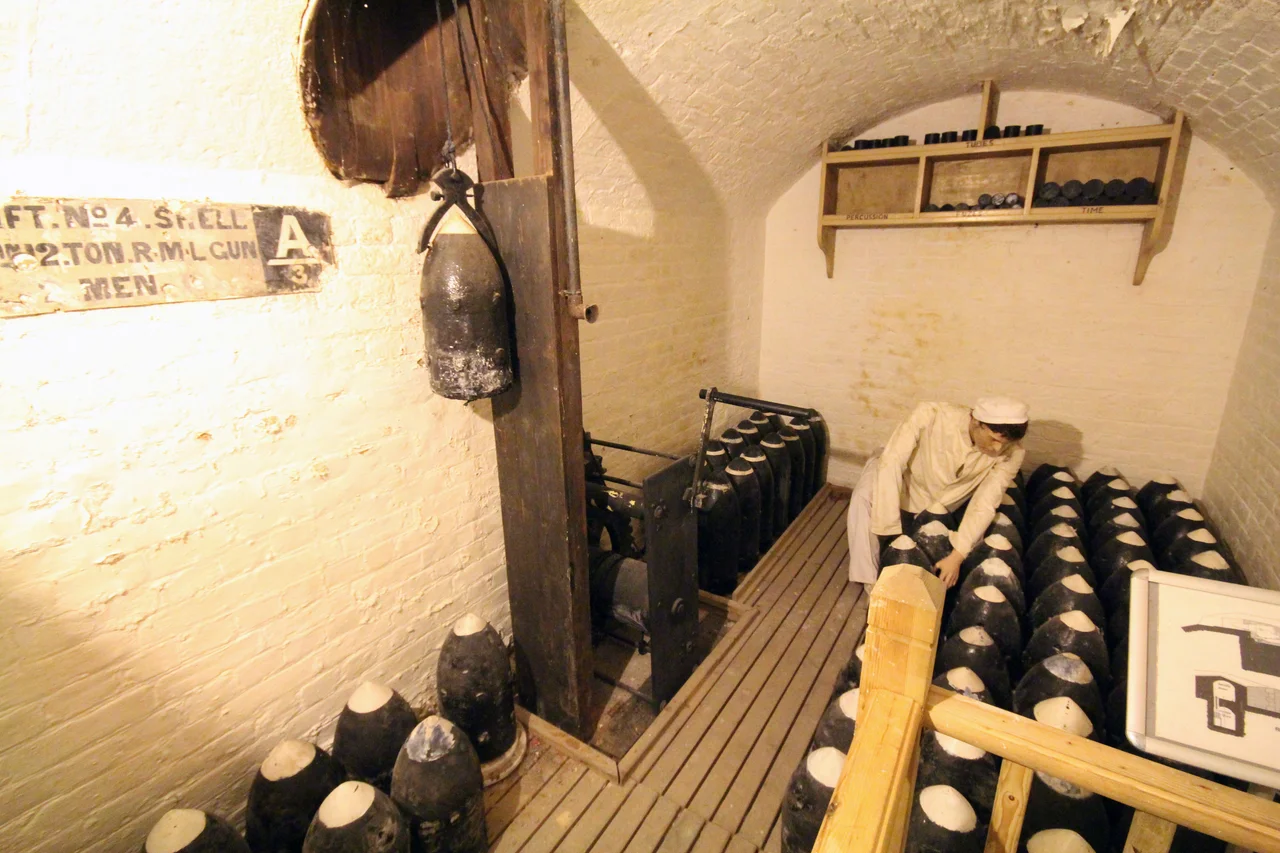
What you cannot see from the bandstand is the network underneath. A brick tunnel zigzags through the rampart, and sixteen smaller storage rooms - expense magazines - open off it. Ammunition lifts run from these rooms up to the gun emplacements above, so a crew could feed the guns without exposing the main magazine. The main magazine itself was a pair of larger cartridge and shell stores, from which ammunition would be carried along the tunnel to the smaller expense rooms when the guns were in action. The whole arrangement was a piece of carefully thought-out fire safety, and it survives largely intact - rare in British coastal forts, where magazines were usually gutted or filled in. New Tavern Fort is now considered to have the most complete refurbished magazine system of any UK coastal fortification.
From Battery to Park
The fort lost its strategic importance around 1900, as longer-range guns at Grain and Shoeburyness took over control of the estuary mouth. A War Office report of 1887-88 complained that New Tavern's guns were 'crowded, and behind weak parapets'. In 1905 the rifled muzzle-loaders were replaced with a pair of 6-inch breech-loaders in concrete pits with a range of six miles - the guns that are still there today, though not the originals. The fort was disarmed before the First World War, rearmed in 1930 for Territorial Army training, and in 1932 Gravesend Corporation took the interior and opened it as a pleasure garden. The battery itself kept training Territorials until 1938. In 1941, with the Battle of Britain just past and the bombing of London continuing, the Admiralty requisitioned the magazines and tunnels as air-raid shelters for HMS Gordon - the naval shore establishment based in the nearby Sea School - and the underground spaces filled up with sailors waiting out the night.
The Museum Above and Below
A V-2 rocket strike in 1944 destroyed Fort House, the residence of the Commanding Royal Engineer, and demolition followed. After the war the fort reopened as a garden. In the 1980s two salvaged 6-inch guns were reinstalled in the concrete pits, making New Tavern the only fully re-armed two-gun 6-inch breech-loading battery anywhere on the UK mainland. The magazines have been refurbished with interpretive displays and are opened by a local heritage group on summer weekends. The result is a single site where you can stand among an 18th-century earthwork, look at 19th-century brick emplacements built for rifled muzzle-loaders, walk into a 20th-century concrete gun pit, and descend into a tunnel network that sheltered Royal Navy crews from German bombs. No other fort in the United Kingdom assembles that span on one piece of ground.
From the Air
Coordinates 51.443 N, 0.3770 E, on the south bank of the River Thames in Gravesend, Kent, immediately east of Gravesend town centre and town pier. From the air, look for the distinctive zig-zag pattern of the earthen rampart and the green parkland inside, with the bandstand at the centre. Tilbury Fort sits directly opposite on the Essex shore - the two were designed to cross fire across this stretch of the river. Recommended viewing altitude 2,000-3,000 feet. Nearest airports: Rochester (EGTO) 8 nm southeast, London Southend (EGMC) 12 nm northeast, London City (EGLC) 20 nm west.
Nearby Stories
- Waltham Abbey Royal Gunpowder Mills 1.6 km away
- Bethlem Royal Hospital 4.4 km away
- Sissinghurst Castle Garden 5.6 km away
- Chelmsford 6.5 km away
- Herne Bay Pier 6.7 km away
- Operation Stack 7.1 km away
- St Osyth's Priory 13 km away
- Plymouth Brethren 24 km away