
Nijkerk
In 1633, the West India Company handed the keys of New Netherland to a 27-year-old from Nijkerk. His name was Wouter van Twiller, and the Nijkerk parish books had recorded his baptism on May 22, 1606. A generation later, his nephew Arent van Curler, also a Nijkerker, would walk into Mohawk country and bargain for the land that became Schenectady. For a Gelderland market town of farmers and tobacco growers, that is an outsized share of the men who shaped seventeenth-century Manhattan, the Hudson Valley, and upstate New York. Nijkerk has never been large. It has simply, repeatedly, punched above its weight.
The Church That Kept Burning
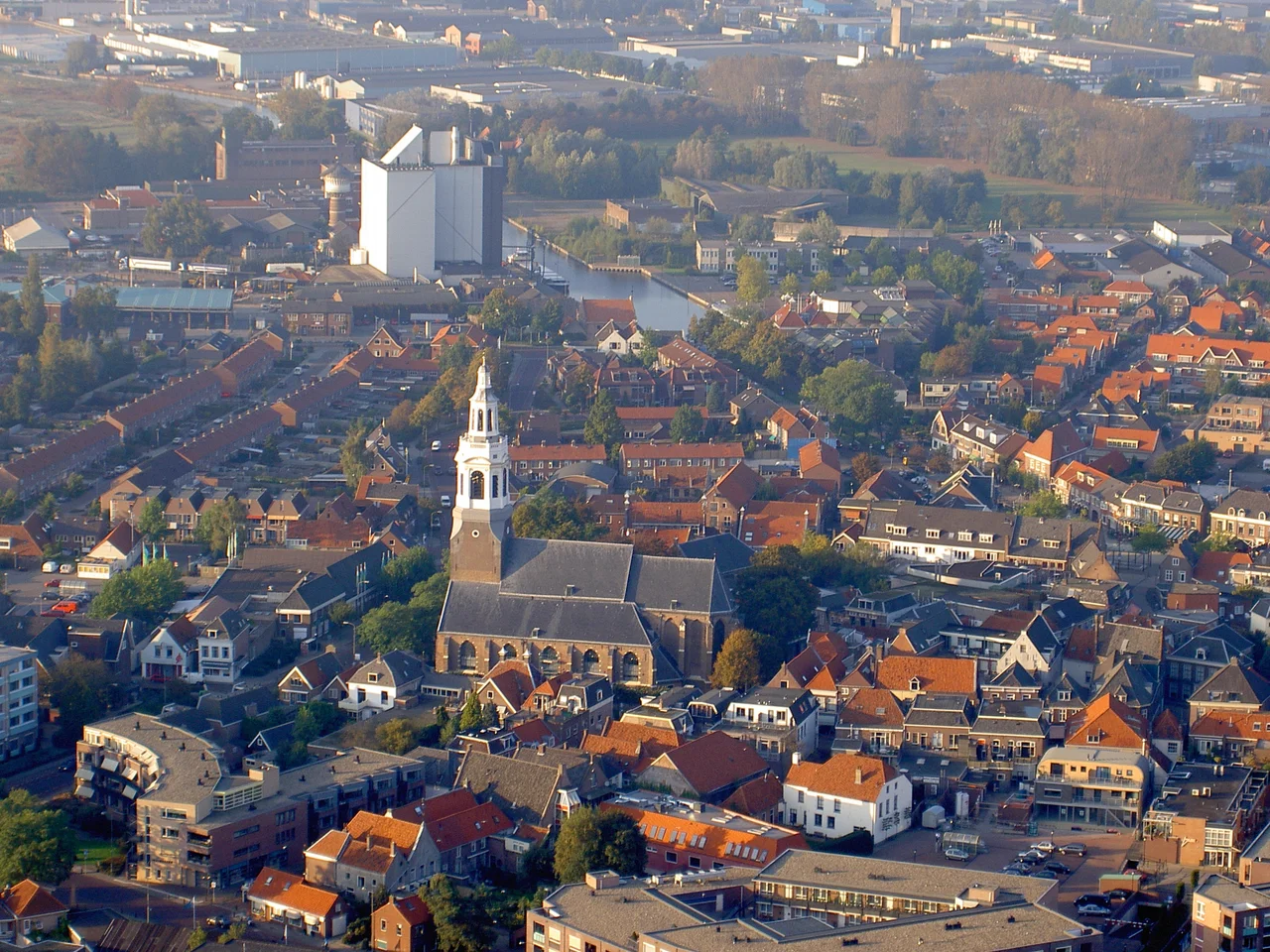
The town's name is literally an explanation: Nieuwe Kerk, the New Church. There was an older chapel here, but it burned in 1221, and the building that replaced it gave the settlement its identity. That replacement also burned, in 1421, and the one after that, and the one after that. Between the Duchy of Guelders and the Bishopric of Utrecht, Nijkerk sat directly on a contested border, and contested borders in the Low Countries meant soldiers, sieges, and fires. The village was wiped out entirely in 1412 and granted city rights as compensation a year later. What stands today is the Grote-of-Sint-Catharinakerk, raised in the 18th century, its 1756 organ by Mathijs van Deventer still in its loft. The name remembers a building that no longer exists, replaced by one that does.
Tobacco and the Hudson
By the 1700s, Nijkerk had found its rhythm: it was a port. Ships could reach the Zuiderzee through the Arkervaart canal, and what the ships carried, increasingly, was tobacco. The Veluwe's sandy soil suited the crop, and growers around Nijkerk, Amersfoort, and Wageningen fed leaves into a trade that ran straight to Amsterdam and out to the world. Early in the 18th century an Italian-Jewish family settled in town and remade the local industry, and the Ashkenazi community that followed them became central to both tobacco and the slaughtering trades. Meanwhile the families who had crossed to the New World a century earlier kept Nijkerk in correspondence with Albany, Schenectady, and Rensselaerswyck. The town traded in leaves and in letters.
The Doctor and the Chickens
Christiaan Eijkman was born here on August 11, 1858. He took his medical training, joined a Dutch military expedition to the East Indies, and ended up running a laboratory in Batavia where men were dying of beriberi - the wasting nerve disease that struck Asian garrisons, prisons, and ships with brutal regularity. Eijkman's chickens caught it too, then suddenly got better. He worked out why: the kitchen had switched from polished white rice to brown. Something in the hull, he reasoned, was keeping the birds alive. He did not know it was thiamine - vitamin B1 was years from being named - but he had spotted the principle. In 1929 he shared the Nobel Prize in Physiology or Medicine for the discovery of vitamins. The Nijkerk boy had opened a new branch of biology.
A Town of Quiet Famous People
The roll continues, oddly long for a place of forty thousand. Henri Nouwen, the Catholic priest whose books on loneliness and grace sold in the millions, was born here in 1932. Bernardus Alfrink, the cardinal who pushed the Dutch church through Vatican II, came from the same streets. Jakob van Domselaer composed minimalist piano works alongside Mondrian as part of De Stijl. The artist Kees de Kort drew the Bible illustrations that taught a generation of Dutch children what Jericho looked like. There is a footballer pipeline too - Bram van Polen and Donny van de Beek both grew up nearby. Walking the market square on a Saturday, none of this announces itself. The town simply gets on with being a town.
From Sea to Lake
The water that made Nijkerk a port is not the water that is there now. When the Afsluitdijk closed off the Zuiderzee in 1932, Nijkerk's salt sea became the freshwater IJsselmeer, and a later dam carved off the Nijkerkernauw - the narrow lake at the city's edge today. The Arkervaart still runs into it. The motorways A1 and A28 pass close enough that Randstad commuters can live among the polders and still reach Amsterdam in under an hour, which is why the population has roughly doubled since the war. From above, the geometry tells the story: medieval grid in the center, polder rectangles on the lake side, low-slung modern neighborhoods on the inland side. A town that has been rebuilt many times, still recognizable as itself.
From the Air
Nijkerk sits at 52.2167 N, 5.4833 E in Gelderland province, on the southwest edge of the Nijkerkernauw - the narrow lake separating Gelderland from Flevoland. From cruising altitude (FL250 and above) it appears as a compact urban cluster bracketed by the A28 motorway running northeast toward Zwolle and the A1 running east-west to the south. Visual cues: the sluice at Nijkerkernauw, the straight-edged Flevoland polder geometry across the water to the north, and the brick spire of the Grote Kerk in the old center. Nearest airport is Lelystad (EHLE) about 25 km north-northwest across the IJsselmeer; Amsterdam Schiphol (EHAM) lies roughly 50 km west. Lelystad airspace is uncontrolled below 1200 ft AGL; Schiphol's TMA covers the area at higher altitudes. Best visibility is in the cool, dry air after a frontal passage, when the polder geometry and water boundaries pop into hard relief.
Nearby Stories
- Amstelveen 4.4 km away
- 2001 United Kingdom foot-and-mouth outbreak 7.2 km away
- Dorestad 9.7 km away
- Schoonhoven 11 km away
- Noordhollandsch Kanaal 13 km away
- Liemers 15 km away
- Urk 15 km away
- Den Hulst 21 km away