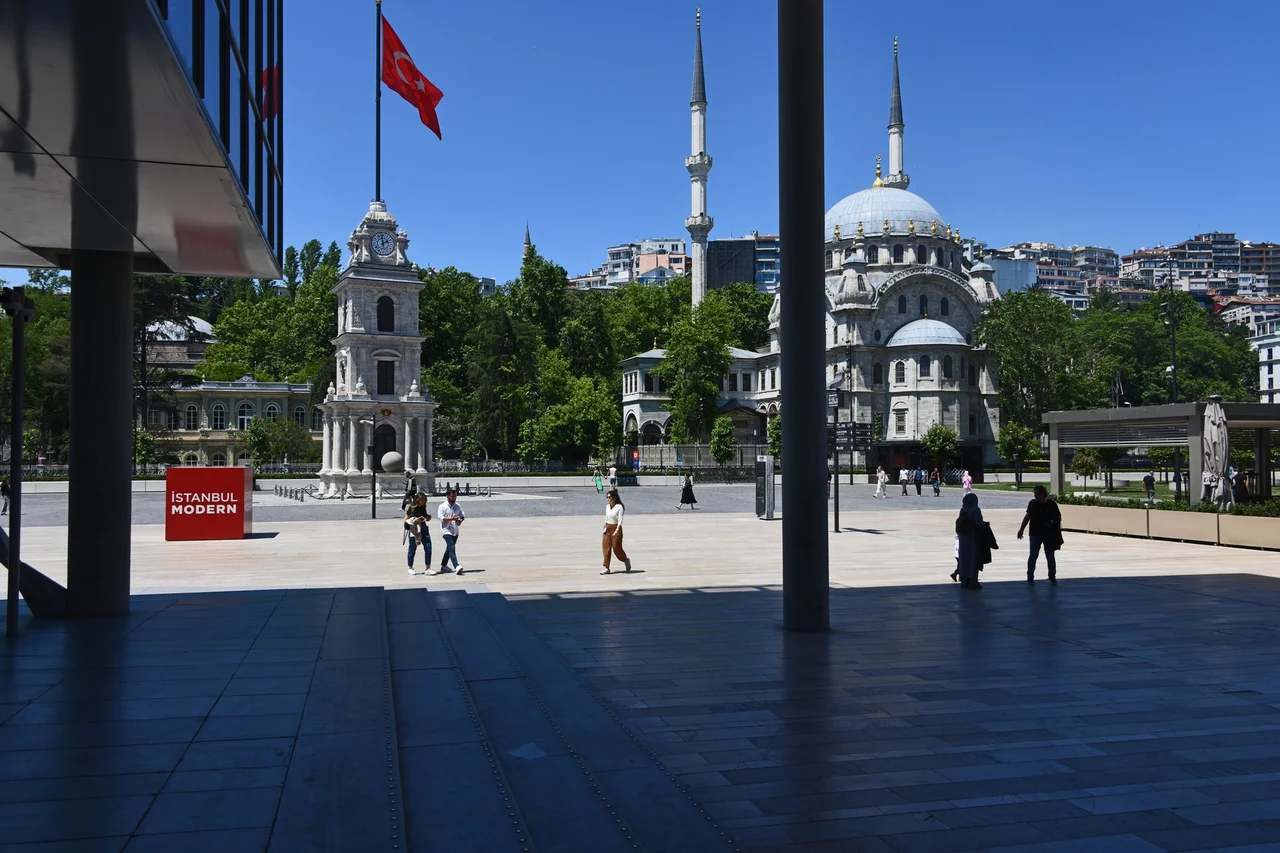

Nusretiye Clock Tower
Above the entrance to the Nusretiye Clock Tower, carved in stone and gilded with imperial confidence, the tughra of Sultan Abdülmecid I announces who put this here and why. It is a signature in the fullest Ottoman sense — not merely decorative, but a statement of sovereignty over time itself. The tower stands at Tophane on the European shore of the Bosphorus, its four neoclassical faces marking hours against the water and the sky, a sentinel between one of Istanbul's grandest mosques and the shimmering strait that has always divided continents.
A Sultan Orders the Hours
Abdülmecid I, who reigned from 1839 until his death in 1861, was a sultan who understood the architecture of authority. To commission a clock tower was to claim modernity — to place the regulated, measured, European concept of time inside an Ottoman streetscape. He ordered the tower built at Tophane, a neighborhood whose name means "cannon foundry" and whose identity had long been tied to military power and imperial ambition. The architect Garabet Amira Balyan, from the gifted Armenian-Ottoman Balyan dynasty that shaped so much of nineteenth-century Istanbul, designed the four-sided, three-story structure in the neoclassical style then fashionable at the Ottoman court. When completed in 1848, it joined Nusretiye Mosque and the Tophane Kiosk in a cluster of monuments along the waterfront that together read as a deliberate composition of imperial presence.
Marking Time by the Strait
The clock tower's position on the Bosphorus waterfront means it has always been seen from the water as much as from the land. Ships heading from the Black Sea toward the Sea of Marmara pass close enough to read its face. Ferries threading between the European and Asian shores use it as a landmark. From the street, it rises above the mosque's courtyard wall with an understated elegance — neoclassical pilasters, three measured stories, the imperial monogram commanding attention above the entrance arch. The original clock mechanism and clock face have fallen into disrepair over the years, which gives the tower a slightly ghostly quality: still standing, still imposing, but silenced, its hands no longer turning over the hours.
Survivors of the Bulldozer
Istanbul in the 1950s was a city under construction — and under demolition. The urban renewal and highway-building campaigns of that decade erased entire neighborhoods and swallowed historic fabric wholesale. The Tophane waterfront was in the path of change. That the clock tower, the Nusretiye Mosque, and the Tophane Kiosk all survived this period intact is remarkable. They were preserved as a coherent ensemble, a rare case of mid-century Istanbul holding its nerve. Today the tower stands in front of Istanbul Modern, the contemporary art museum whose sleek new building occupies the old port warehouse nearby. The contrast is deliberate and somehow fitting: an 1848 neoclassical Ottoman clock tower as the threshold to a museum of contemporary art, time layered on time.
The Balyan Touch
Garabet Amira Balyan belonged to a family that functioned as the Ottoman court's most trusted architects across several generations. The Balyans — Armenian-Ottoman by heritage — designed palaces, mosques, military schools, and public buildings throughout the nineteenth century, navigating the empire's complex relationship with European stylistic influence without ever simply copying it. The Nusretiye Clock Tower reflects this sensibility: it is neoclassical in vocabulary but Ottoman in spirit, a European form pressed into the service of imperial self-presentation. That the same family also designed Nusretiye Mosque, directly beside the tower, makes the Tophane waterfront something of a Balyan showcase — a few dozen meters of Istanbul street where their vision of the empire's modern face was built in stone.
From the Air
The Nusretiye Clock Tower sits at approximately 41.0267°N, 28.9829°E on the European shore of the Bosphorus in Istanbul's Beyoğlu district. It is best viewed from low altitude — below 2,000 feet — approaching from the Bosphorus to the east, where the tower, Nusretiye Mosque, and Istanbul Modern form a compact cluster visible against the waterfront. The nearest major airport is Istanbul Airport (LTFM), roughly 35 km to the northwest. In clear weather the Bosphorus strait, the Galata Tower to the north, and the domes of Sultanahmet to the south provide excellent orientation references.
Nearby Stories
- Kocaeli Peninsula 7.6 km away
- Second Battle of Çatalca 11 km away
- Istanbul's Rural Outskirts 14 km away
- MV Struma 20 km away
- HMAS AE2 36 km away
- Bursa 66 km away
- Sangarius Bridge 71 km away
- Januarius MacGahan 101 km away