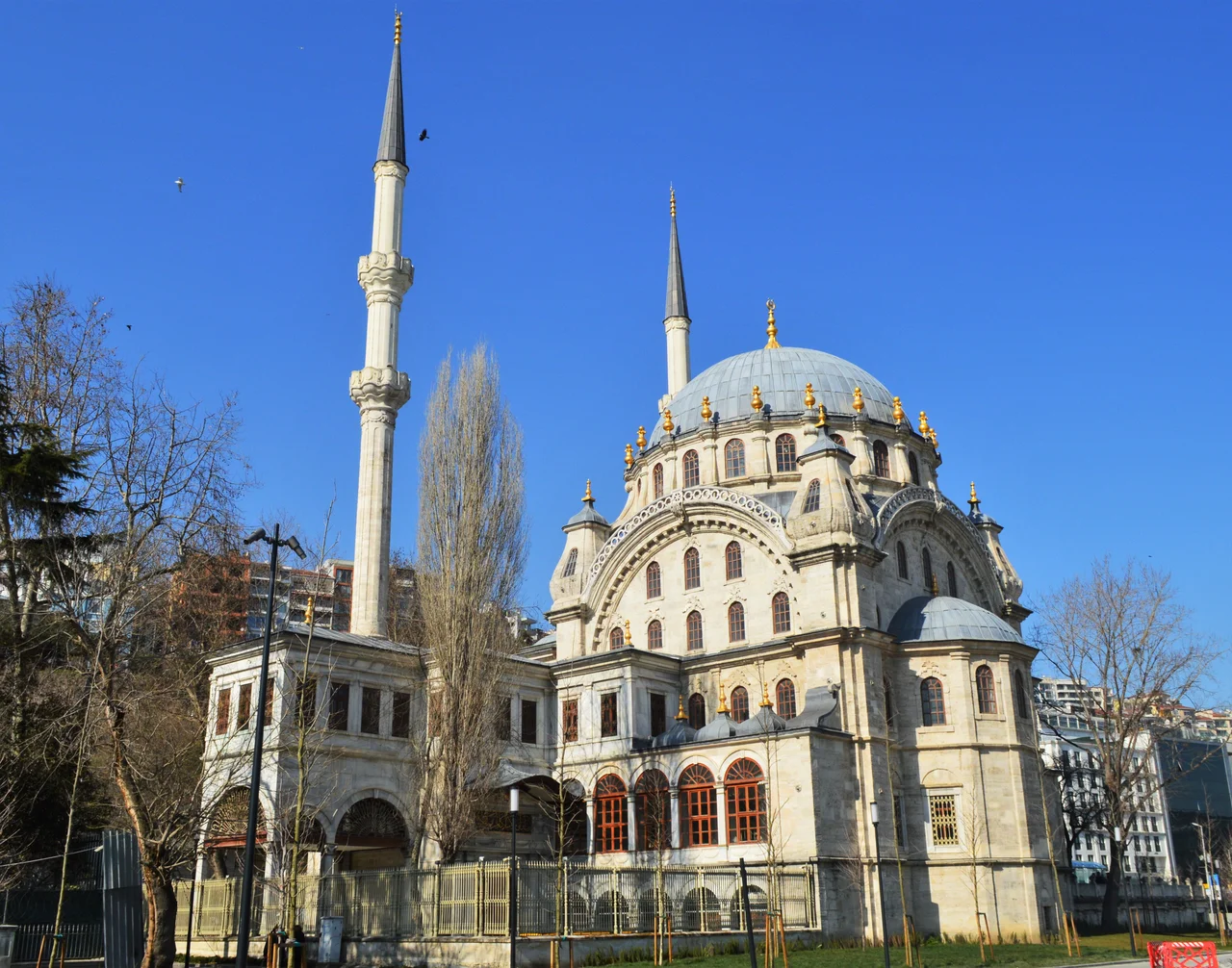

Nusretiye Mosque
The name Nusretiye means "victory," and the victory it commemorates was one of the most brutal acts of internal statecraft the Ottoman Empire ever carried out. In June 1826, Sultan Mahmud II ordered the massacre of the Janissaries — the elite military corps that had dominated Ottoman politics for centuries — in what Turkish history calls the Auspicious Incident. Within weeks, ground was broken on this mosque. The building is an act of triumphalism in carved stone, Rococo marble, and the slenderest minarets in Istanbul, rising over Tophane on the European shore of the Bosphorus.
Built on a Reckoning
Mahmud II had spent years preparing his move against the Janissaries. By 1826, when he was finally ready, the massacre was swift and total: thousands were killed, the corps was abolished, and the Ottoman Empire's long struggle with its own military establishment reached a decisive and bloody end. The mosque Mahmud II built at Tophane that same year was not a coincidence. Nusretiye — "the Victory" — was a statement, placed deliberately in the same neighborhood where the Janissaries had maintained their barracks. Mahmud II also built a new artillery barracks and parade ground nearby, replacing the old Janissary facilities. The whole quarter was being remade, architecturally and symbolically, as a monument to the new order.
Krikor Balian's First Masterwork
The mosque is the first major imperial commission by Krikor Balian, scion of the Armenian-Ottoman Balyan family that served as the Ottoman dynasty's architects across multiple generations. For a young architect, it was an extraordinary assignment — an imperial mosque on the Bosphorus waterfront, designed to mark a pivotal moment in Ottoman history. Balian produced something that scholars still debate: is the Nusretiye Mosque Ottoman Baroque, Empire style, or early Neoclassical? Godfrey Goodwin and Doğan Kuban consider it one of the last Ottoman Baroque mosques; Ünver Rüstem reads it as a transitional work moving toward an Ottoman Neoclassicism. What everyone agrees on is the quality of the decoration and the audacity of the proportions. The minarets are extraordinarily slender — pencil-thin against the sky, as if Balian was testing how far he could push the form.
The Mosque's Unusual Details
Up close, Nusretiye rewards careful attention. The two sebils — the charitable drinking-water kiosks that flank the entrance — are extravagant pieces of Rococo metalwork, their surfaces undulating with carved ornament in a way that feels almost theatrical. Inside, the dome departs from Ottoman convention: instead of the traditional circular Arabic inscription running around its base, Balian used a vegetal foliate motif — leaves and tendrils rather than calligraphy. The wooden elements, where earlier mosques would have used stone, give the interior a warmth and intimacy that larger imperial mosques lack. Despite the building's relatively modest footprint, its tall proportions create a sensation of height that exceeds what the plan would suggest, the culmination of a tendency that scholars trace back through the Ayazma Mosque to earlier Ottoman experiments with verticality.
A Waterfront Ensemble
The Nusretiye Mosque is rarely seen alone. It sits at Tophane alongside the neoclassical clock tower that Sultan Abdülmecid I built in 1848 and the Tophane Kiosk, the three structures forming a coherent ensemble on the Bosphorus shore. The whole complex survived the mid-twentieth-century urban renewal that destroyed much of Ottoman Istanbul — a lucky escape. Today, Istanbul Modern occupies the former port warehouse nearby, and the Galataport cruise terminal has remade the adjacent waterfront. The mosque stands between these new developments with the equanimity of something that has already outlasted a great deal of change. Its minaret tips catch the late afternoon light above the café terraces and the water.
From the Air
The Nusretiye Mosque sits at approximately 41.0273°N, 28.9832°E in the Tophane neighborhood of Beyoğlu, Istanbul, on the European shore of the Bosphorus. Flying along the strait from the northeast at 1,500–3,000 feet, the two slender minarets are identifiable against the waterfront. The Galata Tower serves as a northern orientation point roughly 700 meters away. Istanbul Airport (LTFM) is approximately 35 km to the northwest. Sultanahmet's skyline — the Blue Mosque and Hagia Sophia domes — is visible to the south.
Nearby Stories
- Kocaeli Peninsula 7.6 km away
- Second Battle of Çatalca 11 km away
- Istanbul's Rural Outskirts 14 km away
- MV Struma 20 km away
- HMAS AE2 36 km away
- Bursa 66 km away
- Sangarius Bridge 71 km away
- Januarius MacGahan 101 km away