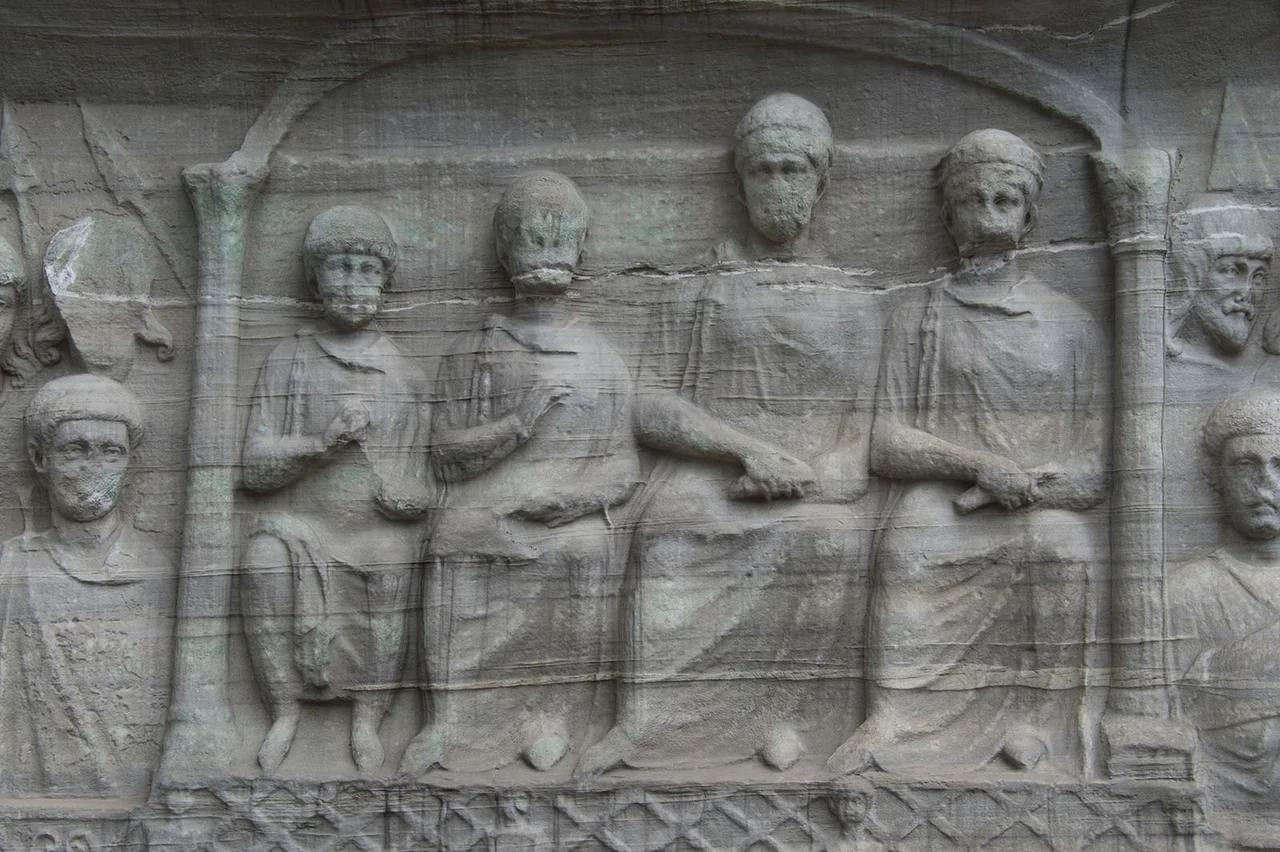

Obelisk of Theodosius
It was already 1,800 years old when the Romans moved it. Stand in Sultanahmet Square today and you are looking at a column of Aswan granite that Pharaoh Thutmose III ordered carved around 1450 BC, to commemorate his victory over the Mitanni on the banks of the Euphrates. Egyptian priests carved hieroglyphs on each of its four faces. Those hieroglyphs are still there, still readable after thirty-four centuries. The obelisk has seen Karnak, Alexandria, and Constantinople in turn, and it has outlasted all of them as functioning centers of empire.
From Karnak to Constantinople
Thutmose III raised the obelisk at Karnak, at the great temple complex near Luxor, positioned south of the seventh pylon. It stood there for more than nine hundred years before the Roman emperor Constantius II decided he wanted it. Around 357 AD, Constantius was preparing to celebrate his twentieth anniversary on the throne — his ventennalia — and he ordered two Egyptian obelisks transported down the Nile to Alexandria as monuments to his reign. One was shipped to Rome that autumn and raised on the spina of the Circus Maximus; it is still standing in the Piazza San Giovanni in Laterano and is now known as the Lateran Obelisk. The other obelisk, Thutmose's, sat in Alexandria's harbor for more than thirty years, apparently waiting. It was Theodosius I who finally acted. In 390 AD, he had it shipped to Constantinople and erected on the spina of the Hippodrome — the central barrier around which chariots raced — where it has stood ever since.
Damaged, Diminished, Still Standing
The original obelisk was approximately 30 meters tall — its companion, the Lateran Obelisk, which Constantius shipped to Rome, originally stood around 32 meters. Sometime during transport or re-erection — the exact moment is lost — the lower section was damaged and apparently had to be removed. What remains stands 18.54 meters high, or 25.6 meters if you include the marble pedestal on which Theodosius mounted it. Four bronze cubes sit at the corners between the obelisk's base and the pedestal: these are the blocks used to maneuver it into position. The inscription on the west face of the pedestal, carved in Byzantine Greek, makes the operation sound almost easy: "The four-sided column, forever lying heavily on the ground, the emperor Theodosius as the only one dared to erect. He called on Proclus; and thus the column stood in two and thirty days." Thirty-two days to raise a 3,400-year-old obelisk using bronze cubes and human labor. It was a feat worth bragging about.
Reading the Hieroglyphs
Each of the obelisk's four faces carries a single central column of hieroglyphic inscription celebrating Thutmose III's military campaigns. The language is the formal elevated Egyptian of the New Kingdom period, commemorating a pharaoh's divine victories in the cadence that temple scribes used for centuries. For most of the obelisk's life in Constantinople — roughly a thousand years of Byzantine rule and then five more centuries of Ottoman — no one in the city could read these inscriptions. They were simply texture and antiquity, a column of mysterious marks on a stone that had stood since before anyone's memory of memory. European scholars began deciphering Egyptian hieroglyphs only in the nineteenth century, after the Rosetta Stone. What the marks say, and that they were carved for Thutmose III, has been known for less than two hundred years.
The Hippodrome's Last Giant
The Hippodrome of Constantinople was once one of the most spectacular public spaces in the ancient world — a chariot-racing venue that could hold tens of thousands of spectators, lined along its central spina with monuments, statues, and trophies brought from across the empire. Almost all of those monuments are gone. The Serpent Column — a bronze tripod from Delphi — survives, damaged. The Walled Obelisk, a column of stone built in imitation of the Egyptian originals, still stands. But the Obelisk of Theodosius is the most ancient and the most intact thing remaining on what was the spina. The square around it is called Sultanahmet Meydanı now. Tourists photograph it against the backdrop of the Blue Mosque. Pigeons land on the bronze cubes. The hieroglyphs of a pharaoh who lived three millennia ago catch the Istanbul sun.
From the Air
The Obelisk of Theodosius stands at approximately 41.0061°N, 28.9754°E in Sultanahmet Square (At Meydanı), Istanbul, directly south of Hagia Sophia and east of the Blue Mosque. At lower altitudes — below 2,000 feet — the narrow pink shaft is visible among the monuments in the square. The distinctive domes of Hagia Sophia and the six minarets of the Blue Mosque provide unmistakable orientation references from the air. Istanbul Airport (LTFM) is approximately 40 km to the northwest. Approach from the Bosphorus to the east offers the clearest view of the Sultanahmet peninsula.
Nearby Stories
- Kocaeli Peninsula 7.6 km away
- Second Battle of Çatalca 11 km away
- Istanbul's Rural Outskirts 14 km away
- MV Struma 20 km away
- HMAS AE2 36 km away
- Bursa 66 km away
- Sangarius Bridge 71 km away
- Januarius MacGahan 101 km away