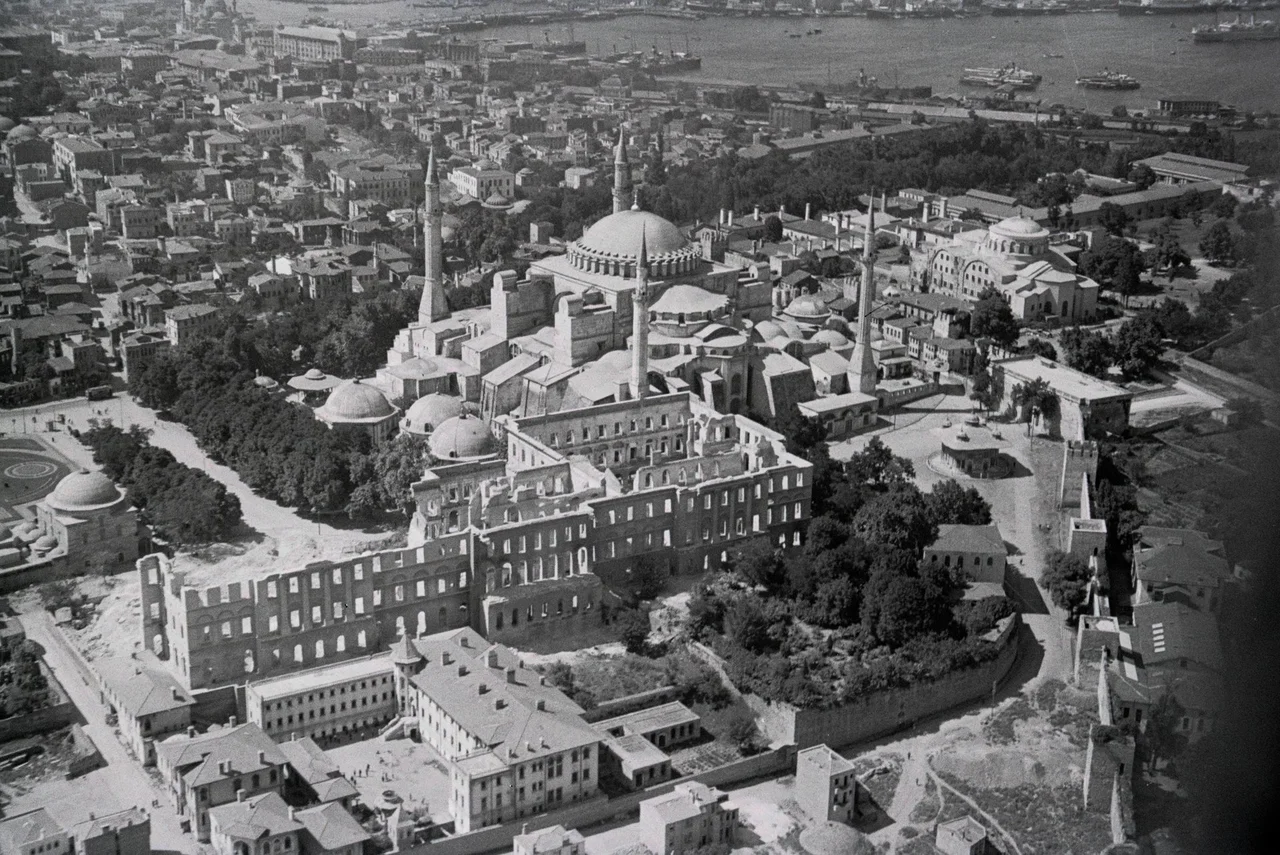

Old Darülfünun Building
The Swiss architect Gaspare Fossati knew Istanbul's most formidable neighbor well — between 1847 and 1849 he would restore Hagia Sophia, carefully mapping every mosaic and crumbling arch of the ancient basilica next door. But even as that landmark commission unfolded, Fossati was already at work on something new: beginning in the mid-1840s, he designed a new university for the Ottoman Empire that would hold its own in that extraordinary company — a three-storey neo-Renaissance palace of learning that rose beside one of the world's greatest buildings and, for nearly eighty years, defined the skyline of the old city. The Darülfünun — the House of Sciences — was completed in 1854.
A Sultan's Ambition in Stone
The Darülfünun was not just a building — it was a statement. The Ottoman reformers of the Tanzimat era understood that knowledge was power, and the empire needed a modern university to train doctors, engineers, lawyers, and administrators. When the building opened in 1854, it was a visual declaration: here stood an empire that could read European architecture and speak it back fluently. Fossati's neo-Renaissance facade — columned, symmetrical, confidently grand — announced that Constantinople was not merely an ancient city but a living capital. The name itself, *Darülfünun*, meant "House of Sciences" in Ottoman Turkish, a compound ambition pressed into a single word.
The Many Lives of One Building
Universities are rarely just universities. Over the decades that followed its opening, the building shed one identity and took on another with the fluency of a diplomat. First came the Ministry of Finance, which occupied the halls where students had studied. Then the Ministry of Justice and Foundation moved in. For a time the building served as a seat of the Ottoman Parliament — lawmakers debating in chambers built for lectures. Finally it became a Palace of Justice, the law courts occupying the same neo-Renaissance corridors that Fossati had envisioned for science and scholarship. Each new tenant repainted the walls and rearranged the rooms, but the bones of the building — its grand proportions, its Bosphorus-facing elevation — remained.
Gaspare Fossati and the Age of Istanbul's Renewal
Fossati arrived in Istanbul in the 1830s as part of a wave of European architects, engineers, and artists drawn to an empire that was modernizing rapidly and willing to pay for talent. He and his brother Giuseppe worked on everything from the Russian embassy to private palaces. But Fossati's most consequential commission was the restoration of Hagia Sophia, which he undertook between 1847 and 1849 — carefully uncovering, documenting, and then re-concealing Byzantine mosaics under the orders of Sultan Abdülmecid I. That intimate knowledge of the ancient building next door surely shaped how Fossati approached the Darülfünun: not in competition with Hagia Sophia, but in conversation with it — a confident modern voice beside an ancient one.
Fire and Memory
On a night in 1933, fire took the building. By then the Ottoman Empire had been dissolved for more than a decade, the Republic of Turkey had been founded, and Istanbul was no longer a capital city. The old neighborhoods around Hagia Sophia had been changing shape for years, and the Darülfünun — already stripped of its original purpose — did not survive the flames. Nothing replaced it on that same footprint beside Hagia Sophia. What remains today is documentary evidence: old photographs, architectural drawings, the written recollections of those who walked its corridors. The building that once declared an empire's educational ambitions exists now only in archives and in the name *Darülfünun*, which lives on in Istanbul University, founded in that same reformist spirit.
From the Air
The Old Darülfünun Building once stood at approximately 41.007°N, 28.980°E, immediately west of Hagia Sophia in Istanbul's historic Sultanahmet district. From the air at 3,000–5,000 feet, the site is unmistakable: look for the distinctive mass of Hagia Sophia's dome and the Blue Mosque's minarets — the Darülfünun occupied the open area directly adjacent to the great basilica's western facade. The nearest major airport is Istanbul Airport (LTFM), roughly 35 km to the northwest. The historic peninsula is best viewed on approach from the Bosphorus, where centuries of monumental architecture line the waterfront ridge.
Nearby Stories
- Kocaeli Peninsula 7.6 km away
- Second Battle of Çatalca 11 km away
- Istanbul's Rural Outskirts 14 km away
- MV Struma 20 km away
- HMAS AE2 36 km away
- Bursa 66 km away
- Sangarius Bridge 71 km away
- Januarius MacGahan 101 km away