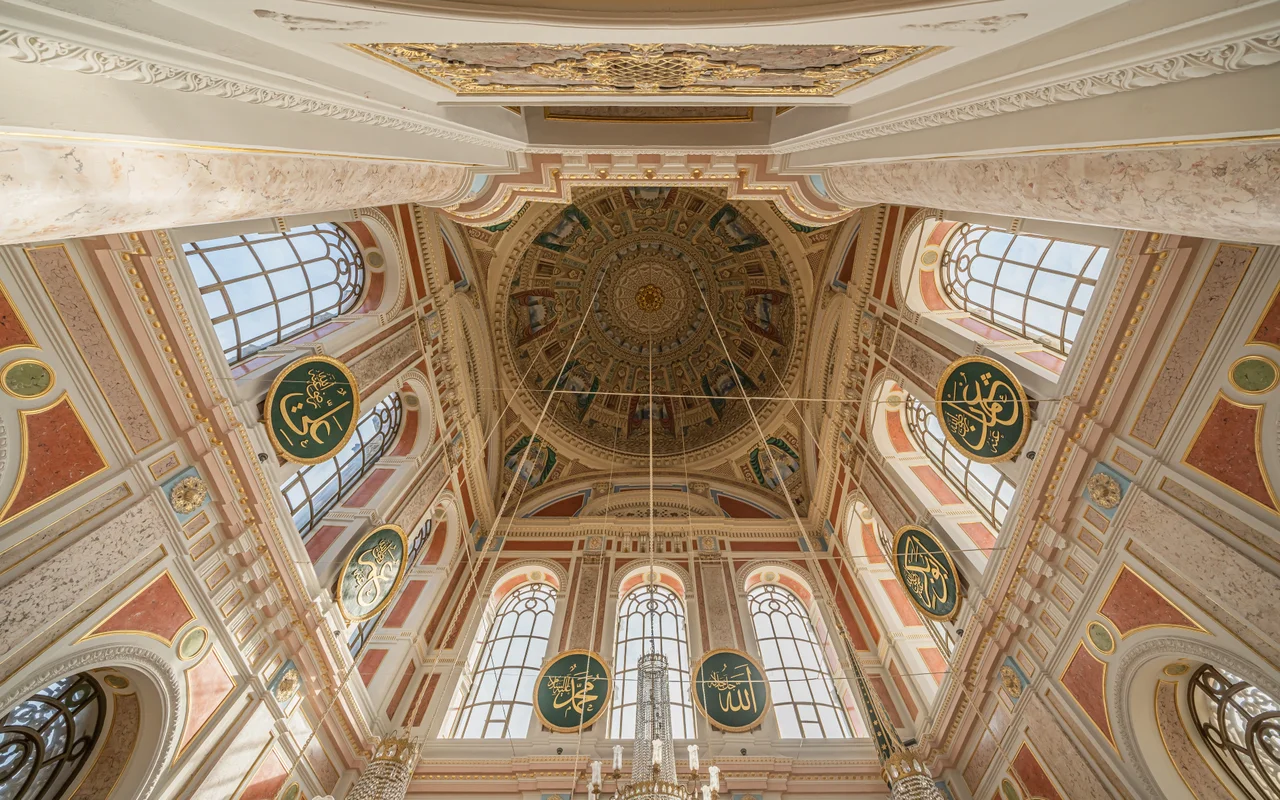

Ortaköy Mosque
Stand at the waterfront in Ortaköy and you will understand why this mosque appears in more photographs than almost any building in Istanbul. The Büyük Mecidiye Camii — the Great Mecidiye Mosque, named for the sultan who commissioned it — sits so close to the Bosphorus that its reflection shimmers in the strait below. Behind it, rising enormously into the sky, the cables and pylons of the Bosphorus Bridge (now officially the 15 July Martyrs Bridge) form an accidental frame. A 19th-century monarch's prayer house and a 20th-century engineering marvel: the contrast is jarring, and somehow exactly right.
A Mosque Built for the Modern Age
Sultan Abdülmecid I commissioned the mosque in the mid-19th century, a period when Ottoman rulers were deliberately turning toward Europe — architecturally, diplomatically, militarily. The Tanzimat reforms were reshaping the empire's laws and institutions, and the arts followed. The architects chosen for the project, Garabet Amira Balyan and his son Nigoğayos Balyan, belonged to the Balyan family, an Armenian dynasty of imperial architects who had built much of the Ottoman court's grandest 19th-century structures. Their design was unmistakably European in vocabulary: arched windows, slender corner towers with ornamental crenellations, and a central dome surrounded by delicate stonework that gives the building its distinctive lacy quality. Construction was completed around 1854 or 1856 — the sources disagree on the precise date.
What Stood Here Before
The Bosphorus shore at Ortaköy had already been sacred ground for more than a century when the Büyük Mecidiye rose. An earlier, smaller mosque had occupied the site since 1721, commissioned by Mahmud Ağa, son-in-law of Grand Vizier Ibrahim Pasha, during the reign of Ahmed III — a period of relative Ottoman cultural flourishing. That mosque was badly damaged in the Patrona Halil Uprising of 1730 — a violent revolt by janissaries and artisans that toppled the grand vizier and forced the sultan's abdication, one of the more turbulent episodes in early 18th-century Ottoman history. The building that replaced it more than a century later was of an altogether different ambition: not a neighborhood mosque but an imperial statement, visible from the water and designed to be seen.
The Earthquake and What Changed
The mosque suffered serious damage in the catastrophic Istanbul earthquake of 1894. The tremor — magnitude 7.0, causing some 474 deaths across the city — cracked the dome and toppled the ornate minaret caps at Ortaköy. The minarets were substantially rebuilt and reworked in a repair completed in 1909 by the Ministry of Foundations. The current minarets — slender, elegant, matching the neo-Baroque refinement of the rest of the structure — date from that 1909 restoration. In a city that has been rebuilt so many times, the fact that what visitors admire today is partly a reconstruction does nothing to diminish the effect. The building that now stands at the Bosphorus shore is the product of two eras of Ottoman craftsmanship, joined by a disaster and a recovery.
Frame Within a Frame
What makes the Ortaköy Mosque so irresistible to photographers is not any single feature but a combination that no human planner could have arranged. The mosque was built decades before the Bosphorus Bridge existed; the bridge opened in 1973, and the placement of its European pylon near Ortaköy was an engineering decision, not an aesthetic one. Yet the two structures frame each other with a strange perfection — the soaring span above, the ornate stonework below, the water between them catching the light. Every traveler who photographs Istanbul carries this image away. Ferries passing on the strait see it from the water side; the view from the bridge itself, looking down at the mosque's dome, is something else entirely. The mosque endures as a place of worship. Friday prayers fill it with sound. And the photographs keep accumulating.
From the Air
The Ortaköy Mosque sits at 41.047°N, 29.027°E on the European shore of the Bosphorus, directly beneath the 15 July Martyrs Bridge (Bosphorus Bridge). From the air at 2,000–4,000 feet, the site is unmistakable: the long suspension span crosses the strait, and the mosque's dome and minarets cluster just south of the bridge's European tower. The nearest major airport is Istanbul Airport (LTFM), approximately 25 km to the northwest. Light along the Bosphorus is best in late afternoon when the western sun catches the mosque's facade.
Nearby Stories
- Kocaeli Peninsula 7.6 km away
- Second Battle of Çatalca 11 km away
- Istanbul's Rural Outskirts 14 km away
- MV Struma 20 km away
- HMAS AE2 36 km away
- Bursa 66 km away
- Sangarius Bridge 71 km away
- Januarius MacGahan 101 km away