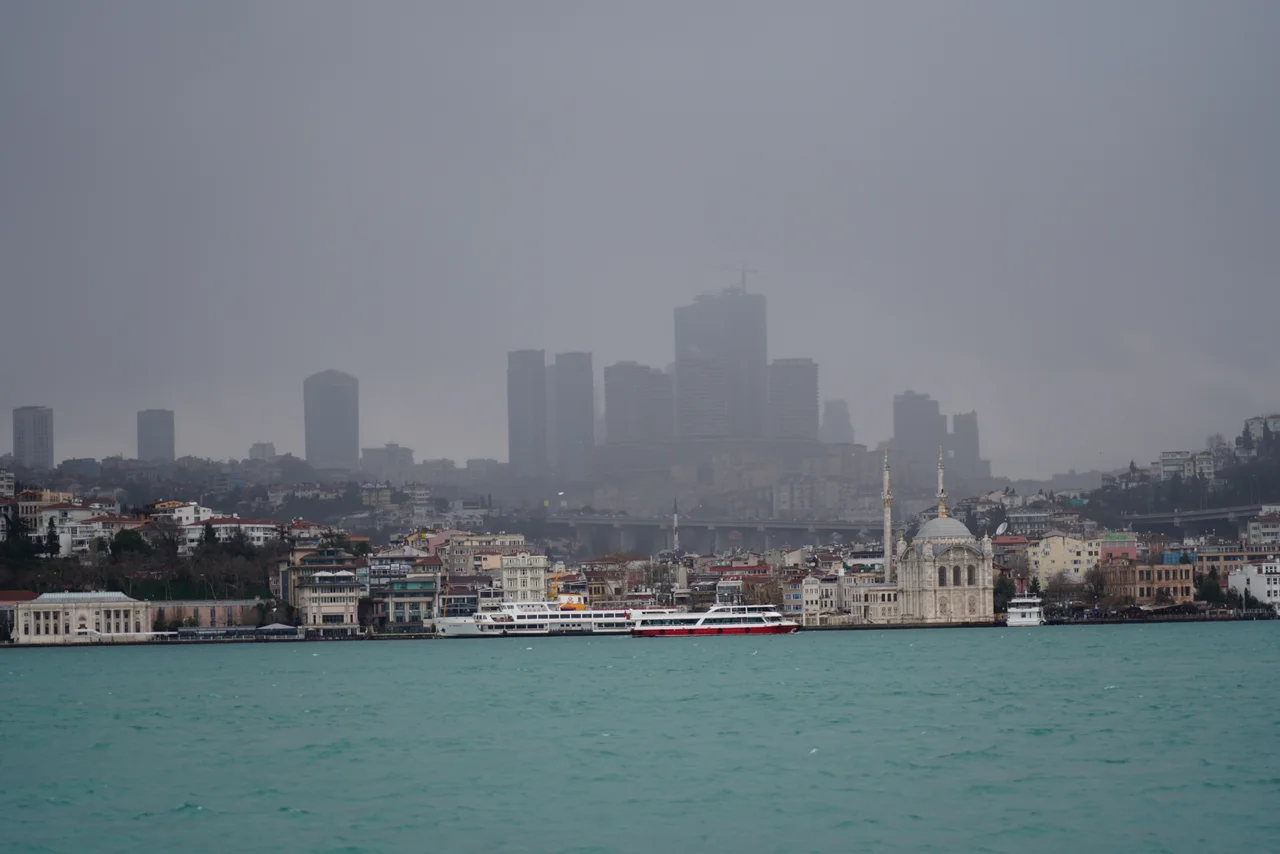

Ortaköy
The name means Middle Village, and for centuries that is exactly what Ortaköy was — a settlement in the middle of the Bosphorus shoreline, neither the city's ceremonial heart nor its distant margins. But middle does not mean unremarkable. The village of Ortaköy, tucked between the water and the hills of Beşiktaş, has been drawing outsiders for well over two centuries: a British writer who came during wartime and stayed long enough to fill a book, a German architect fleeing Nazi Germany who built himself a house on the hillside, a US president who gave a speech in its university square. The village draws them still.
The Waterfront That Has Everything
Ortaköy's defining feature is its relationship with the Bosphorus. The neighborhood sits on the European shore of the strait, at a point where the water narrows and the views across to Asia are sharp and close. The Ortaköy Mosque — formally the Büyük Mecidiye Camii, built in the neo-Baroque style by architects Garabet Amira Balyan and Nigoğayos Balyan for Sultan Abdülmecid I between 1854 and 1856 — sits right at the water's edge, its dome and minarets reflected in the strait. Just behind it, the cables of the 15 July Martyrs Bridge (the Bosphorus Bridge) sweep across the sky. The square in front of the mosque has been a gathering place for generations, and on weekends it fills with stalls, music, and the particular democratic bustle that waterfront squares in great cities seem to generate.
Exiles and Observers
During the Crimean War, the British writer Emilia Hornby rented a house in Ortaköy and recorded what she found in her 1863 book *Constantinople During the Crimean War* — one of the more vivid firsthand accounts of mid-19th-century Istanbul. Decades later, the German architect Bruno Taut arrived under very different circumstances. A prominent figure in the modernist movement and a target of Nazi cultural politics, Taut fled Germany in 1933 and eventually settled in Istanbul, where he lived in a hillside house above Ortaköy. The house combined Japanese and European architectural influences, reflecting the layered life of a man who had spent years in exile. These are not coincidences. Ortaköy, with its mix of communities and its waterfront openness, has long been the kind of place where outsiders find a way to belong.
Palaces Along the Shore
The neighborhood's proximity to the imperial palaces of the Ottoman court shaped its character for centuries. In 1871, Sultan Abdülaziz built the Çırağan Palace beside the Bosphorus between Beşiktaş and Ortaköy — a grand marble structure that served as the sultan's residence and, later, as a place of confinement for members of the imperial family. The Ottoman Parliament met there until fire gutted the building in 1910. After decades of disrepair, the palace was restored in the 1980s and reopened as the Çırağan Palace Kempinski Istanbul Hotel. Nearby, the Esma Sultan Mansion — a traditional Bosphorus waterfront residence known as a yalı, given to Princess Esma Sultan as a wedding gift by her father Sultan Abdülaziz in 1875 — was badly damaged by fire in 1975, renovated in the 1990s, and reopened as an event venue. Its fire-scarred exterior has been deliberately left unchanged.
A Village That Keeps Reinventing Itself
In 2004, George W. Bush gave a speech at Galatasaray University in Ortaköy during the NATO summit held in Istanbul — one of those moments when a neighborhood suddenly finds itself hosting the world. In 2017, Ortaköy was the scene of a devastating terrorist attack at the Reina nightclub on New Year's Eve, in which 39 people lost their lives. The club was closed and demolished in May 2017. The neighborhood carried that grief and kept going, as cities do. Galatasaray University, Kabataş Erkek Lisesi, the waterfront mosque, the weekend market, the old palace hotel — Ortaköy holds all of these at once. Its population was 9,121 as of 2024, a small number for a place that carries so much. The Middle Village keeps moving.
From the Air
Ortaköy sits at 41.055°N, 29.028°E on the European shore of the Bosphorus, immediately south of the 15 July Martyrs Bridge. From the air at 2,000–4,000 feet, the neighborhood is easy to identify by the bridge's massive European pylon and the Ortaköy Mosque's dome at the waterfront. The Çırağan Palace stretches along the shore to the south. The nearest major airport is Istanbul Airport (LTFM), approximately 25 km to the northwest. The Bosphorus strait is visible as a wide blue ribbon cutting between the European and Asian sides of the city.
Nearby Stories
- Kocaeli Peninsula 7.6 km away
- Second Battle of Çatalca 11 km away
- Istanbul's Rural Outskirts 14 km away
- MV Struma 20 km away
- HMAS AE2 36 km away
- Bursa 66 km away
- Sangarius Bridge 71 km away
- Januarius MacGahan 101 km away