
Osman Nuri Pasha
They outnumbered him more than three to one by the end. The Russian and Romanian forces encircling the Bulgarian town of Plevna in the winter of 1877 had swollen to 100,000 soldiers; Osman Nuri Pasha held the hills with 30,000. Supplies had run out. Starvation and disease had thinned the ranks. On the night of 9 December, Osman chose not to surrender but to attack — a desperate breakout through the Russian lines that came within moments of succeeding. A bullet caught him in the leg. Rumor spread through his troops that he was dead. The line collapsed. He surrendered the next day to a Romanian colonel, having lost the battle but — in the judgment of Ottoman history — won something harder to measure.
From Tokat to the Cavalry
Osman Nuri was born in 1832 in Tokat, in northern Anatolia, into the prominent Muslim Turkish Yağcıoğulları family. He entered the Ottoman army's Cavalry Arm at the start of the Crimean War, and his bravery there earned him a promotion to first lieutenant — a pattern that would repeat throughout a career defined by performance under pressure. By 1873 he had risen to lieutenant general and had served in Rumelia, Scutari, and Bosnia, building a reputation as a capable and combative commander who was sometimes difficult to work alongside. His assignment to the Vidin region in 1876 positioned him for the moment that would define his life.
The Defense of Plevna
When Russia declared war on the Ottoman Empire in April 1877 and crossed the Danube into Bulgaria, Osman was ordered to reinforce the fortress at Nikopol. He arrived too late — Nikopol had fallen on 16 July. But where another commander might have retreated, Osman saw an opportunity. He moved his army 20 miles south to Plevna, a small town surrounded by hills and ravines, and began fortifying. His troops had Krupp breech-loading artillery, long-range Peabody-Martini rifles, and Winchester repeaters — weapons that outranged the Russian infantry attacking across open ground. The first Russian assault on 20 July was repulsed easily. The second attack on 31 July cost the Russians 10,000 men. The third, in September, cost them roughly 20,000. Total Russian and Romanian losses from the beginning of the siege reached up to 50,000. The military world was watching; Plevna was making reputations.
The Siege Closes, the Breakout Fails
By October the Russian-Romanian army had fully encircled the town, cutting off supply lines. Osman asked permission to withdraw before the trap closed. It was denied. General Eduard Ivanovich Todleben — veteran of the great siege of Sevastopol — arrived to take command of the encirclement, and he was not a man who made mistakes. As December came and starvation set in, Osman made his decision: a night attack on 9 December, aimed at breaking through the Russian line. His troops nearly broke through. Then the Russians recovered. The breach closed. Romanian forces stormed the rear defenses, cutting off retreat to Plevna. Osman, wounded in the leg, fell from his horse; panic spread at the rumor of his death. He surrendered the next morning to Colonel Mihail Cerchez. The Siege of Plevna was over — five months after it began.
Hero in Defeat, Marshal of the Palace
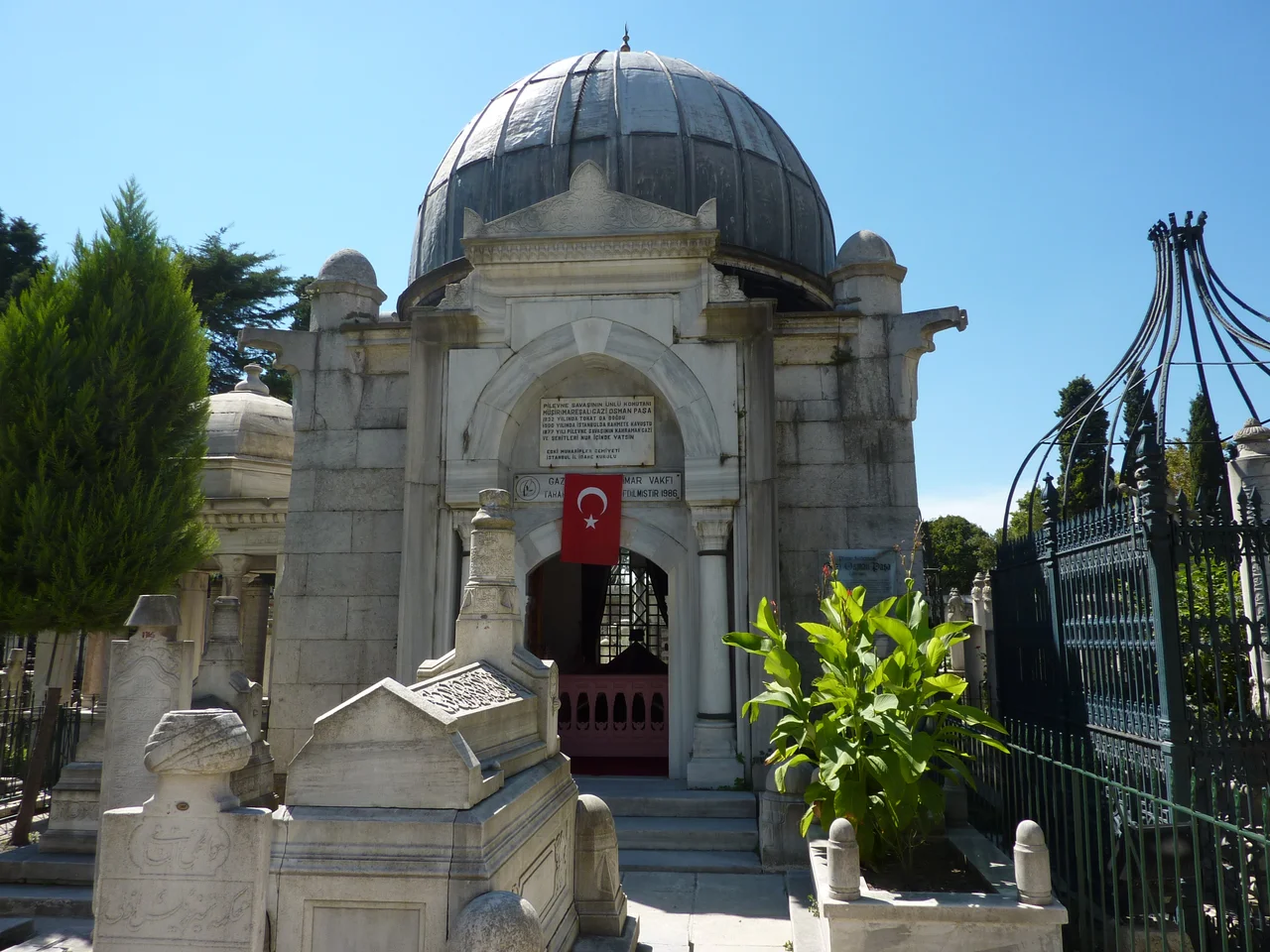
Osman Nuri Pasha returned from Russian captivity in 1878, after the Treaty of Berlin settled the war. Constantinople received him as a hero. Sultan Abdülhamid II promoted him to Field Marshal and awarded him the title *Gazi* — warrior, victor — along with the Order of the Medjidiye in Gold and the Imtiyaz Medal. He became Marshal of the Palace. The Ottoman military march composed in his honor, the *Plevna March*, is still used by the Turkish armed forces today. He served as War Minister on four occasions in the years that followed. When he died in Constantinople on the night of 4 to 5 April 1900, he was buried next to the Mosque of Fatih Sultan Mehmet at his own request, his tomb commissioned personally by the sultan. The flag draped over his tomb was still being renewed a century later. Turkey remembers him as a figure of gallant perseverance in the face of impossible odds — not despite the defeat at Plevna, but because of how he bore it.
From the Air
Osman Nuri Pasha's life was centered on Constantinople (Istanbul), where he served and died. His tomb stands near the Fatih Mosque in the Fatih district at approximately 41.019°N, 28.950°E. From the air at 3,000–5,000 feet, the Fatih district is visible on the historic peninsula between the Golden Horn and the Sea of Marmara. The nearest major airport is Istanbul Airport (LTFM), approximately 35 km to the northwest. The city he defended from foreign powers for decades spreads across both sides of the Bosphorus below.
Nearby Stories
- Kocaeli Peninsula 7.6 km away
- Second Battle of Çatalca 11 km away
- Istanbul's Rural Outskirts 14 km away
- MV Struma 20 km away
- HMAS AE2 36 km away
- Bursa 66 km away
- Sangarius Bridge 71 km away
- Januarius MacGahan 101 km away