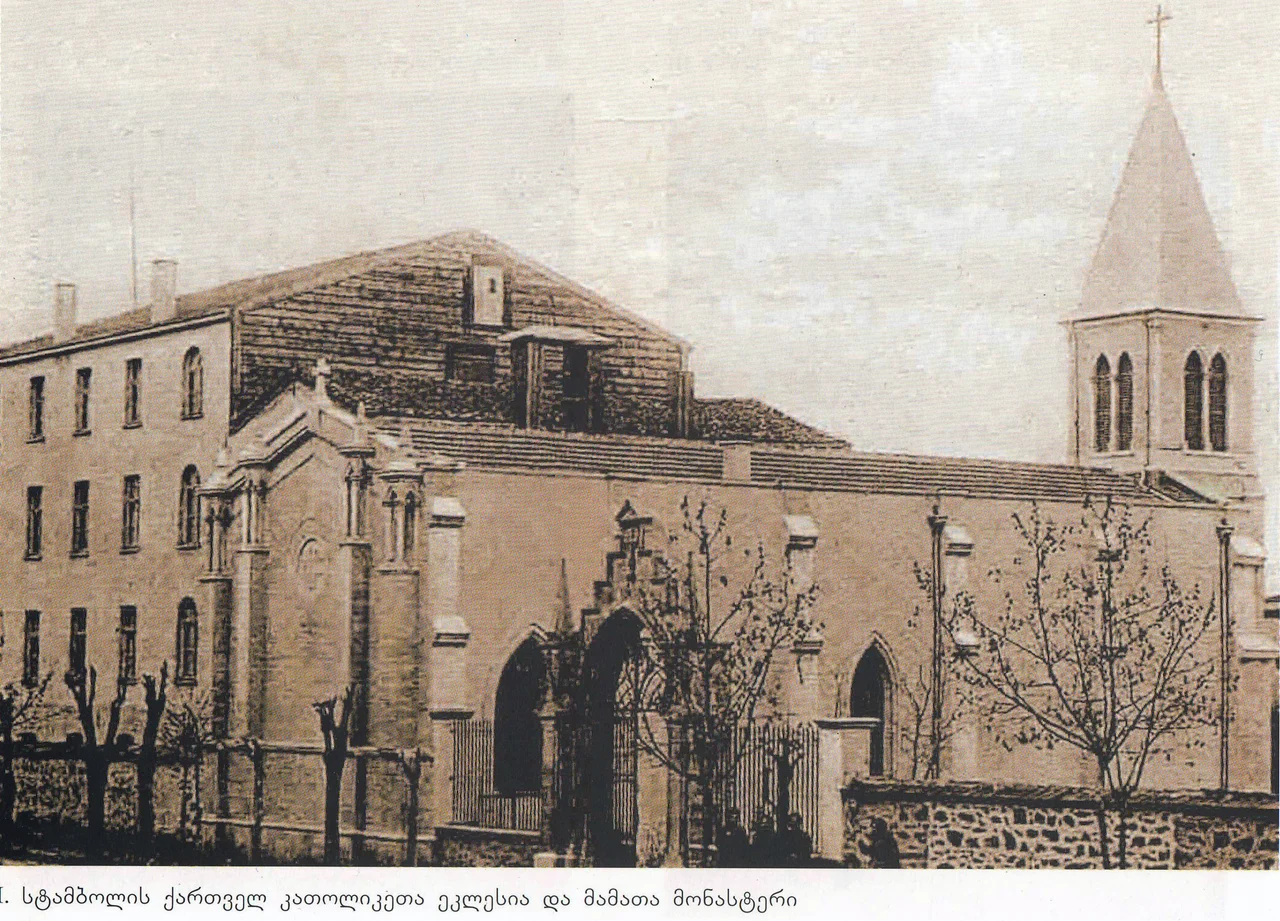

Our Lady of Lourdes Church, Istanbul
Peter Kharischirashvili arrived in Istanbul in the mid-nineteenth century with a specific liturgical mission: he wanted to give Catholics who prayed in the Georgian language a place to do so without abandoning either their faith or their tongue. In 1861, he built the Church of Our Lady of Lourdes in the Bomonti neighborhood of Şişli, founding alongside it two monasteries — one for men, one for women. It was an act of quiet determination, and the community it created has endured, in diminished but unbroken form, for more than 160 years.
A Rite Waiting for Approval
From its founding, the church operated under the Georgian Byzantine rite — a tradition rooted in the ancient liturgical heritage of the Caucasus, distinct from both the Roman rite of Western Catholicism and the Greek-derived rites of Eastern Orthodoxy. Kharischirashvili and his congregation practiced this rite from the beginning, but Rome did not formally recognize it until 1875, fourteen years after the church's construction. The delay was not unusual for the era; the Vatican's relationship with Eastern Catholic communities was often slow-moving and complicated. What is notable is that the congregation did not wait for approval to begin. They built their church, founded their monasteries, and worshipped in Georgian — and the pope eventually caught up.
Ten Thousand Georgian Catholics
By the 1950s, a substantial Georgian Catholic community had taken root in Istanbul. At its height, the community numbered up to 10,000 ethnic Georgians of the Catholic faith living in the city — a presence large enough to support not just the church in Bomonti but an entire social world organized around shared language, liturgy, and origin. Istanbul had long been a city where minority communities maintained separate institutions: Greek Orthodox, Armenian Apostolic, Jewish, and Catholic congregations each occupied distinct neighborhoods and ran their own schools and charities. The Georgian Catholic community was smaller than most of these, but no less rooted.
The Pogrom of 1955
On September 6 and 7, 1955, coordinated mob violence erupted across Istanbul, targeting Greek, Armenian, and Jewish communities and their property. The events became known as the Istanbul pogrom. Shops were destroyed, churches were damaged, cemeteries were desecrated, and thousands of people who had lived in the city for generations fled in the aftermath. The pogrom occurred during the government of Prime Minister Adnan Menderes and represented one of the most violent episodes in modern Turkish history directed against the city's non-Muslim minorities. The Georgian Catholic community, though not the primary target, was part of the broader Christian population that felt the violence's chill. Many Georgians and other Christians emigrated from Turkey in the years that followed, and the community around Our Lady of Lourdes contracted sharply.
What Remains
The church is still open. That fact alone is remarkable given what the community has endured. Today the Georgian-Catholic congregation numbers only 200 to 250 people — a fraction of its mid-century peak. As the number of ethnic Georgian Catholics in Istanbul has declined, the parish has gradually broadened: a significant portion of today's worshippers are ethnic Armenians and ethnic Turks who have converted to Catholicism. The congregation has, in a sense, become a community of communities. What unites them is not a common ethnic heritage but a specific rite, a specific building, and the continuity of a liturgical tradition that Kharischirashvili planted here in the final decade of the Ottoman Empire's reform era. Our Lady of Lourdes remains one of the only Georgian Byzantine-rite parishes in the world still in regular use.
From the Air
The Church of Our Lady of Lourdes stands in the Bomonti neighborhood at approximately 41.059°N, 28.983°E, on the European side of Istanbul. From the air at 2,500 feet, Bomonti appears as a residential and light-commercial district north of the historic peninsula, between the Bosphorus shoreline and the ridge running inland toward Şişli. Istanbul Airport (LTFM) lies roughly 30 km to the northwest. The church is not visible from altitude, but the surrounding urban fabric of Şişli — densely built, with few open spaces — gives a sense of the tight-knit neighborhood context in which minority communities like this one survived for more than a century.
Nearby Stories
- Kocaeli Peninsula 7.6 km away
- Second Battle of Çatalca 11 km away
- Istanbul's Rural Outskirts 14 km away
- MV Struma 20 km away
- HMAS AE2 36 km away
- Bursa 66 km away
- Sangarius Bridge 71 km away
- Januarius MacGahan 101 km away