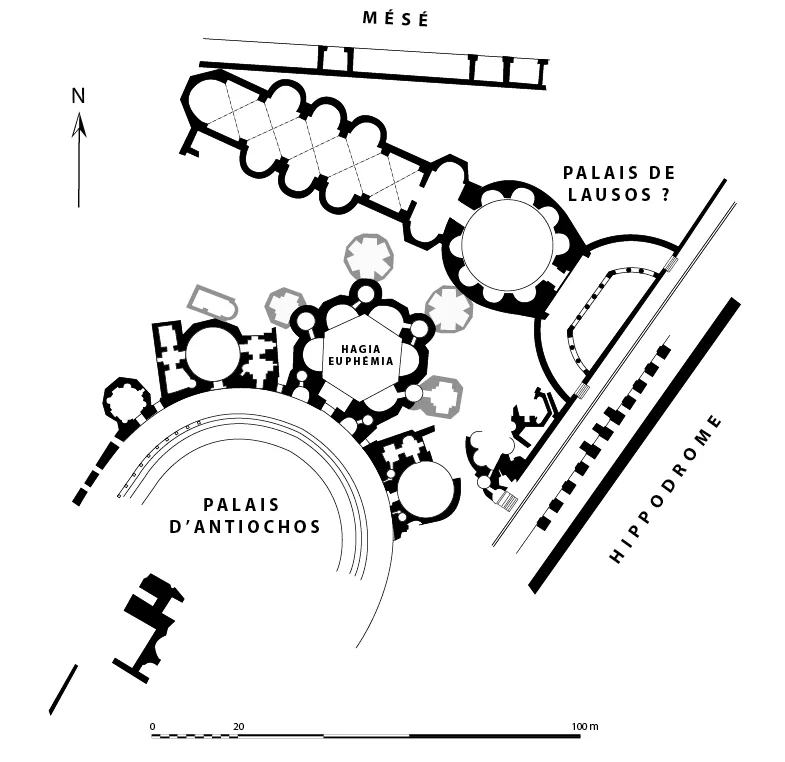

Palace of Antiochos
Somewhere beneath a hotel dining room near the old Hippodrome of Constantinople, behind a glass floor that diners walk across without giving it much thought, lie the frescoed walls of a church that witnessed fourteen centuries of Byzantine history. The church grew from a palace. The palace belonged to a man named Antiochos — a eunuch of Persian origin who tutored a child emperor, rose to one of the highest offices in the Byzantine state, fell from grace through the scheming of an imperial princess, and ended his career in a monastery. The stones that housed his ambition have outlasted empires.
The Man Behind the Walls
Antiochos was a cubicularius — a chamberlain — at the court of Theodosius II, who became emperor in 402 at the age of seven. As tutor to the young emperor, Antiochos occupied a position of intimate influence: he shaped the education and daily life of the man who would rule the Eastern Roman Empire for nearly half a century. He rose eventually to the rank of praepositus sacri cubiculi, the chief of the imperial bedchamber, and was granted the title of patricius. His dominance over the young Theodosius proved his undoing. Pulcheria, the emperor's formidable elder sister, moved against him. The exact date of his fall is disputed, but he was forced out of his position and relegated to his palace — allowed to remain in the city, active in its politics, until a final disgrace around 439 sent him into the clergy. His property, including the palace, was then confiscated by the emperor.
Architecture of Power
The palace Antiochos built for himself was substantial. Excavations carried out in 1942 by Alfons Maria Schneider and again in 1951 and 1952 by R. Duyuran uncovered its footprint: a hexagonal hall opening onto a semicircular portico, a large rotunda of 20 meters in diameter that served as an audience hall, a C-shaped portico facing the Hippodrome street, and a small bathhouse accessible from outside. The site had been noticed earlier — in 1939, workers discovered frescoes depicting the life of Saint Euphemia — but it was a column base bearing the inscription "of the praepositus Antiochos" that confirmed the identification. Brick stamps from the site suggest the palace was not built before 430, placing its construction near the end of Antiochos's influence rather than at its height. A later 52.5-meter-long hall with six apses on each side was added in the 6th century, during the palace's time as imperial property.
From Palace to Martyrium
At some point in the 7th century, the hexagonal hall at the heart of the complex was converted into a church dedicated to Saint Euphemia — specifically designated a martyrion, a shrine built to house the remains or memory of a Christian martyr. The western chapel received frescoes depicting her martyrdom, and the sanctuary was given a canopy dome. Modifications to the original structure were pragmatic but substantial: the bema was repositioned, new entrances were opened, and two mausolea were eventually attached to the northern circular rooms. A marble pool that had sat at the center of the hall — a feature common in Late Antique domestic architecture — remained in place within the reorganized sacred space. The altar foundation, chancel barrier, synthronon, and solea uncovered by excavators show the church as a fully equipped Byzantine liturgical space.
Iconoclasm, Relics, and Rescue
During the Byzantine Iconoclasm — the prolonged theological and political conflict over religious images that convulsed the empire in the 8th and 9th centuries — the Church of Saint Euphemia was secularized and reportedly converted into a storehouse for arms and manure. The bones of the saint were ordered thrown into the sea, according to tradition at the command of Emperor Leo III the Isaurian (ruled 717–741) or his son Constantine V (741–775). They did not disappear. Two unnamed brothers, described as pious, rescued the relics and carried them to the island of Lemnos. In 796, after the first Iconoclasm period ended at the Second Council of Nicaea, Empress Eirene brought the relics back to Constantinople and restored the church. It was redecorated in the late 13th century with frescoes in the Palaiologan style, fourteen of them forming a cycle depicting the life and martyrdom of the saint, along with a unique depiction of the martyrdom of the Forty Martyrs of Sebaste.
Ruins Under Glass
The church survived until the end of the Byzantine Empire, its final artistic campaign completed in a period when the empire was already a shadow of its former self. Today, the site sits beneath a hotel that was constructed over the ruins. Some traces of the palace remain visible through a glass floor in the dining room — a peculiar form of preservation that allows breakfast guests to peer into fifteen hundred years of layered history without quite confronting it. The frescoes from the late 13th century survive on the southwestern wall, viewable behind protective glass. The palace of a disgraced chamberlain, transformed into the shrine of a Christian martyr, survives as a curiosity beneath a floor that few visitors stop to examine closely.
From the Air
The Palace of Antiochos site lies at approximately 41.007°N, 28.975°E, just west of the Hippodrome of Constantinople in the historic Sultanahmet district of Istanbul. From the air at 3,000 feet, the Hippodrome — now Sultan Ahmet Square — is identifiable by the surviving obelisks and the open plaza framed by the Blue Mosque to the south. The palace ruins are embedded in the dense urban fabric directly northwest of the square. Istanbul Airport (LTFM) is located approximately 40 km to the northwest; on final approach over the European side of the city, the historic peninsula with its cluster of domes and minarets is visible on the right.
Nearby Stories
- Kocaeli Peninsula 7.6 km away
- Second Battle of Çatalca 11 km away
- Istanbul's Rural Outskirts 14 km away
- MV Struma 20 km away
- HMAS AE2 36 km away
- Bursa 66 km away
- Sangarius Bridge 71 km away
- Januarius MacGahan 101 km away