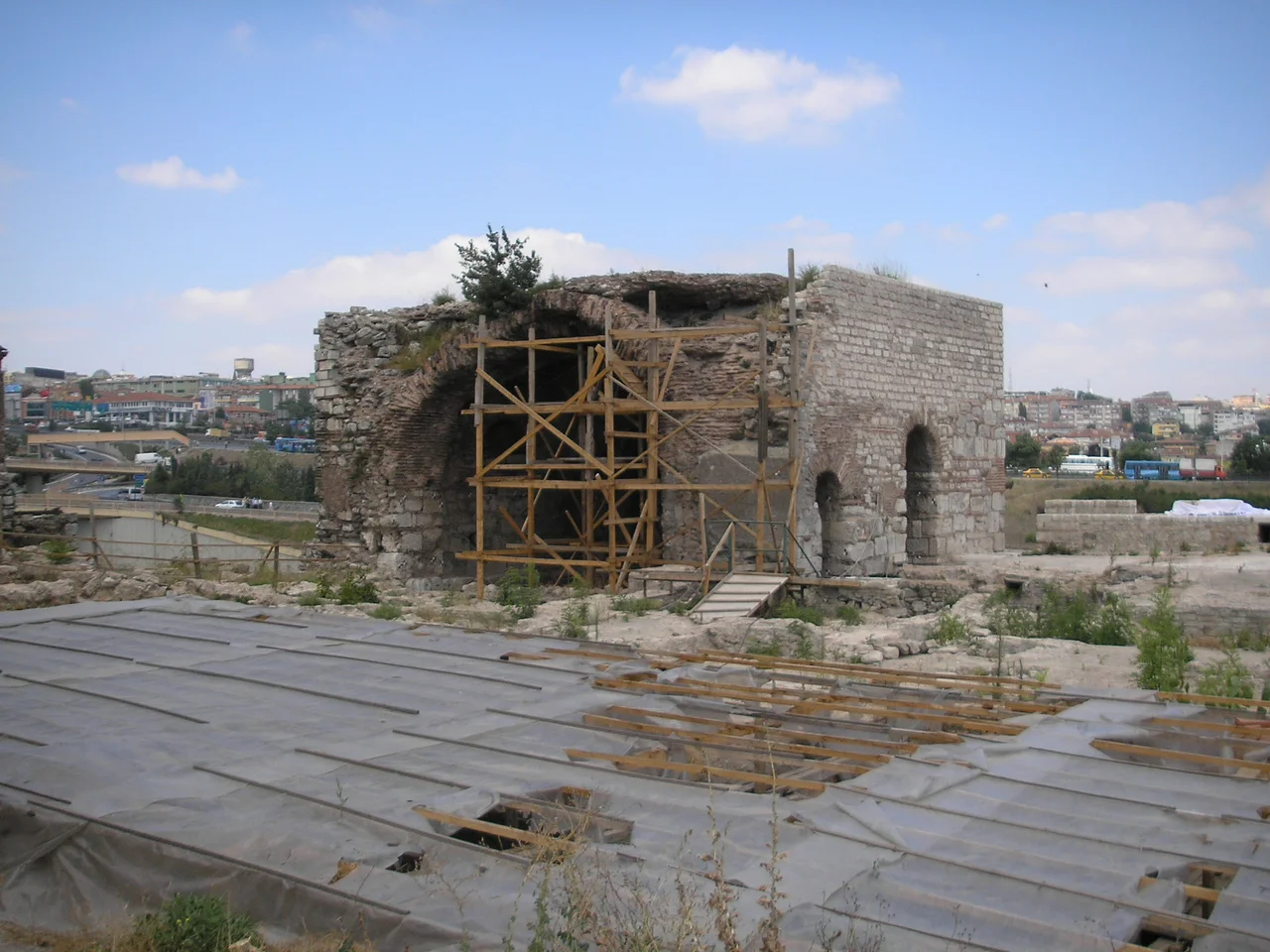

Palace of Blachernae
The palace stood at the end of the world — or at least at the end of the empire, pressed into the northwestern corner where Constantinople's massive land walls met the shore. When the Byzantine emperors abandoned their ancient seat at the Great Palace on the Bosphorus and moved their court here in the late 12th century, they were not simply changing addresses. They were reorganizing an empire around a new center, and the complex at Blachernae became the political heart of Byzantium's final two centuries. Today only fragments survive. The rest is buried under the streets and apartment blocks of a modern Istanbul neighborhood, and the palace exists mainly in the pages of Byzantine ceremonial manuals and the chronicles of visitors who stood inside its halls.
From Hillside to Imperial Seat
Construction on the northern slopes of the city's Sixth Hill began around 500, early enough that the Blachernae complex predates the better-known Great Palace by more than a generation in its initial form. The hill was partially remodeled over the centuries, with terraces cut into the slope to support the accumulated weight of buildings added by successive emperors. For most of Byzantine history, Blachernae was a secondary residence — used for ceremonies and visits, documented in the elaborate protocols of Constantine VII Porphyrogenitos's 10th-century De Ceremoniis, but not the primary seat of imperial power. That role belonged to the Great Palace at the city's eastern tip. The structures described by Constantine VII included the hall of Anastasius, the hall of the Ocean, the portico of Joseph, and the hall of the Danube, the last of which connected through a series of staircases to the nearby Church of St. Mary of Blachernae.
The New Palace
In the 12th century, the Blachernae complex underwent a dramatic expansion. Emperor Manuel I Komnenos added splendid new halls, among them the Hall of Irene — named for his mother Empress Irene of Hungary — and the Polytimos Oikos, which translates roughly as the Precious Hall. The complex became known as the New Palace and, by that point, had effectively displaced the Great Palace as the heart of court life. Its elevated position at the landward corner of the city gave it a strategic vantage the older eastern palace lacked. During the Second Crusade, it was here that Manuel welcomed Louis VII of France and his queen, Eleanor of Aquitaine. The palace by then embodied the empire's peculiar position: simultaneously the most powerful Christian state in the medieval east and increasingly hemmed in by threats from every direction.
Crusaders and Reclamation
The Fourth Crusade in 1204 ended the Byzantine Empire's continuous tenure in Constantinople. Latin crusaders sacked the city and established a Latin Empire in its place, and the Latin emperors chose the Bucoleon Palace on the Marmara shore as their residence, leaving Blachernae to decline. When the Byzantines recaptured Constantinople in 1261 under Michael VIII Palaiologos, the Blachernae complex was restored as the principal imperial residence. The Palaiologan dynasty — the last emperors of Byzantium — lived and ruled here for the next two centuries, which is why the nearby Palace of the Porphyrogenitus, dating to the late 13th century, is associated with the Blachernae complex even though it stands slightly to the south. It is the only relatively intact example of Byzantine palace architecture remaining in the city.
The Fall
On May 29, 1453, Ottoman forces under Sultan Mehmed II broke through Constantinople's walls and the city fell after a siege of 53 days. The Palace of Blachernae, along with the rest of the city's rich houses, was pillaged during three days of looting that followed. The Ottoman official Tursun Beg recorded the scene: soldiers took silver and gold vessels, precious stones, fabrics, and people — enslaving boys and girls from the imperial palace and the houses of the wealthy. Every tent was filled with captives, he wrote. The palace that had stood as the center of Christian imperial power was stripped bare. Its inhabitants were enslaved. What the walls had protected for nearly a thousand years was gone in three days.
What Time Left Behind
Almost nothing of the main Blachernae complex stands above ground today. The area is overbuilt — residential streets and modern structures cover the terraced hillside where emperors once received foreign kings. Only literary sources survive as evidence of what the palace looked like in its prime: the De Ceremoniis, the chronicles of crusader visitors, the accounts of Byzantine court historians. One exception is the so-called Prison of Anemas, a fortified substructure that formed part of the palace complex and whose walls still rise in the Ayvansaray neighborhood of Fatih. The Prison of Anemas is a ruin, not a destination, but it is tangible — stone and mortar that once belonged to the last great seat of Byzantine power. It is enough to know the complex was real.
From the Air
The Palace of Blachernae stood at approximately 41.034°N, 28.940°E, in the Ayvansaray quarter of Fatih, Istanbul. From the air at 3,000 feet, the position is identifiable where the ancient land walls — still visible as a long green corridor of ruins running north-south through the city — reach the Golden Horn waterway. The palace complex occupied the northwestern corner of this junction. Istanbul Airport (LTFM) lies roughly 30 km to the northwest. Approaching from the north over the European side, the Golden Horn is the narrow inlet cutting east from the Bosphorus; the wall corridor runs south from its uppermost point, and Blachernae's former site is at that intersection.
Nearby Stories
- Kocaeli Peninsula 7.6 km away
- Second Battle of Çatalca 11 km away
- Istanbul's Rural Outskirts 14 km away
- MV Struma 20 km away
- HMAS AE2 36 km away
- Bursa 66 km away
- Sangarius Bridge 71 km away
- Januarius MacGahan 101 km away