
Palace of Lausus
Sometime around 420 CE, a eunuch named Lausus rose to the rank of imperial chamberlain in the court of Theodosius II in Constantinople. He was charitable, by the bishop of Caesarea's account, and also very wealthy. He was reportedly a devout Christian. And yet he quietly became the custodian of the pagan world's most extraordinary art collection — including, by all surviving accounts, the original Statue of Zeus at Olympia.
A Devout Man's Pagan Museum
The contradiction at the heart of Lausus's collection is part of what makes it so remarkable. As the empire's Christian emperors ordered pagan temples stripped and emptied across the eastern provinces, Lausus acquired the spoils — not out of religious devotion to the old gods, but on purely aesthetic and historical grounds. His was the first collection in Constantinople's history assembled for beauty and historical significance alone, not for cult worship. The philosopher's detachment of the connoisseur, rather than the believer's reverence, governed how he arranged his statues. Lausus was a new kind of person: the secular collector, centuries before the type became commonplace.
The Wonders Gathered Under One Roof
What Lausus assembled inside his palace near the Hippodrome was staggering. At the far end of the great hall stood the Statue of Zeus at Olympia, carved by Phidias around 430 BCE — one of the Seven Wonders of the Ancient World, a colossal ivory-and-gold throne figure that ancient writers claimed to have been so overwhelming that the sight of it alone could lift a viewer's despair. Flanking Zeus were statues of Eros and Kairos. Elsewhere in the hall stood Praxiteles' Aphrodite of Cnidus — the first full female nude in Greek sculpture, so famous in antiquity that pilgrims reportedly sailed to the island of Knidos just to see it. Lausus also owned the Hera of Samos and the Athena of Lindos. One wall was devoted to goddesses; another to animals. The arrangement was deliberate, even curatorial — a gallery, not a warehouse.
The Fire That Erased Everything
Lausus died around 436, and the palace passed on without him. He would not live to see what happened to his collection. In 475, a great fire swept through Constantinople, and the Palace of Lausus burned with it. The Byzantine chroniclers Zonaras and Cedrenus both record the destruction. Everything inside was lost — the Zeus, the Aphrodite, the Hera, all of it, gone in an afternoon. No fragments survive. No detailed descriptions precise enough to reconstruct their appearance. The works had already survived roughly nine centuries from their creation to their arrival in Constantinople; the fire erased what centuries of religious change had not.
What Remains
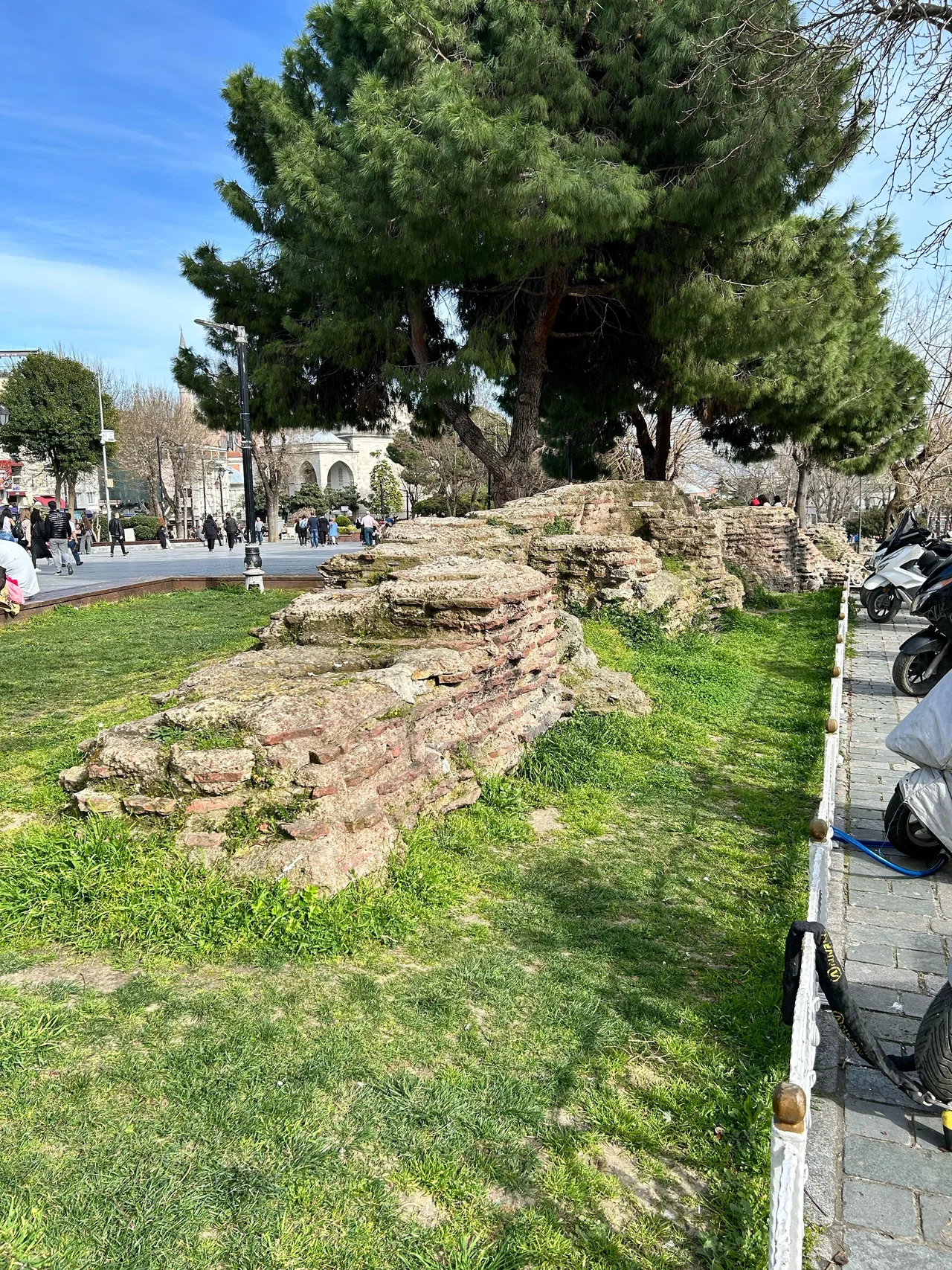
The site is not entirely without a trace. Beneath the spot where the Palace of Lausus is believed to have stood lies the Cistern of Philoxenos, one of Constantinople's many underground water cisterns that survive to this day. The ruins of the adjacent Palace of Antiochos still occupy part of the area, and the rubble of a rotunda that once connected the Palace of Lausus to the Hippodrome remains in place. These fragments of stone do not conjure the works that burned. But they locate the loss — they tell you where the Zeus once stood, in a city that no longer has it.
From the Air
The Palace of Lausus stood at approximately 41.0078°N, 28.9754°E, in the heart of historic Constantinople near the Hippodrome, now in the Sultanahmet district of Istanbul. From the air at 3,000 to 5,000 feet, the dense historic peninsula is clearly visible, with the Hagia Sophia dome and Blue Mosque minarets serving as unmistakable reference points. The Hippodrome (now Sultanahmet Square) lies immediately to the southwest of the palace site. Nearest major airport: Istanbul Airport (LTFM), approximately 35 km to the northwest. Visibility is typically excellent over the old city on clear days, with the Bosphorus Strait providing a strong geographic anchor to the east.
Nearby Stories
- Kocaeli Peninsula 7.6 km away
- Second Battle of Çatalca 11 km away
- Istanbul's Rural Outskirts 14 km away
- MV Struma 20 km away
- HMAS AE2 36 km away
- Bursa 66 km away
- Sangarius Bridge 71 km away
- Januarius MacGahan 101 km away