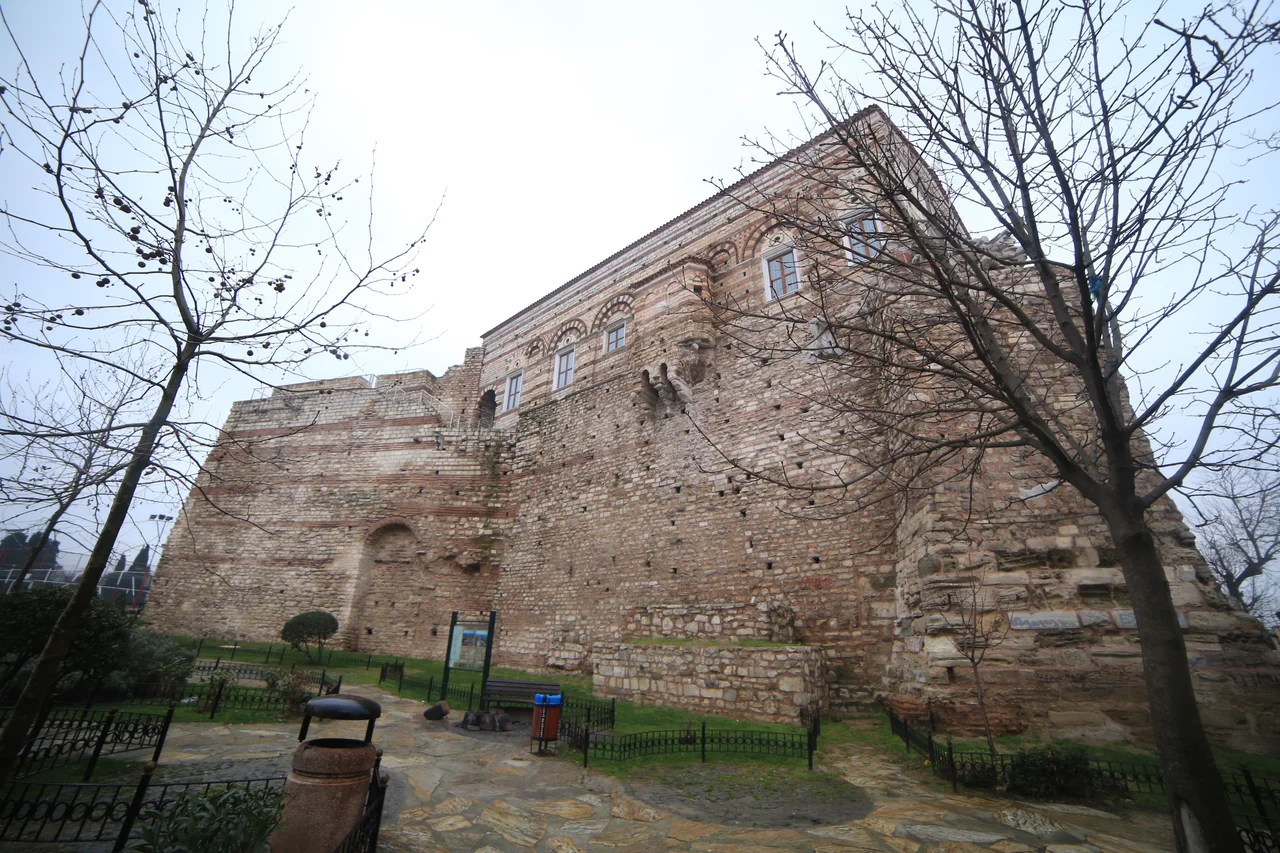

Palace of the Porphyrogenitus
Near the spot where the Theodosian Walls bend northward to meet the sea, a three-story palace stands largely intact — its red brick and white marble facade still patterned in the geometric diamonds and interlocking arches of the late Byzantine style. Most Byzantine buildings in Istanbul survive only as ruins or have been so thoroughly transformed by later centuries that the original is barely detectable. Tekfur Sarayı, the Palace of the Porphyrogenitus, is different. The shell is remarkably complete. Stand in its courtyard and look up, and what you see is the 13th century.
Born to the Purple
The palace's name carries a meaning that once defined imperial succession. Porphyrogenitus — literally 'born to the purple' — was the title given to a child born to a reigning emperor, so called because the imperial birthing chamber was lined with porphyry, the deep purple-red stone reserved for royalty. The name belongs not to the famous 10th-century scholar-emperor Constantine VII, as it might seem, but to Constantine Palaiologos, a son of Michael VIII Palaiologos, during whose dynasty the palace was built in the late 13th or early 14th century. When a Porphyrogenitus was born, the emperor would display the infant heir from the palace balcony and proclaim the child 'Caesar Orbi' — ruler of the world. That balcony still exists, projecting from the east face of the building.
A Palace of Waiting Emperors
Almost by accident, Tekfur Sarayı became a staging ground for Byzantine power transitions. Andronicus III lived there while his grandfather resisted abdicating the throne. During the civil war of 1341 to 1347, John VI Kantakouzenos lodged in the palace while negotiating his regency of John V Palaiologos with Empress Anna of Savoy. When that arrangement collapsed into yet another civil war, John V himself moved into the palace to organize his rival's removal. Three emperors, three moments of contested succession — all channeled through the same rooms. The palace served as an imperial residence right up to the Ottoman conquest of 1453.
Six Centuries of Second Lives
After the fall of Constantinople, the palace's story grew stranger. In the 16th and 17th centuries it housed part of the Sultan's menagerie — exotic animals occupying rooms where Byzantine emperors once held audience. The animals were eventually moved, and the building became a brothel. Then, in 1719, it was reinvented as a pottery workshop, the Tekfur Sarayı kilns producing ceramic tiles that blended the patterns of İznik ware with European color and design. Five kilns operated for roughly a century before the workshop closed. By the early 19th century the palace had become a poorhouse for Istanbul's Jewish community. The early 20th century brought a brief stint as a bottle factory before the building was abandoned entirely, its roof open to the sky.
Red Brick and Restoration
What survived the centuries of neglect and repurposing was the outer fabric: the elaborate brick-and-marble facade with its repeated geometric patterns, the ground-floor four-arched arcade opening onto the courtyard, and the upper-story windows that give the building its characteristic vertical rhythm. Restoration work began in earnest in 2010. A new roof was installed during the restoration, and in 2019 the palace opened as a museum. The courtyard, now floored and occasionally used for concerts, is enclosed by walls that still bear the original patterned stonework. Displayed inside are examples of the pottery produced here during the 18th century — a quiet reminder of the building's industrial chapter, tucked inside what was once a place of dynastic ceremony.
From the Air
The Palace of the Porphyrogenitus sits at 41.0339°N, 28.9403°E, in the Ayvansaray neighborhood of the Fatih district, pressed against the northwestern corner of the Theodosian land walls. From the air at 3,000 to 5,000 feet, the great sweep of the Theodosian Walls is visible running north-south across the old city's western edge, with the palace appearing where the walls turn toward the Golden Horn. The Golden Horn estuary is a strong visual anchor to the east. Nearest major airport: Istanbul Airport (LTFM), approximately 30 km to the northwest. The area is often hazy in summer; autumn and spring offer clearest views.
Nearby Stories
- Kocaeli Peninsula 7.6 km away
- Second Battle of Çatalca 11 km away
- Istanbul's Rural Outskirts 14 km away
- MV Struma 20 km away
- HMAS AE2 36 km away
- Bursa 66 km away
- Sangarius Bridge 71 km away
- Januarius MacGahan 101 km away