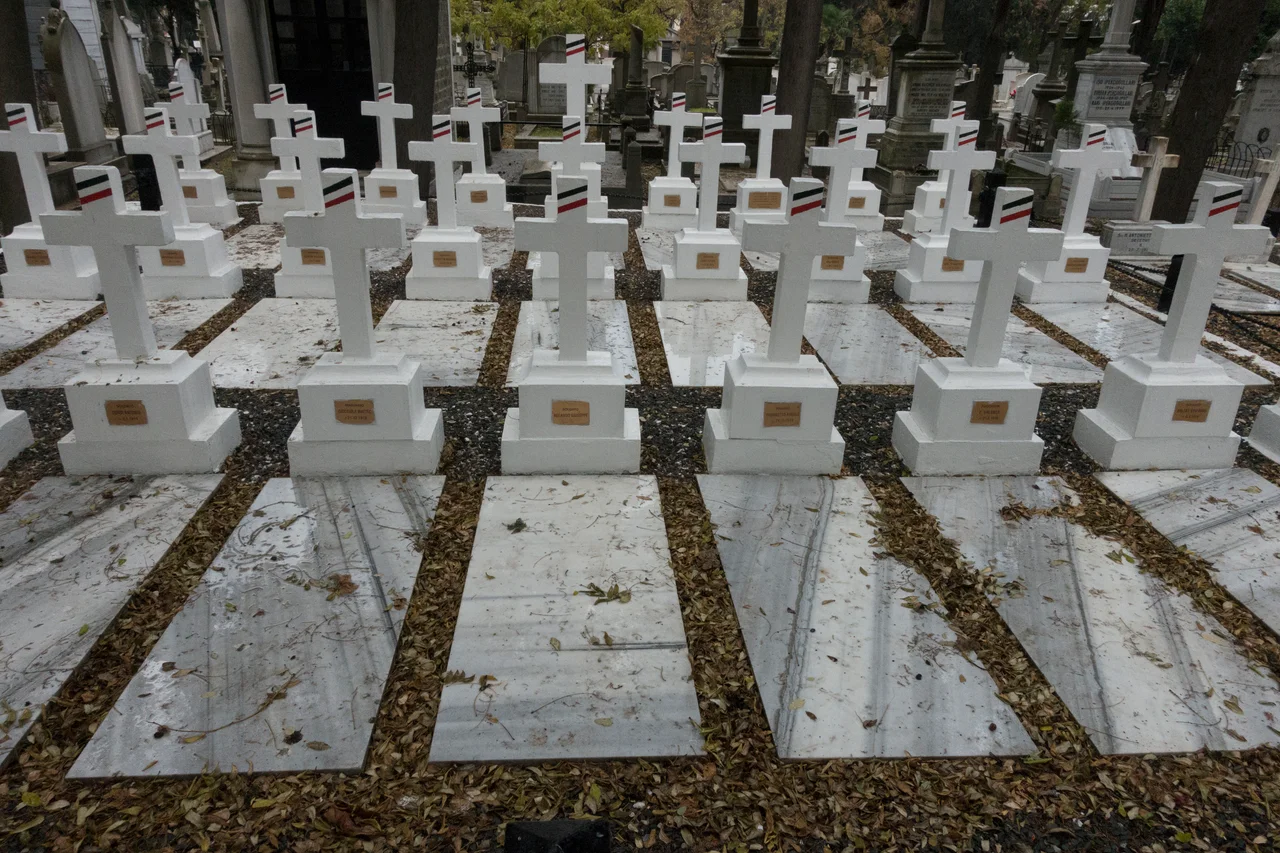

Pangaltı Catholic Cemetery
The dead in Feriköy were moved twice. First they were buried in the Grand Champs des Morts, the great Frankish cemetery at Pera that stretched across what is now some of Istanbul's most densely inhabited streets. Then, as the city expanded northward from Taksim toward Şişli in the mid-nineteenth century, the Ottoman government decided the land was needed for the living. Between 1863 and 1864, remains were exhumed and transferred — together with their grave markers — to a new site near the Imperial War Academy in the Feriköy neighborhood of Şişli. The Pangaltı Catholic Cemetery has stood here ever since, the city pressing close on every side, a quiet enclosure just three kilometers north of Taksim Square where the cosmopolitan world of Ottoman-era Istanbul has outlasted the empire that made it.
A City of the Dead, Displaced
The cemetery's origins are inseparable from the story of urban change. By 1853, the Ottoman government had concluded that the Frankish burial ground at Pera — part of the ancient Grand Champs des Morts — was no longer fit for use, and a first parcel of land was set aside near the Imperial War Academy in Pangaltı for Istanbul's Protestant and Catholic communities together. Four years later that proved insufficient. Sultan Abdülmecid I issued a second grant in 1857, and the site at Feriköy took its current form.
The ossuary here was built from reclaimed gravestones salvaged from the old Petits-Champs and Grand Champs cemeteries at Pera in the 1850s — stones that had nowhere else to go once the city swallowed their original resting places. It is a monument assembled from other monuments, a second life given to the markers of a first. Immediately across Abide-i Hürriyet Avenue, the Feriköy Protestant Cemetery stands as a close neighbor, the two communities of Istanbul's non-Muslim faithful separated by a street, as they often were in life.
The Levantine Dead
Walk among the headstones and the names tell the story of Istanbul's once-thriving communities of European descent and Eastern-rite Christians. The Levantines — those Catholic families of Italian, French, Spanish, and mixed Ottoman heritage who had lived in Pera for centuries — are the most represented, their monuments ranging from modest carved stones to elaborate family mausoleums in weathered stone. Beside them stand the markers of Greek Catholics, Armenian Catholics, Syriac Catholics, Chaldeans, and Melkites: a gathering of Eastern churches that would have been impossible to find in any single location in their home regions.
These were real families with children, professions, and loyalties that ran simultaneously toward Rome and toward Constantinople. Their deaths, like their lives, did not fit neatly into the categories that later history would impose on them. The cemetery preserves that complexity in stone.
Soldiers of the Crimea
Several monuments in the cemetery honor the French and Italian soldiers who died during the Crimean War of 1853 to 1856 — men who came to fight alongside the Ottoman Empire against Russia and who never made it home. The war ended with an Allied victory, but the cost was enormous, and Istanbul was a staging ground for much of the Allied effort. Thousands of soldiers passed through the city; some were buried here when they died of wounds or disease before reaching home.
These military graves add a different dimension to a cemetery that is otherwise primarily a community burial ground. They are a reminder that the Feriköy site received its first European dead at precisely the moment of its founding: the Crimean War and the establishment of the new cemetery overlapped almost exactly, and the conflict shaped who was available to fill it.
What Remains
Most of the communities buried here no longer exist in Istanbul in any significant numbers. The Levantine families who once animated the diplomatic and commercial life of Pera dispersed over the twentieth century — departing in waves that corresponded to the upheavals of two world wars, the population exchanges of 1923, and the ongoing pressures that made minority life in the city increasingly difficult. The congregations that maintained these Eastern-rite churches shrank. The languages spoken at family graves shifted.
The cemetery itself persists. Its chapel stands. Cats move among the grave markers, as they do throughout Istanbul. In winter snow, the old family mausoleums sit in silence. The ossuary, built from the recycled stones of one displaced cemetery, is itself now a historic artifact of the displaced world it was meant to serve. Coming here is an act of attention to people and communities who were once the fabric of this city and who are mostly, now, gone.
From the Air
Pangaltı Catholic Cemetery sits at approximately 41.053°N, 28.985°E in the Feriköy neighborhood of Şişli, on Istanbul's European side. Approaching from Istanbul Airport (LTFM) to the northwest, descend toward 3,000 feet and follow the European shoreline of the Bosphorus southward. The Şişli district's denser mid-city blocks are visible inland from the Bosphorus; the cemetery occupies a green rectangle within that urban fabric about 3 kilometers north of the unmistakable open expanse of Taksim Square. The Abide-i Hürriyet Avenue runs alongside. At low altitude in clear weather, the contrast between the cemetery's tree canopy and the surrounding rooftops is visible. The sister Protestant cemetery lies immediately adjacent across the avenue.
Nearby Stories
- Kocaeli Peninsula 7.6 km away
- Second Battle of Çatalca 11 km away
- Istanbul's Rural Outskirts 14 km away
- MV Struma 20 km away
- HMAS AE2 36 km away
- Bursa 66 km away
- Sangarius Bridge 71 km away
- Januarius MacGahan 101 km away