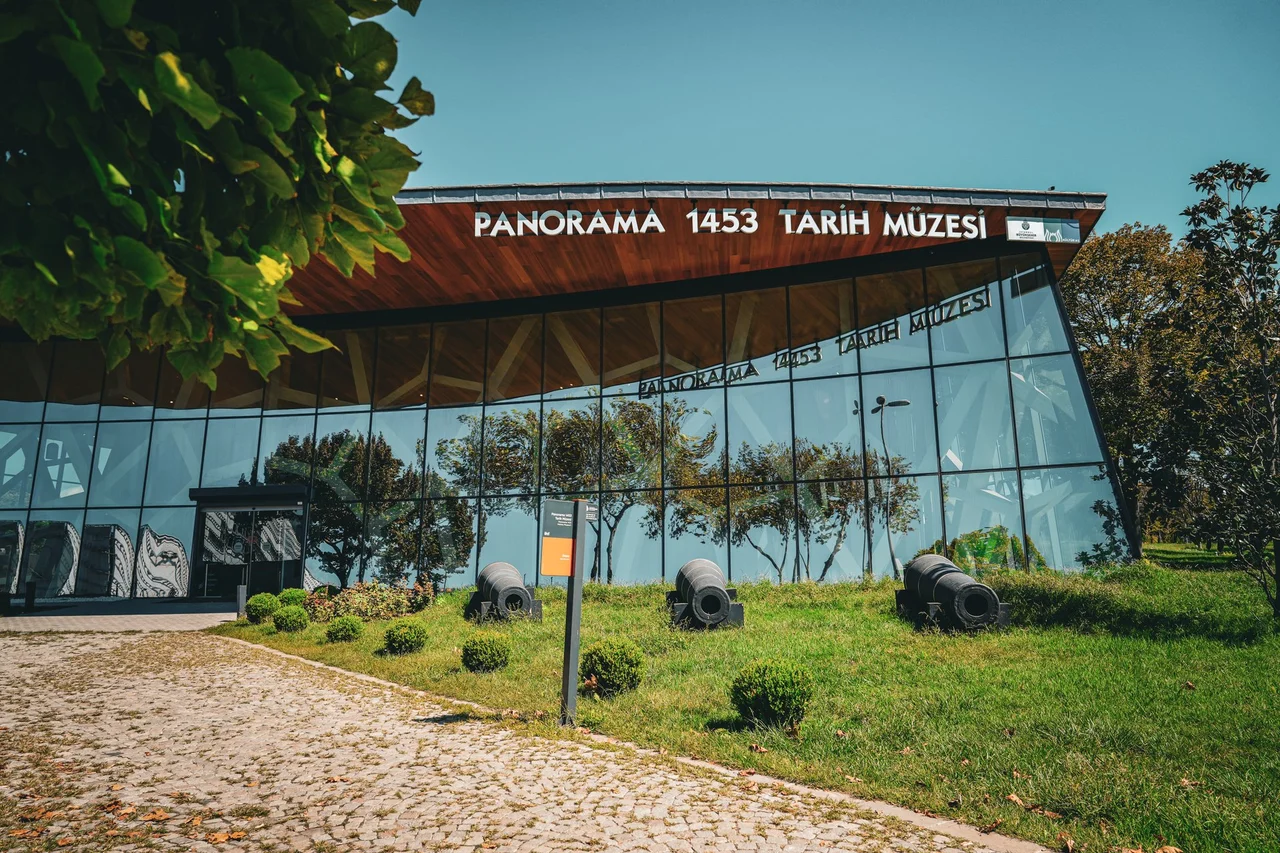

Panorama 1453 History Museum
On 29 May 1453, Sultan Mehmed II's forces breached the Theodosian Walls that had protected Constantinople for over a thousand years, ending the Byzantine Empire and beginning a new era in the city's history. More than five and a half centuries later, a museum was built as close as possible to the spot where the walls gave way. It opened on 31 January 2009, and the main thing it contains is a painting — though 'painting' barely describes it. The panorama wraps around you in a complete circle 38 meters in diameter, covering 2,350 square meters of painted surface, and the sound effects close in from every direction: cannons, shouted commands, and the pounding rhythms of the Mehter military band. For a moment, or several, you are standing in the middle of the battle.
The Day the Walls Came Down
The fall of Constantinople on 29 May 1453 is one of the pivotal events of the medieval world. The city had resisted sieges for centuries, its location on a peninsula between the Golden Horn and the Sea of Marmara making it nearly impregnable. By 1453, though, the Byzantine Empire had contracted to little more than the city itself, and Mehmed II brought a force equipped with some of the most advanced artillery of the age. When the walls finally failed, after weeks of bombardment, it was near the Edirnekapı section — the very stretch of surviving wall that still stands adjacent to this museum.
The Panorama 1453 museum was deliberately sited at Topkapı, opposite the Topkapı-Edirnekapı section of the ancient defenses. From the museum grounds, visitors can see the actual Theodosian Walls rising not far away, still massive after fifteen centuries. The decision to place the museum here was not accidental — proximity to the authentic site gives the panorama its context and its weight.
Ten Thousand Figures in a Hemisphere
Construction of the building and the painting of the panorama mural began in 2005, with eight artists working on the project. The depiction of the damaged walls at the moment of breach was informed by a report on their repair written by Khidr, the first mayor of Istanbul after the conquest. The painting was completed in 2008. The museum opened on 31 January 2009, at a cost of five million dollars, and was Turkey's first panoramic museum of this type.
The cyclorama technique — wrapping a continuous painted scene around a circular viewing platform — was developed in Europe in the late eighteenth century and enjoyed enormous popularity through the nineteenth. The Panorama 1453 revives the form with modern attention to detail: 10,000 individual figure drawings are spread across the curved surface, and three-dimensional objects occupy the platform floor between the viewer and the painting, blending seamlessly with the two-dimensional image behind them. The effect is disorienting in the best sense. The painted horizon offers no start or end point, no frame, no edge — and so the eye accepts what it is being shown.
Sound, Scale, and Illusion
Standing on the central platform, you are nominally in a closed room 38 meters across. You do not experience it that way. The absence of any visible boundary — the painted scene wraps behind you as fully as it wraps in front — tricks the perceptual system into interpreting the space as vast and open. The sound reinforces the illusion: the crack of gunfire, the shouts of soldiers in the Ottoman host, the distinctive percussion of the Mehter Marşı, the military march that accompanied Ottoman armies for centuries and can still make the hair on your arms stand up when heard at volume.
The museum documentation notes that visitors can experience a perceptual shock of up to ten seconds on the platform — the moment before the brain recalibrates and accepts that this is an artwork rather than a scene. That brief window, before reason reasserts itself, is what the cyclorama form was designed to produce. It is a technology of temporary belief.
Walls, Then and Now
The Topkapı neighborhood where the museum stands is not heavily touristed by the standards of Istanbul's old city. Hagia Sophia and the Sultanahmet draw the crowds; this museum, reachable by the T1 or T4 tram to Topkapı station, sits in a working residential district. The Theodosian Walls nearby — a UNESCO World Heritage site as part of the Historic Areas of Istanbul — run for several kilometers along the western edge of the old city, their towers intact in many sections, their foundations in the ground since the fifth century.
Walking from the museum to the walls and then along them is one of the stranger historical walks available in Istanbul. The city that fell in 1453 and the city built in its place both left physical traces that you can touch. The panorama inside the museum gives you the catastrophe at maximum intensity, full surround, ten seconds of genuine disorientation. Stepping back outside and looking at the actual stones gives you something slower and harder to name.
From the Air
The Panorama 1453 History Museum is located at 41.018°N, 28.921°E in Istanbul's Fatih district, on the European side near the ancient Theodosian Walls. Approaching from Istanbul Airport (LTFM) to the northwest, the Theodosian Walls are visible from altitude as a linear feature cutting across the western edge of the old city peninsula. At 3,000 to 5,000 feet in clear conditions, the historic wall line is distinguishable running roughly north-south, with the Sea of Marmara to the south and the Golden Horn inlet to the north. The museum sits just inside the walls at the Topkapı section. The distinctive bulk of the Hagia Sophia dome and the minarets of the Blue Mosque are visible to the southeast, orienting the viewer within the old city grid.
Nearby Stories
- Kocaeli Peninsula 7.6 km away
- Second Battle of Çatalca 11 km away
- Istanbul's Rural Outskirts 14 km away
- MV Struma 20 km away
- HMAS AE2 36 km away
- Bursa 66 km away
- Sangarius Bridge 71 km away
- Januarius MacGahan 101 km away