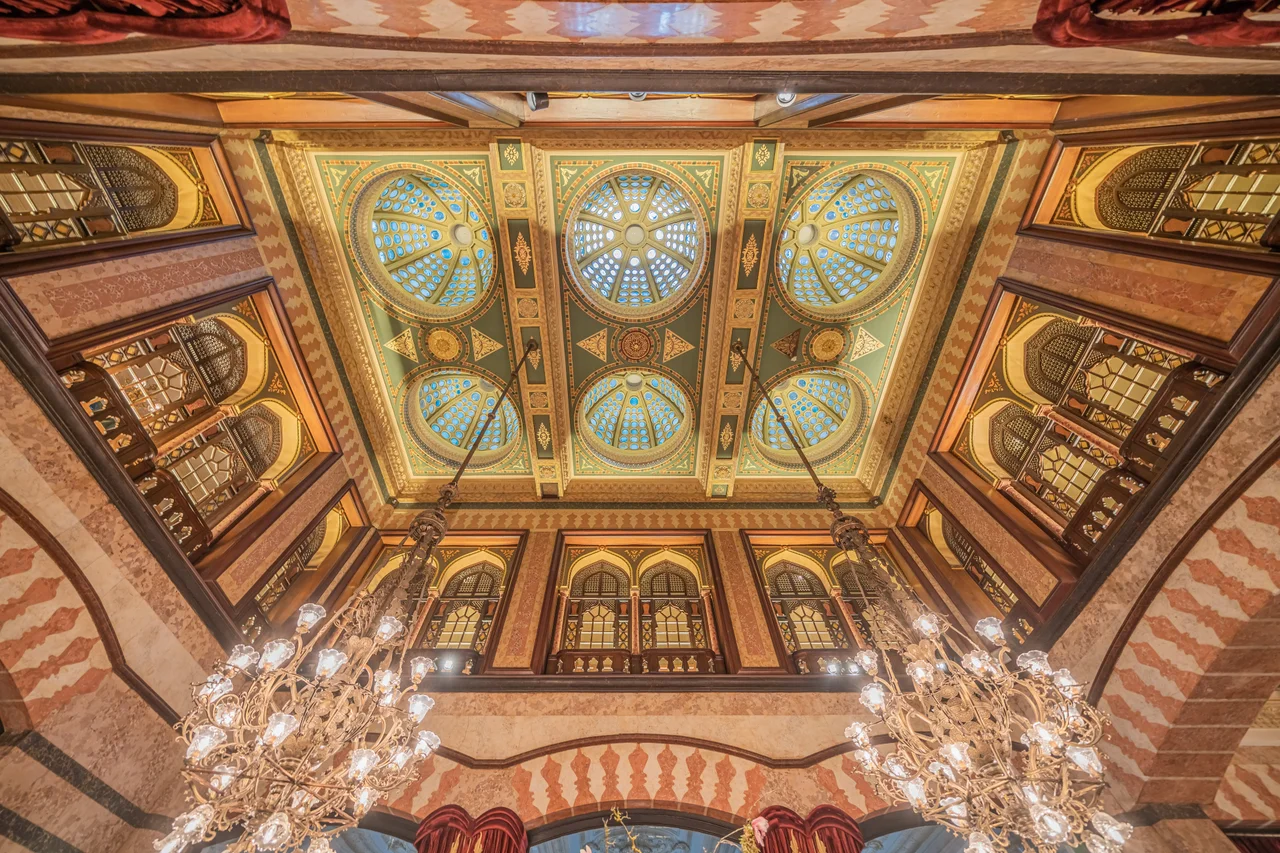

Pera Palace Hotel
Agatha Christie checked into the Pera Palace Hotel and, by the account the hotel has carefully maintained ever since, wrote Murder on the Orient Express in her room. Whether that is precisely true hardly matters. What is true is that the Pera Palace is exactly the kind of place where such a story would happen: a grand Belle Époque hotel on the hill above Galata, built in 1892 for passengers stepping off the Orient Express at the end of the line, and furnished with every luxury that the late Ottoman Empire could marshal — including, famously, the first electric elevator in Constantinople and the first electric lighting in any building in the empire outside the imperial palaces themselves. The guests who walked through its doors brought with them the intrigue of a continent in transition. The hotel absorbed it all.
The End of the Line
When the Orient Express service to Constantinople began, it created a problem: there was no hotel in the city equipped to receive European travelers accustomed to the comforts of Paris or Vienna. The Wagons-Lits company addressed this by commissioning a hotel built to their passengers' expectations. Work began in 1892 and the grand opening ball was held in 1895.
The architect was Alexandre Vallaury, a French-Ottoman architect who had also designed the Ottoman Bank Headquarters and the Imperial Museum in Constantinople. He blended neo-classical, Art Nouveau, and Oriental elements — strict symmetry on the exterior, more fluid decorative work in the ballroom and around the elevator cage, a coffee house where the styles mingled freely. The result was something that felt simultaneously European and specifically Ottoman: a building designed to make arriving Europeans feel at home while reminding them they had arrived somewhere different.
The hotel was one of the first owners' properties of the Ottoman Armenian Esayan family, part of the cosmopolitan commercial world of Pera that the hotel itself embodied.
Firsts and Luxuries
The Pera Palace offered things its guests could not have found elsewhere in Constantinople. It was the first building outside the imperial palaces in the Ottoman Empire to run on electricity. Hot running water — entirely normal to European hotel guests — was available here when it was available almost nowhere else in the city. The elevator, wrought iron and ornate in the Art Nouveau manner, was the first electric elevator in Constantinople and, at the time of installation, the second in all of Europe.
These were not incidental boasts. They were the substance of what the hotel was selling: proof that the old city at the edge of Europe could accommodate the expectations of the new century. For travelers who had spent three days on a train crossing the continent, stepping into the Pera Palace was an arrival in more than one sense. The train journey ended here; the city began.
Famous Guests and Dark Chapters
The register of notable guests at the Pera Palace reads like a survey of the twentieth century's most turbulent personalities. Agatha Christie stayed here and is said to have written Murder on the Orient Express in her room; the hotel preserves it as a memorial. Mustafa Kemal Atatürk, who would go on to found the Turkish Republic and transform the country utterly, also stayed at the Pera Palace, and his room — Room 101 — is now kept as a museum room, his personal items and reading material on display.
The hotel also witnessed darker events. On 11 March 1941, during World War II, a bomb attack struck the building. Five people were killed, including four Turkish nationals and a British diplomatic worker; thirty were injured, among them two hotel porters. The bombs had been placed in suitcases belonging to staff of the British Legation in Sofia, who were evacuating to Istanbul following the breakdown of diplomatic relations with Bulgaria. The city was, as it had so often been, a place where the pressures of a larger world arrived without warning.
The hotel closed in 2006 for an extensive renovation — a €23 million project completed on 1 September 2010 — before reopening to guests.
A Hotel in the Pages
Few buildings have accumulated as many fictional addresses as the Pera Palace. Ernest Hemingway placed his protagonist in the hotel during the Allied occupation of Constantinople in 'The Snows of Kilimanjaro.' Graham Greene's Henry Pulling and his aunt stay here in Travels with My Aunt, the narrator unimpressed by the food. Erin Morgenstern's The Night Circus sends two of its characters to the hotel in 1900. The Turkish novelist Peyami Safa set a ball scene here. Netflix produced a time-travel series called Midnight at the Pera Palace, released in 2022, using the hotel as its central location.
Something about the building invites fiction. It is old enough to carry genuine history, grand enough to suggest importance, and positioned at the intersection of East and West in a city that has always been the most complicated address in the world. Writers instinctively reach for it when they need a place where remarkable things might plausibly occur. The Pera Palace, for its part, has always obliged.
From the Air
The Pera Palace Hotel sits at 41.031°N, 28.974°E in the Beyoğlu district of Istanbul, on the European side of the Bosphorus. Approaching from Istanbul Airport (LTFM) approximately 38 kilometers to the northwest, the Beyoğlu ridge is visible rising above the southern shore of the Golden Horn. At 3,000 to 5,000 feet on a clear day, the Istiklal Avenue corridor and the distinctive profile of Galata Tower are the primary visual landmarks orienting the approach. The hotel sits just downhill from Istiklal, in the Tepebaşı neighborhood, with the Bosphorus strait and its bridges visible beyond. The minarets of the Süleymaniye Mosque across the Golden Horn to the south provide an additional bearing point.
Nearby Stories
- Kocaeli Peninsula 7.6 km away
- Second Battle of Çatalca 11 km away
- Istanbul's Rural Outskirts 14 km away
- MV Struma 20 km away
- HMAS AE2 36 km away
- Bursa 66 km away
- Sangarius Bridge 71 km away
- Januarius MacGahan 101 km away