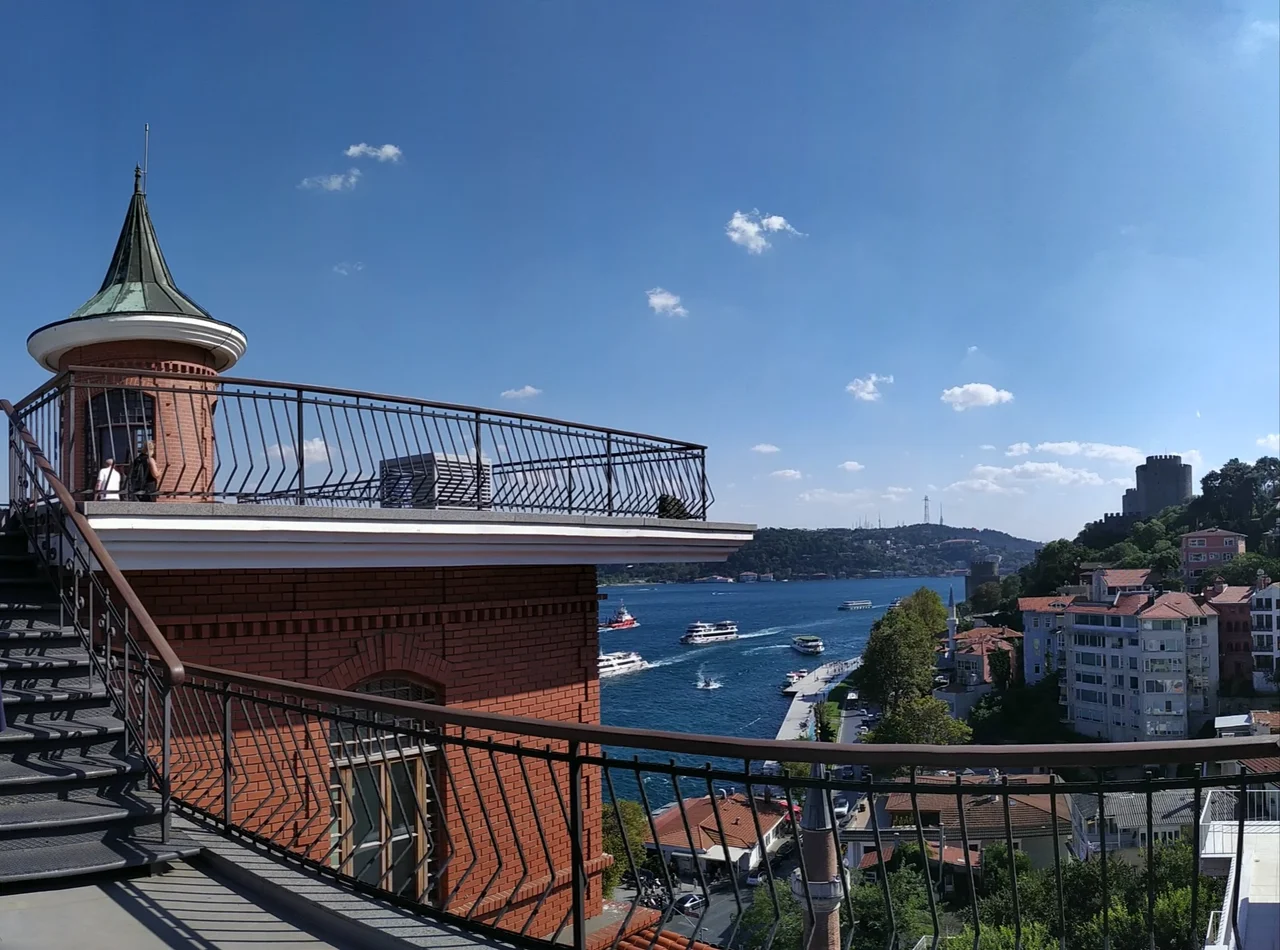

Perili Köşk
The mansion got its nickname from its emptiness. Built in 1911 as the Yusuf Ziya Pasha Mansion — a castle-like red brick tower with stained glass windows rising nine floors above the Bosphorus at Rumelihisarı — it sat with its second and third floors unfinished for decades. Locals began calling it Perili Köşk, the Haunted Mansion. The name stuck through the long years of partial completion, through the silence of floors that were never inhabited, through the slow accumulation of weather and story that gathers around abandoned grandeur. Today the building houses both the headquarters of Borusan Holding and the Borusan Contemporary art museum, its exterior restored to match the original design, its interior rebuilt for the twenty-first century. The ghost story has become a gallery story. But the name has not changed.
A Tower on the Strait
The Rumelihisarı neighborhood where Perili Köşk stands takes its name from the Rumeli Fortress, the massive fifteenth-century fortification built by Mehmed II in 1452 — the year before the conquest of Constantinople — to control the Bosphorus at its narrowest point. The mansion rises a few hundred meters from those ancient walls, on the same European shore, with the strait flowing past below and the Fatih Sultan Mehmet Bridge visible in the near distance.
At this point the Bosphorus is among its narrowest and most dramatic: the current runs strong, the Asian shore is close enough to see clearly, and the passage of tankers, ferries, and cargo ships through the strait is constant. For a building designed to impress — and the nine-floor, 5,000-square-meter Yusuf Ziya Pasha Mansion was certainly designed to impress — the location was well chosen. The problem was completion.
Decades of Haunting
The building was constructed in 1911, but the story of why its upper floors remained empty for so long is not fully documented in the sources. What is documented is the result: a substantial, castle-like structure sitting on one of the most expensive stretches of waterfront in Istanbul with its lower and upper floors inhabited and its middle floors sealed, unused, slowly acquiring a reputation. Buildings do not need to be genuinely haunted to feel that way. Incompletion is its own form of atmosphere.
The mansion changed hands and purposes over the decades. In 1993 it was bought by the philanthropist businessman Basri Erdoğan. The exterior was then carefully restored and completed — in line with the original design — between 1995 and 2000 by architect Hakan Kıran, who also renovated the interior. The building that emerged from that project looked, at last, as it had been intended to look when it was built more than eighty years earlier.
Borusan Moves In
In May 2002, Borusan Holding — a Turkish industrial conglomerate with operations spanning steel, logistics, automotive, music, and the arts — took a 25-year lease on the property and established its headquarters there. The choice of the Perili Köşk as a corporate address was not simply practical. Borusan had an existing commitment to arts and culture that would eventually reshape what the building is known for.
In September 2011, Borusan opened Borusan Contemporary, an art museum occupying the building alongside the company offices. The museum presents contemporary art in a space that is itself architecturally distinctive — a Victorian-inflected red brick tower on the Bosphorus, stained glass intact, with views across the water that no purpose-built gallery could replicate. The combination of corporate headquarters and art museum in a single historic building on prime waterfront is unusual. At the Perili Köşk, it works in part because the building's whole history has been about the gap between what a space appears to be and what it actually is.
What the Name Preserves
Borusan Contemporary runs temporary exhibitions, and the building now appears on architecture lists and cultural itineraries. It is accessible on weekends, when the offices are closed and the museum is open to visitors who make the trip up the Bosphorus to Rumelihisarı by ferry or road. Standing outside and looking up at the red brick facade — the turrets and the tall windows, the stained glass catching light from the strait — it is easy to see why the neighborhood gave it the name it did.
The haunting, if there ever was one, came from potential unfulfilled: a building of obvious ambition sitting incomplete, floors empty, waiting for something that had not yet arrived. What arrived, eventually, was restoration and purpose. The name Perili Köşk remains anyway, a reminder that a building's history is not only what happened inside it but also what people imagined about it during the years they could not get in.
From the Air
Perili Köşk stands at 41.089°N, 29.057°E on the European shore of the Bosphorus in the Rumelihisarı neighborhood of Sarıyer district. This location is on the European side of Istanbul; the nearest major airport is Istanbul Airport (LTFM), approximately 20 kilometers to the northwest. Approaching from the northwest and descending over the Bosphorus, the Fatih Sultan Mehmet Bridge is a prominent landmark — the second suspension bridge on the strait, its towers rising sharply from both shores. Perili Köşk sits on the European bank just south of the bridge. The red brick nine-story tower is distinctive against the hillside of the Rumelihisarı neighborhood. At 2,000 to 3,000 feet on a clear day, the contrast between the historic Rumeli Fortress walls nearby and the surrounding residential blocks helps locate the building. The Asian shore and Anadolu Hisarı fortress are visible directly across the strait.
Nearby Stories
- Kocaeli Peninsula 7.6 km away
- Second Battle of Çatalca 11 km away
- Istanbul's Rural Outskirts 14 km away
- MV Struma 20 km away
- HMAS AE2 36 km away
- Bursa 66 km away
- Sangarius Bridge 71 km away
- Januarius MacGahan 101 km away