
Pertevniyal Valide Sultan Mosque
She was the mother of a sultan and the consort of another, and when Pertevniyal Sultan commissioned a mosque in the Aksaray neighborhood of Istanbul, she did not commission anything modest. Construction began in November 1869 and was completed in 1871, the work probably designed by Sarkis Bey of the Ottoman Armenian Balyan family — the dynasty of architects whose work defined imperial Istanbul's built form in the nineteenth century. What they produced for Pertevniyal is one of the most stylistically adventurous buildings in the city: Rococo ornament, classical Ottoman domes, Moroccan and Gothic and Renaissance references all pressed into the same facade. Some have found it magnificent. Others have found it bewildering. Pertevniyal Sultan, who died in 1883 and was buried within the mosque she built, presumably found it fitting.
A Woman Who Built
A valide sultan — the mother of the reigning Ottoman sultan — occupied the highest position available to a woman in the Ottoman imperial system. She could exercise real political influence, she controlled substantial wealth, and she had access to the resources of the state. One of the most visible ways a valide sultan could express her power and piety was through architectural patronage: funding mosques, schools, fountains, and charitable foundations.
Pertevniyal Sultan was the consort of Sultan Mahmud II and the mother of Sultan Abdülaziz, who reigned from 1861 to 1876. Her mosque in Aksaray was one of the last imperial mosques built in Istanbul before the end of the empire, and it stands today as a testament to both her ambition and the eclectic aesthetic that characterized late-Ottoman court patronage. She also endowed the Pertevniyal High School adjacent to the mosque, completed in 1872. She died thirteen years after the mosque's completion and was interred within the complex she had built — a common arrangement for Ottoman imperial patrons, and a form of presence that persists.
A Gathering of Styles
The Pertevniyal Valide Sultan Mosque is regularly described as an example of Turkish Rococo, but that label captures only part of what is happening on its facades. Classical Ottoman elements are present: the square prayer hall with its single dome, the dome raised on a twelve-sided drum, the traditional arrangement of portico and sultan's loge. But pressed against those elements are turrets embedded in the east, west, and south facades, triangular pediments capping the central projections, and decorative details drawn from Moroccan, Andalusian, North African, Indian, Gothic, and Renaissance traditions.
Critics have called this mixture garish, a departure from the disciplined grandeur of earlier Ottoman mosques. Defenders have read it as a sophisticated expression of the eclectic internationalism that defined the late empire: a building designed in a moment when Ottoman architects were deliberately engaging with global visual culture rather than retreating into a single inherited form. Whether garish or sophisticated, the mosque is undeniably distinctive. No other building in Istanbul looks quite like it.
Inside the Blue
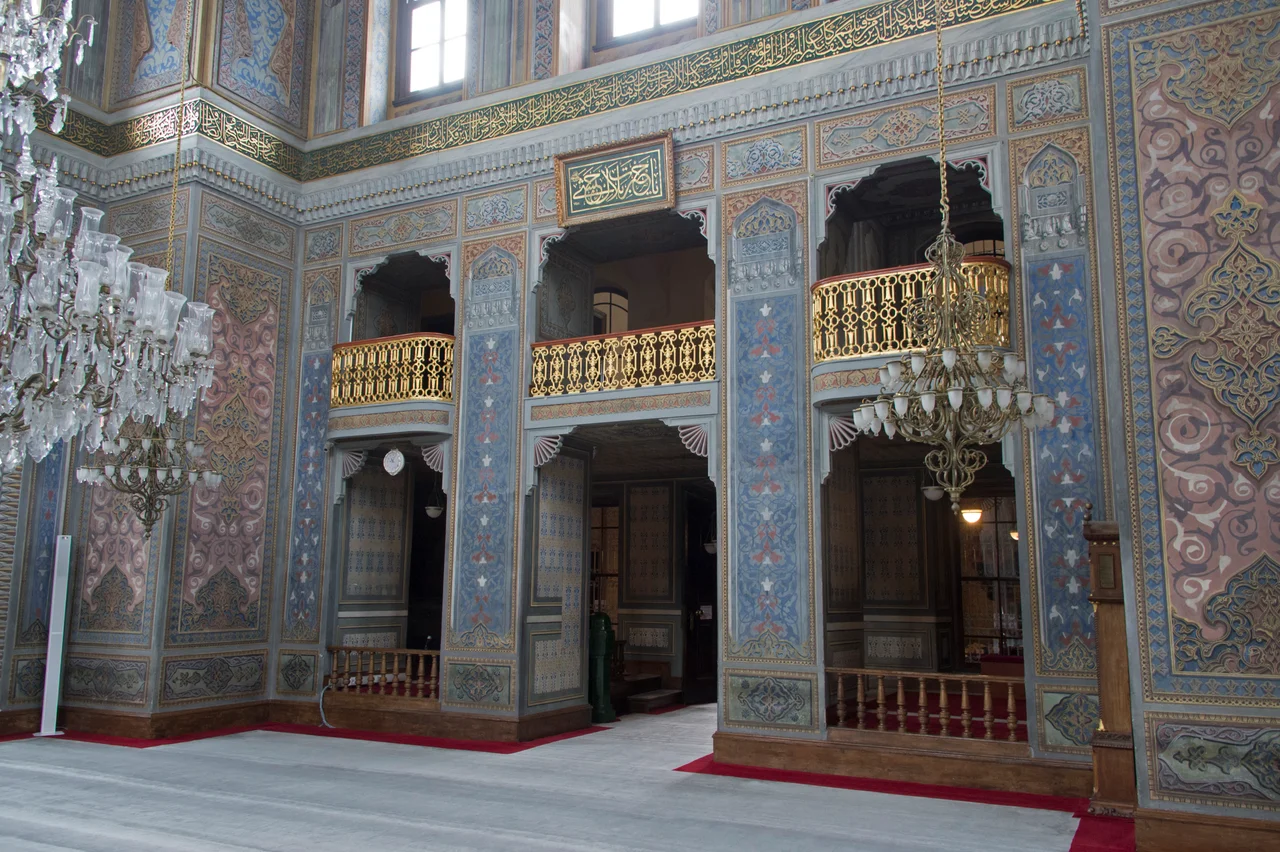
The interior of the Pertevniyal Valide Sultan Mosque is elaborately ornamented, with blue as the dominant color of the decoration. Across the walls run the classical Ottoman vocabulary of blind niches, muqarnas carved in cascading geometric patterns, arch motifs, arabesques, and Chinese-inspired floral arrangements — that last element a reminder of how broad the Ottoman decorative tradition's sources actually were.
The prayer hall measures 10 meters by 10 meters, and the dome above floats high on its drum, filling the space with light. During regular prayer times the mosque draws 400 to 500 worshipers; on Fridays, when the community gathers for the congregational prayer, more than 2,500 people have been counted. Whatever architectural critics have said about the exterior, the building has functioned continuously as a house of worship for more than 150 years, which is a different kind of judgment.
Below Street Level
One of the stranger features of visiting the Pertevniyal Valide Sultan Mosque today is the approach. The building sits below the level of the surrounding streets — a consequence of successive rounds of road construction that raised Aksaray's thoroughfares while the mosque remained at its original grade. You descend to reach it, passing through a grand gateway adorned with fountains. The whole complex — mosque, tomb, sebil (a public water fountain), library, time-keeper's room, and madrasa — occupies a precinct that feels, because of this grade change, slightly removed from the traffic and noise of the Ordu Street and Atatürk Boulevard intersection above.
Aksaray was a vital commercial center during the Ottoman period, and Pertevniyal Sultan clearly regarded the location as an important one. What is now a busy transit hub was once, the sources note, an area known for its gardens and orchards. The mosque occupies the same ground, now below the grade of the streets it once presided over, the fountain courtyard offering a quiet anteroom to the ornate interior beyond.
From the Air
The Pertevniyal Valide Sultan Mosque stands at 41.010°N, 28.953°E in the Aksaray neighborhood of Fatih district, on the European side of Istanbul. Approaching from Istanbul Airport (LTFM) to the northwest, the old city peninsula is visible as a wedge of dense urban fabric extending between the Sea of Marmara to the south and the Golden Horn inlet to the north. At 3,000 to 5,000 feet on a clear day, the mosque's position near the Atatürk Boulevard axis — one of the principal arteries cutting through the historic peninsula — is identifiable by the road geometry and the open tram corridor. The Süleymaniye Mosque complex on the ridge to the northeast is a major landmark for orientation. Aksaray sits inland from the Sea of Marmara shore, roughly midway between the Bosphorus and the Theodosian Walls to the west.
Nearby Stories
- Kocaeli Peninsula 7.6 km away
- Second Battle of Çatalca 11 km away
- Istanbul's Rural Outskirts 14 km away
- MV Struma 20 km away
- HMAS AE2 36 km away
- Bursa 66 km away
- Sangarius Bridge 71 km away
- Januarius MacGahan 101 km away