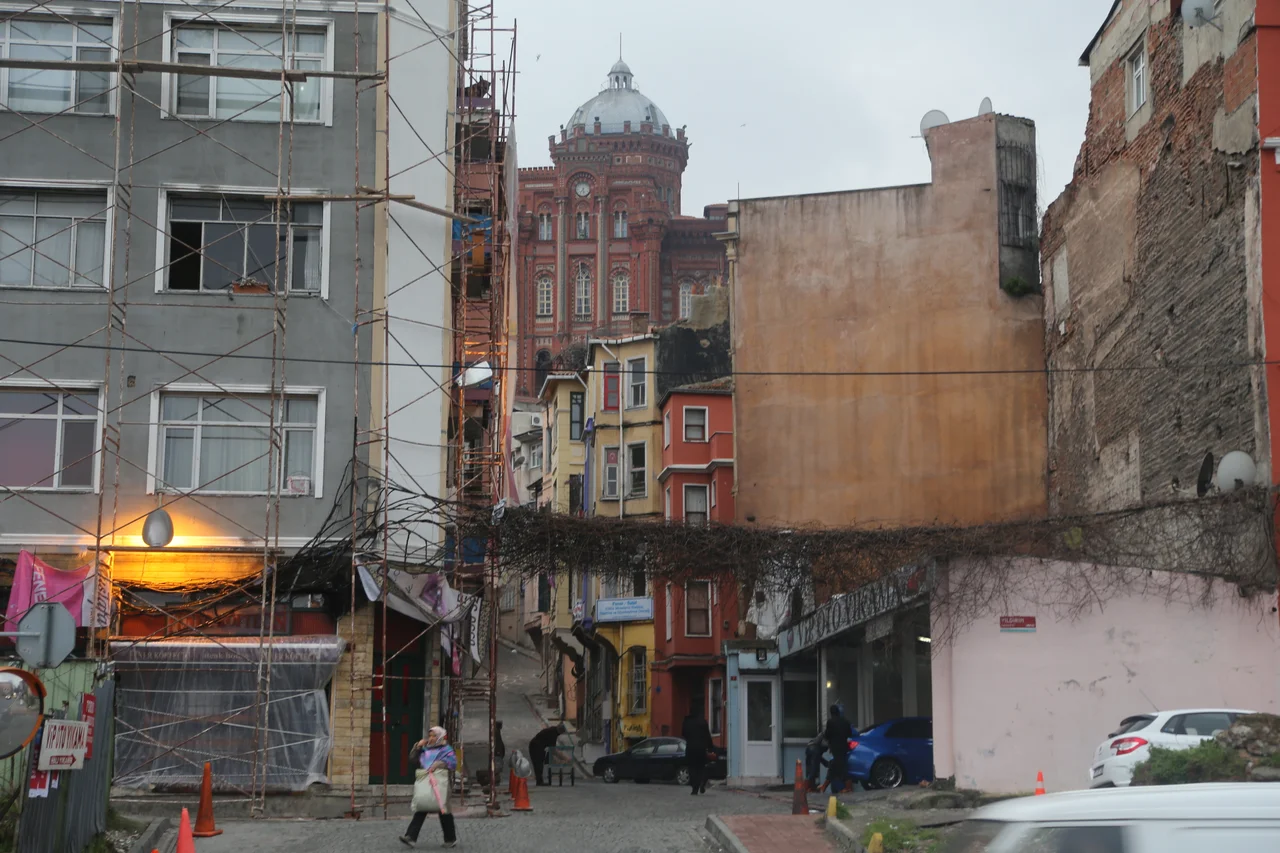

Phanar Greek Orthodox College
In October 2025, Turkish education authorities handed the school a notice that stopped staff and students cold: vacate within 90 days. The building had failed updated earthquake-reinforcement standards, and the cost of compliance — more than ten million euros — far exceeded what the institution could raise. For the Phanar Greek Orthodox College, which has educated the Greek and Orthodox communities of Istanbul without interruption since 1454, the notice arrived with a particular weight. This was not the first time the school had faced an existential threat. It was simply the latest.
The Great School of the Nation
The college's Greek name, Megáli tou Génous Scholí — the Great School of the Nation — was not chosen modestly. Founded in its present form by Patriarch Gennadius Scholarius just one year after the Ottoman conquest of Constantinople, it was conceived as a lifeline: a place where the Greek Orthodox community could preserve its language, faith, and learning under an entirely new political order. Scholarius appointed Matthaios Kamariotis of Thessaloniki as its first director, and the school quickly drew the sons of prominent Phanariote Greek families and other Orthodox communities from across the Ottoman Empire. Wallachian and Moldavian princes — men who would govern Danubian principalities on behalf of the Porte — studied here. Dimitrie Cantemir, the Moldavian prince and polymath who would later write the first history of the Ottoman Empire, was among its graduates. The school became, over generations, one of the most important centers of Greek intellectual life anywhere in the world.
The Red Castle on the Horn
The building that stands today is not the original school. The current structure was designed by the Greek architect Konstantinos Dimadis and built between 1881 and 1883, funded almost entirely by Georgios Zariphis, a prominent Greek banker and member of the Rum community of Istanbul. The cost was 17,210 Ottoman gold pounds — a staggering sum for the era. What Dimadis produced was something between a school and a fortress: an eclectic red-brick pile with towers and battlements that looms over the neighborhood of Fener (Phanar in Greek) and can be seen from the waters of the Golden Horn below. Locals have always called it the Red Castle or the Red School, and the nickname fits. The building is sometimes described informally as the fifth largest castle in Europe — a comparison that speaks more to its silhouette than any formal ranking, but captures the impression it makes. At its summit, a large dome houses an observatory used for astronomy classes, complete with a large antique telescope.
Learning Beside St. George
The school sits near the Church of St. George in Fener, the neighborhood that has served as the seat of the Ecumenical Patriarchate of Constantinople for centuries. This proximity is not incidental. The college and the Patriarchate have always existed in close relationship — the school was, from the start, the institution through which the Patriarchate maintained the intellectual formation of its community. Today the college operates under Turkish law as a minority school, applying the full Turkish national curriculum alongside its distinctive Greek-language subjects: Greek language, literature, and religion. Of its twenty-one teachers, fifteen are Greek and six are Turkish. The arrangement reflects a careful legal and cultural balance that the Greek community of Istanbul has had to negotiate for generations.
Continuity Under Pressure
The school's survival across five centuries is the result of constant negotiation with successive authorities — Ottoman sultans, the Turkish Republic, and now municipal education bureaucracies. Fires, political upheaval, and the dramatic demographic decline of Istanbul's Greek community through the 20th century all threatened the institution. At its peak, the Rum (Greek Orthodox) community of Istanbul numbered in the hundreds of thousands; today it is a few thousand at most. The school's enrollment reflects this reality. Yet the institution has persisted, its red towers still marking the Fener skyline. The 2025 earthquake-compliance order is the most recent pressure. Whether the school can find the funds to reinforce or relocate its historic building — or whether it will be forced to close one of the oldest continuously operating educational institutions in the region — remains unresolved.
A View from the Golden Horn
From the water, the approach to Fener is unmistakable. The Red School stands on a slope above the Golden Horn, its rust-colored towers rising above the rooftops of a neighborhood whose layers of history — Byzantine, Ottoman, Greek, Turkish — remain visible in the fabric of the streets. The Church of St. George's modest exterior gives no hint of its enormous institutional significance; the college, by contrast, announces itself loudly, as if the community that built it wanted to ensure that no one, from the hills of Pera across the water or from the decks of ships passing below, could overlook the fact that Greek Orthodox life continued here. From this vantage, on a clear day, you can understand exactly what the building was meant to say.
From the Air
The Phanar Greek Orthodox College sits at approximately 41.029°N, 28.949°E in the Fener neighborhood on the European side of Istanbul, overlooking the Golden Horn. From the air at 3,000–5,000 feet, the red-brick towers of the college are visible on the south bank of the Golden Horn, just west of the Atatürk Bridge. The nearest major airport is LTFM (Istanbul Airport), approximately 35 km to the northwest. Approach from the west following the Golden Horn eastward; the distinctive red-brick castle-like profile of the school stands out against the lower surrounding buildings. Visibility is generally best in morning hours before afternoon haze develops over the city.
Nearby Stories
- Kocaeli Peninsula 7.6 km away
- Second Battle of Çatalca 11 km away
- Istanbul's Rural Outskirts 14 km away
- MV Struma 20 km away
- HMAS AE2 36 km away
- Bursa 66 km away
- Sangarius Bridge 71 km away
- Januarius MacGahan 101 km away