
Philadelphion
The square was named for a lie. Or rather, for a sculpture depicting an event that almost certainly never took place: the three sons of Constantine the Great embracing after their father's death in 337, pledging mutual devotion and harmony. In reality, Constantine's sons met only briefly in Pannonia, and the peace between them dissolved quickly into civil war. But the statue group stood at the Philadelphion — the 'place of brotherly love' — in the heart of Constantinople for centuries, commemorating an ideal of imperial concord even as the actual history of the imperial family ran in a different direction entirely.
Where the Road Forked
The Mese Odos, Constantinople's great central thoroughfare, ran from the Milion — the golden milestone near the Hagia Sophia — westward through the city's ceremonial heart. After passing the Forum of Theodosius, it split. One branch angled toward Yedikule and the southwestern quarter; the other continued northwest through Şehzadebaşı and Fatih toward the Gate of Charisius, the road to Adrianople and the European hinterland. The point where these routes diverged was the Philadelphion. Byzantine urban theory held this spot to be the mesomphalos — the navel of the city, its geographical and symbolic center. In a capital organized around ritual, ceremony, and the careful choreography of imperial movement through public space, the choice to mark this junction with imperial statuary was not incidental. It announced something about how Constantinople understood itself.
The Oldest Layers
Long before the statue group gave the square its famous name, the site had its own history. According to the 8th-century Byzantine text known as the Parastaseis syntomoi chronikai, the location was once called the Proteichisma — the 'fore-wall' — and had served as a gateway in an early city wall built during the brief reign of Emperor Carus in the 280s. The scholar Raymond Janin suggested this outer wall may have been protecting the earlier fortifications of Septimius Severus, implying that Byzantium had already grown beyond its Severan boundaries by the late 3rd century. The Parastaseis also records the presence at this site of statues of Constantine the Great, his mother Helena, and his sons, arranged around a four-sided porphyry column topped by a gilded cross. Whether the column was erected by Constantine to commemorate a vision of the cross he claimed to have had here, or later to honor Helena's discovery of the True Cross, is a matter scholars still debate.
The Tetrarchs and the Question of Venice
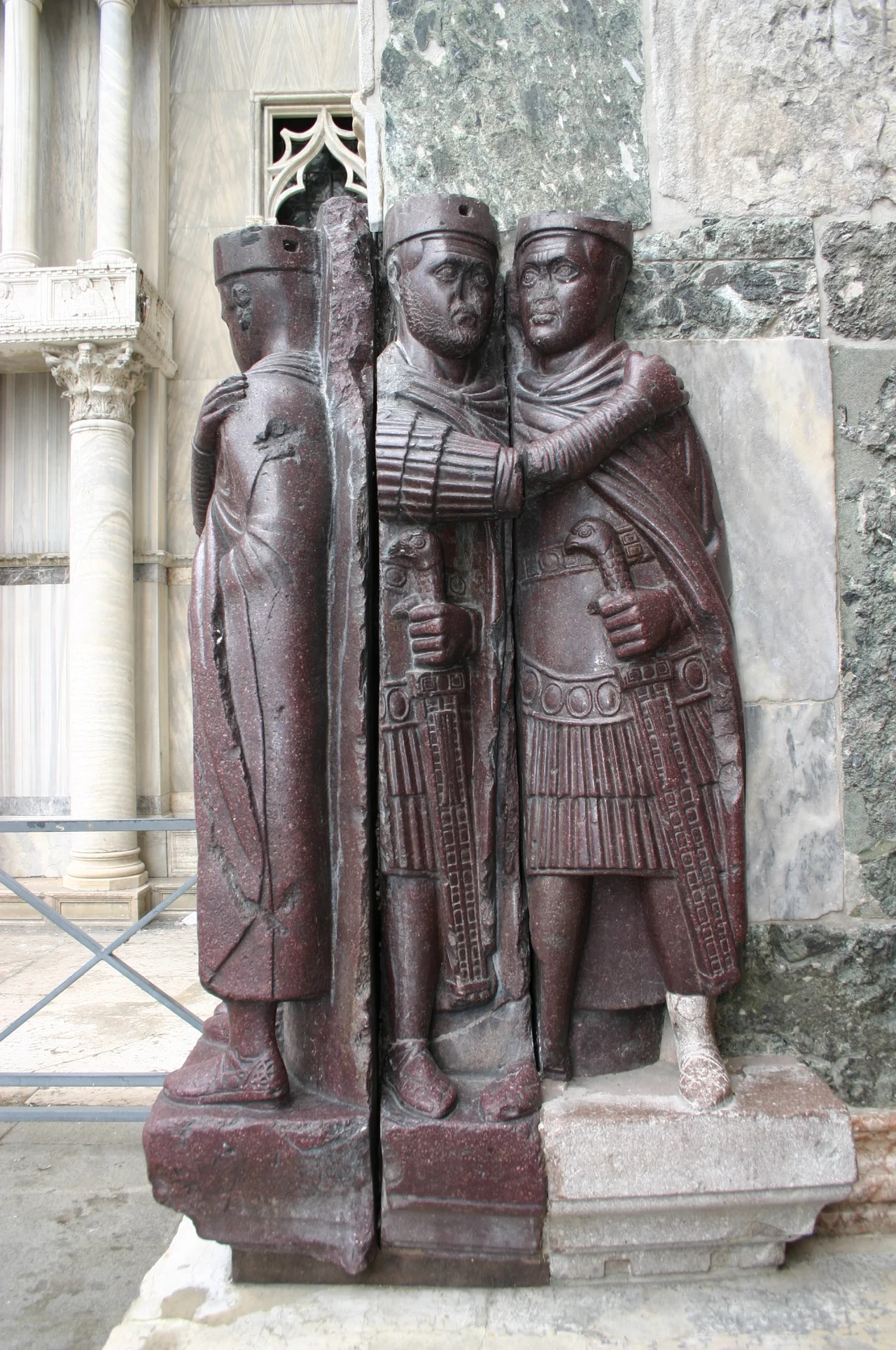
The most famous objects ever associated with the Philadelphion are now embedded in the corner of St. Mark's Basilica in Venice: the porphyry Portrait of the Four Tetrarchs, four squat soldier-emperors carved in dark Egyptian purple stone, embracing in pairs. They were plundered from Constantinople during the Fourth Crusade in 1204 and installed in Venice as trophies. In 1958, the scholar P. Verzone proposed that these were the same statues the Parastaseis described at the Philadelphion. Supporting this identification: a missing fragment of one statue's foot was discovered near the Bodrum Mosque in Istanbul, now held in the Istanbul Archaeology Museum. But the editors of the Parastaseis themselves urged caution, noting too many discrepancies between the Venetian group and the Byzantine text's descriptions to permit certainty. The Tetrarchs depict four emperors of the late 3rd century, not the sons of Constantine — the chronology and the iconography pull in different directions.
Judges, Ghosts, and Forgetting
Other statues at the Philadelphion lingered longer in the city's memory. Two figures that the Parastaseis identifies as sons of Constantine seated on thrones were apparently still standing in the early 15th century — nearly a millennium after the square's founding — when Byzantines knew them simply as the 'True Judges.' Entire generations had passed, the statues' imperial identities had faded into popular legend, and still they remained, presiding over a crossroads in a city that was slowly losing its grip on its own past. The Ottoman conquest of 1453 erased whatever remained of the square as a functioning monument. Today the location in the Fatih district holds no trace of the Philadelphion above ground. The square that once marked the center of a world empire is fully absorbed into the fabric of Istanbul, visible only in old maps and the arguments of Byzantine scholars.
From the Air
The Philadelphion stood at approximately 41.014°N, 28.957°E in what is now the Fatih district on the European side of Istanbul, near the modern neighborhood of Şehzadebaşı. From the air at 3,000–5,000 feet, this area lies south of the Golden Horn and slightly west of the historic core — look for the distinctive silhouette of the Süleymaniye Mosque as a landmark; the Philadelphion site is roughly 700 meters to its southeast. The nearest major airport is LTFM (Istanbul Airport), approximately 30 km to the northwest. No surface trace of the Byzantine square remains visible from the air.
Nearby Stories
- Kocaeli Peninsula 7.6 km away
- Second Battle of Çatalca 11 km away
- Istanbul's Rural Outskirts 14 km away
- MV Struma 20 km away
- HMAS AE2 36 km away
- Bursa 66 km away
- Sangarius Bridge 71 km away
- Januarius MacGahan 101 km away