
Piyale Pasha Mosque
Mimar Sinan, the master architect of the Ottoman Empire, designed more than three hundred buildings across his long career. Most of his mosques follow a clear formal logic: a grand central dome, flanked by semi-domes or smaller cupolas, reaching toward a single high point. The Süleymaniye, the Selimiye in Edirne, the Şehzade — they announce a hierarchy. The Piyale Pasha Mosque, completed in 1573 near the Golden Horn in what is now the Kasımpaşa neighborhood, does something different. Six identical domes, arranged in two rows of three, each about nine meters in diameter. No central dome, no hierarchy. Just six equal vaults, covering the prayer hall like a grid. Among all of Sinan's mosques, this one is the anomaly.
The Admiral's Mosque
The mosque was commissioned by Piyale Mehmed Pasha, a figure of remarkable biographical interest. Born of Croatian or Hungarian origin, Piyale Pasha rose through the Ottoman system as a devshirme — a recruit from the empire's non-Muslim subject populations — to become one of the most powerful men in the empire. He served as grand admiral of the Ottoman fleet and as a vizier, and his marriage to Gevherhan Sultan, a daughter of Sultan Selim II, placed him at the center of the imperial family. The mosque near the Golden Horn was built in his honor between 1565 and 1573, in the Kasımpaşa neighborhood that sat adjacent to the imperial naval arsenal — appropriate for the man who commanded the sultan's ships. The neighborhood is also known as Tersane Camii, the Shipyard Mosque, a name that anchors the building in its naval setting.
Six Domes and Two Pillars
Inside, the effect of the six-dome design is immediately unusual. The prayer hall is wide and relatively low, supported at its center by a pair of slender granite pillars — the only interior supports. Light enters through the windows evenly, without the dramatic concentration that a single central dome would create. Around three walls, a row of Iznik tiles carries inscriptions in white thuluth script on a cobalt-blue background, their color still vivid. The interior walls are now whitewashed, though they were originally decorated more elaborately. The minaret's placement is equally unconventional: it stands at the center of the wall opposite the qibla — the direction of Mecca — rather than at a corner. Scholars have proposed various explanations for these departures from convention, including the possibility that Sinan was deliberately reviving an earlier Turkish mosque typology, but no consensus has emerged.
Tiles That Traveled
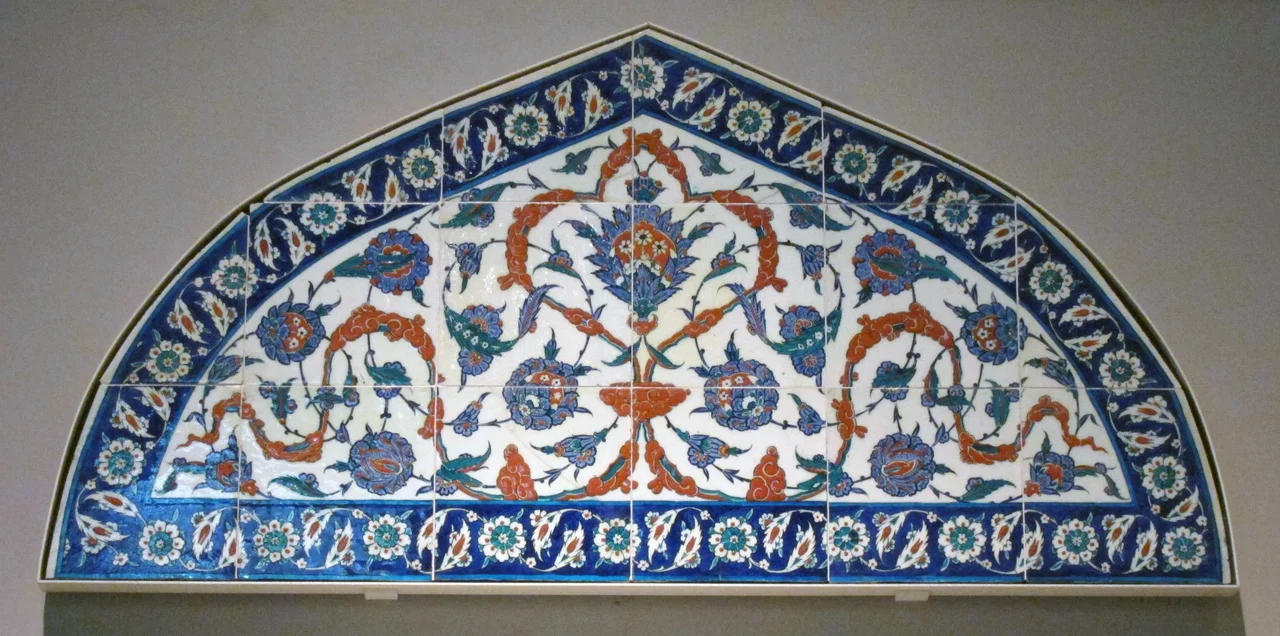
The Piyale Pasha Mosque once possessed an exceptional collection of Iznik lunette panels — arched decorative tiles that would have been placed above the lower windows. Sometime in the 19th century, a number of these panels disappeared, and they have since been traced to three of the world's great museums: the Musée du Louvre in Paris, the Museu Calouste Gulbenkian in Lisbon, and the Victoria and Albert Museum in London. Two additional tiles from a lunette panel and a pair that probably came from the mihrab were sold at Christie's in 2004. Whether the tiles were taken from the mosque itself or from a now-demolished kiosk associated with the complex is unclear, but their dispersal across European collections is a reminder of how thoroughly the 19th century stripped Ottoman monuments of their decorative layers.
The Mausoleum and the Family
To the northwest of the mosque stands a domed octagonal mausoleum, where Piyale Pasha is buried alongside his sons and daughters — thirteen sarcophagi in total. His wife Gevherhan Sultan, the emperor's daughter, is not among them. She remarried after Piyale Pasha's death and was eventually interred in the mausoleum of her father, Sultan Selim II, located beside Hagia Sophia. The separation speaks to the different trajectories available to Ottoman imperial women and to the men who married into the dynasty. The mosque complex, with its mausoleum and garden, has survived relatively intact in a neighborhood that has changed considerably around it.
A Quiet Anomaly
The Piyale Pasha Mosque sits in Kasımpaşa, a working district of Istanbul that sees considerably fewer visitors than the monuments of the historic peninsula or Sultanahmet. It is not a tourist destination in any conventional sense. But for those interested in the full range of Ottoman architectural experimentation, it is essential — the one place where Sinan set aside the vocabulary he had developed across a lifetime of buildings and tried something genuinely different. Whether the six-dome design represents a conscious reference to earlier Islamic architecture, an experiment that didn't take hold, or simply a commission that pushed him in an unexpected direction, the mosque remains one of the most thought-provoking buildings in Istanbul.
From the Air
The Piyale Pasha Mosque stands at approximately 41.045°N, 28.966°E in the Kasımpaşa neighborhood on the European side of Istanbul, overlooking the northern shore of the Golden Horn. From the air at 3,000–5,000 feet, the mosque is visible northeast of the historic peninsula, close to the water on the Beyoğlu (north) bank of the Golden Horn. The nearest major airport is LTFM (Istanbul Airport), approximately 30 km to the northwest. The mosque's low profile and six-dome roofline are best distinguished from lower altitudes; the Galata Tower to the south-southwest provides a useful orientation landmark.
Nearby Stories
- Kocaeli Peninsula 7.6 km away
- Second Battle of Çatalca 11 km away
- Istanbul's Rural Outskirts 14 km away
- MV Struma 20 km away
- HMAS AE2 36 km away
- Bursa 66 km away
- Sangarius Bridge 71 km away
- Januarius MacGahan 101 km away