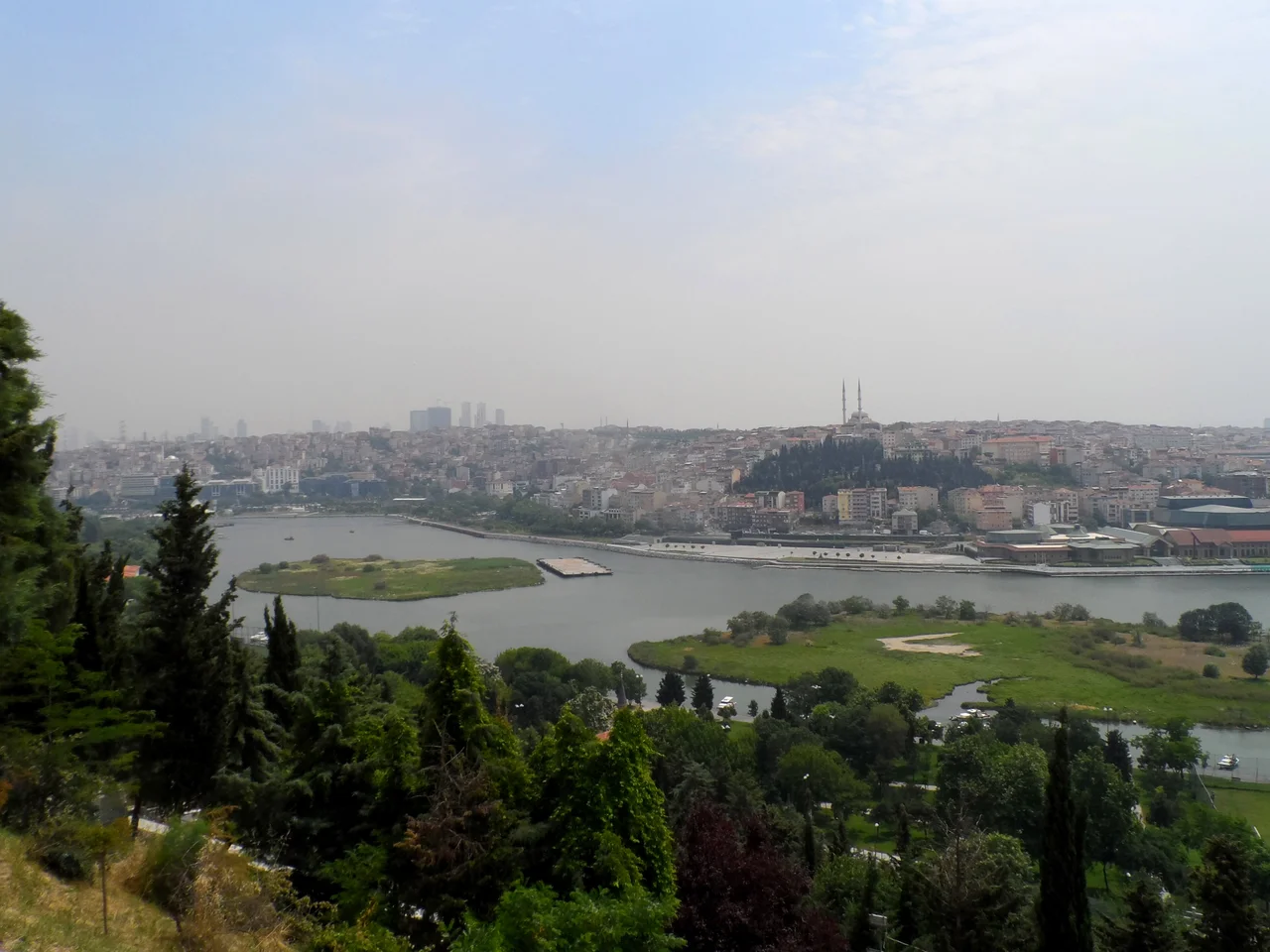

Piyer Loti Museum
Pierre Loti arrived in Istanbul for the first time in 1876, a young French naval officer with a gift for languages and an appetite for the unfamiliar. He came back repeatedly over the following decades, drawn to the city's waterways, its cemeteries, its layered coexistence of cultures. He frequented a coffeehouse on a hill above the Golden Horn in the Eyüp district, and there — looking out at the inlet and the rooftops below — he completed his 1879 novel Aziyadé, a love story set in Ottoman Istanbul. The coffeehouse survived him. The hill took his name. And today the room where he wrote has become a small museum, free of charge, where visitors can sit with his gramophone and his typewriter and look out at the same view.
The Hill with Many Names
The hill above Eyüp has been a destination for centuries, though not always under its current name. The 17th-century Ottoman traveler Evliya Çelebi, whose ten-volume account of his journeys across the empire remains one of the great documents of early modern travel writing, recorded the area as the İdris Köşkü Mesiresi — the İdris Mansion resort — a popular picnic ground for Istanbul residents. By the 19th century, a coffeehouse called the Rabia Kadın Kahvesi had established itself on the hilltop, taking advantage of the exceptional view of the Golden Horn below. The hill was then, as now, not particularly high — about 70 meters — but positioned well enough that the entire inlet stretches out beneath it, with the minarets and rooftops of the historic city visible across the water.
The Writer Who Stayed
Pierre Loti — born Louis Marie Julien Viaud in 1850 — was one of the most widely read French novelists of the late 19th century. He wrote under a pen name, traveled throughout the world as a naval officer, and wove his experiences into fiction that blended autobiography, travel writing, and romance. Aziyadé, published in 1879, tells the story of a British officer's love affair with a Circassian woman in Istanbul and is largely autobiographical in tone. The novel brought Ottoman Istanbul to French readers at a time when few Westerners had direct access to the city, and it shaped European perceptions of the place for decades. Loti returned to Istanbul throughout his life, maintaining connections to the city and its people that went well beyond the visit that produced his most famous book.
The Coffeehouse and the Museum
The Rabia Kadın Coffeehouse, now called the Piyer Loti Coffeehouse, still operates on the hilltop. A portion of it has been set aside as the Piyer Loti Museum — a small, free-of-charge exhibition space housing photographs of Loti and his Istanbul circle, copies of his novels, and objects associated with him: a gramophone, a typewriter. The museum does not aim at comprehensiveness. It aims at atmosphere. Visitors can walk through the rooms where Loti worked, then step onto the terrace to look out at the Golden Horn below, understanding something of what drew him here repeatedly and what he found when he sat down to write. The coffeehouse functions simultaneously as a tourist landmark and a working cafe, with souvenir shops at its entrance and a cable car service installed by the Istanbul municipality for visitors who prefer not to walk up the hill.
Eyüp and the Sacred Neighborhood
The hill sits at the southern edge of Eyüp, one of Istanbul's most significant neighborhoods for Muslim religious life. The Eyüp Sultan Mosque, which marks the tomb of Abu Ayyub al-Ansari — a companion of the Prophet Muhammad who died during the Arab siege of Constantinople in the 7th century — draws pilgrims from across Turkey and beyond. The neighborhood's cemetery is one of the oldest and most visited in the city. Pierre Loti, as a Westerner drawn repeatedly to a district defined by Ottoman and Islamic tradition, was himself something of an anomaly on this particular hillside. That the coffeehouse bearing his name has endured in this neighborhood, becoming part of its visitor landscape, speaks to Istanbul's persistent capacity to hold different kinds of memory in proximity.
The View That Made the Novel
What made the Rabia Kadın hilltop compelling for Loti, and what makes the Piyer Loti Museum worth the climb, is the view. At 70 meters above sea level, the Golden Horn opens below in its full extent — a narrow inlet cutting through the city, its banks lined with mosques, bridges, and neighborhoods that have been here in various forms for fifteen hundred years. On clear days, the Bosphorus is visible in the distance, connecting the Black Sea to the Marmara. Loti understood that the view from this hill offered something rare: a perspective on a city that was, even in the 1870s, beginning to change faster than most people recognized. He came to the coffeehouse, ordered his coffee, looked out, and wrote. The museum preserves the fact of that choice, which is perhaps the most important thing it has to preserve.
From the Air
The Piyer Loti Museum sits at approximately 41.054°N, 28.934°E on a hilltop in the Eyüp district, on the European side of Istanbul at the northern end of the Golden Horn. From the air at 2,000–4,000 feet, the hilltop location is distinctive: it rises just south of where the Golden Horn narrows toward its western terminus, with the large Eyüp Sultan Mosque complex visible at the base of the hill near the waterfront. The nearest major airport is LTFM (Istanbul Airport), approximately 25 km to the northwest. Morning approaches from the west offer the best views of the Golden Horn in good light.
Nearby Stories
- Kocaeli Peninsula 7.6 km away
- Second Battle of Çatalca 11 km away
- Istanbul's Rural Outskirts 14 km away
- MV Struma 20 km away
- HMAS AE2 36 km away
- Bursa 66 km away
- Sangarius Bridge 71 km away
- Januarius MacGahan 101 km away