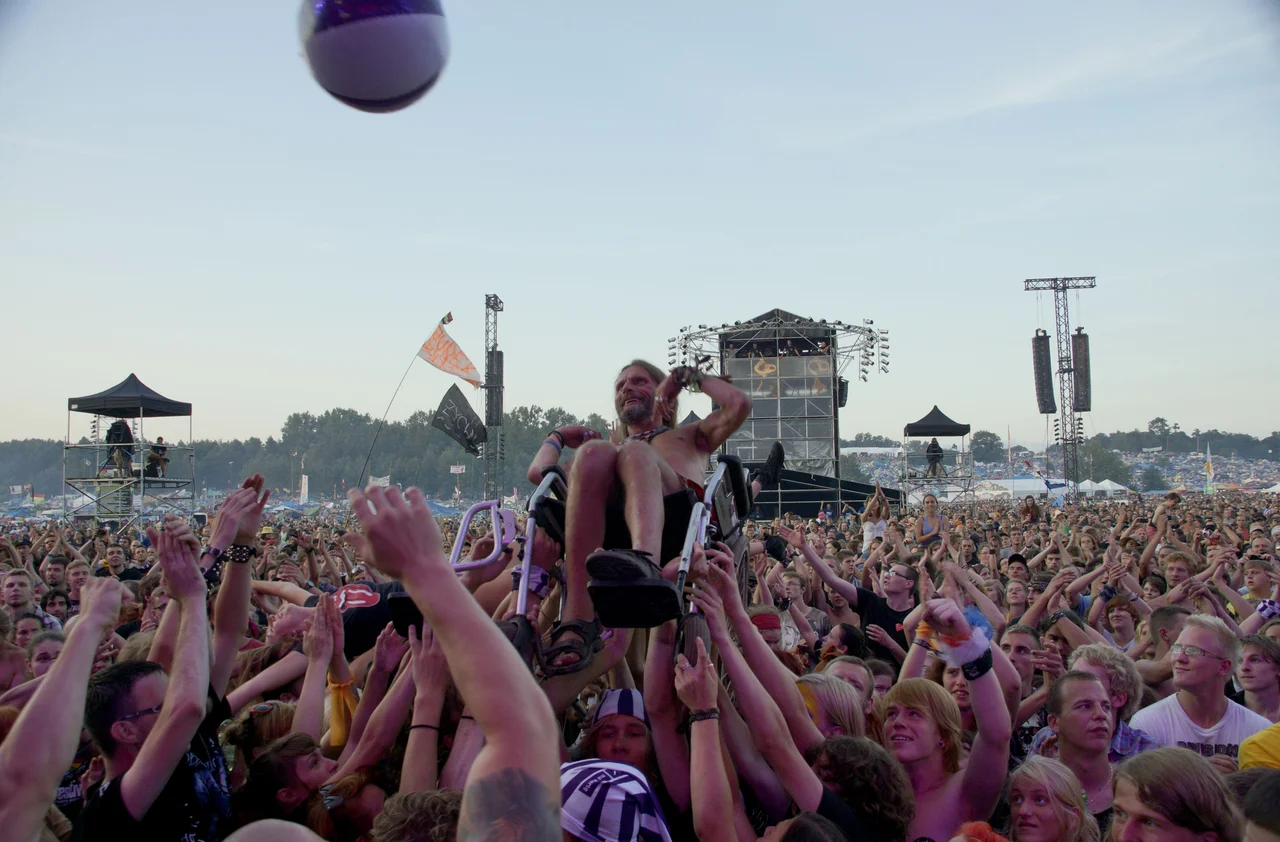

Pol'and'Rock Festival
The name came from a television show. In the mid-1990s Poland was watching Northern Exposure, retitled for local broadcast as Przystanek Alaska — Alaska Station — and it was enormously popular. So when Jerzy Owsiak came home from the twenty-fifth-anniversary Woodstock festival in New York State with an idea, the thing he founded in 1995 was called Przystanek Woodstock: Woodstock Station. A place you stop at rather than buy your way into. Three decades and several addresses later it has never once charged admission, it has drawn crowds of three-quarters of a million, and for sixteen summers its address was a set of flat fields on the Polish-German border outside Kostrzyn nad Odrą.
Love, Friendship, Music
That is the official motto, and the economics behind it are unusual enough to explain a lot. The festival is staged by the Great Orchestra of Christmas Charity, Poland's enormous annual fundraising drive, as a thank-you to the volunteers who make the collection happen. Nobody is buying a ticket because nobody is selling one. Stages run continuously from early afternoon until dawn — two at first, five in later years — with around thirty bands a season and a competition beforehand that hands slots to unsigned acts. The billing has stayed deliberately wide. Rock is the spine, but folk, reggae, electronica, experimental music and classical have all had their turn, and Polish regulars like Dżem, Hey, Riverside, Acid Drinkers, Myslovitz and Maria Peszek have shared the running order with Skunk Anansie, The Stranglers, Papa Roach, Within Temptation, Shaggy and the violinist Nigel Kennedy.
Czymanowo, Szczecin, Żary
The first edition ran on 15 and 16 July 1995 at Czymanowo near Gnewin, by Żarnowieckie Lake, with Carrantouhill, Skankan, Żuki, Myslovitz, Ira and Urszula playing and no alcohol sold at all — a rule inherited from the legendary Jarocin festivals. Szczecin-Dąbie hosted 1996, where the prohibition was partly lifted and beer appeared. From 1997 the festival settled at Żary; that year's edition, planned for July, was pushed to 16 and 17 August by the catastrophic flood that hit much of Poland. Nearly fifty bands played in 1998 to almost 150,000 people, and 1999 pushed close to 200,000. Then 2000 collapsed: a planned move to Lębork ran into permit trouble and organised opposition from a local Committee for the Defence of Morality, and the festival was cancelled. More than a thousand people came anyway and held an unauthorised rock-and-roll picnic with no bands at all, an event affectionately remembered as Dziki Przystanek — the Wild Station. Żary hosted again in 2001, was filmed in 2002 for a concert film released across Polish cinemas the following year, and hosted for the last time in 2003.
Sixteen Summers on the Oder
From 2004 the fields north of Kostrzyn nad Odrą took over, and the scale became genuinely difficult to picture. Over 400,000 people came in 2009. In 2011 attendance passed 700,000; 2012 drew around 550,000 and 2013 around 500,000; 2014 set a record at roughly 750,000, matched again in 2019. Kostrzyn itself has fewer than eighteen thousand residents. For one weekend a year the population of a mid-sized European city assembled on farmland at a border crossing and then dispersed. The Prodigy and Helloween played in 2011. Sabaton recorded Swedish Empire Live here in 2012. Anthrax came in 2013, Accept in 2014, Black Label Society in 2015, Judas Priest and Arch Enemy in 2018, and Prophets of Rage closed out the final Kostrzyn edition in 2019.
The Academy of Finest Arts
Between the sets, something less predictable runs alongside. The Akademia Sztuk Przepięknych — the Academy of Finest Arts — puts young audiences in front of politicians, writers, film-makers and clergy for open panel discussions, and the guest list reads like a cross-section of Polish public life since 1989: Lech Wałęsa, Tadeusz Mazowiecki, Bronisław Komorowski, Jerzy Buzek, Leszek Balcerowicz, the Nobel laureate Olga Tokarczuk, Andrzej Wajda, Agnieszka Holland, Jerzy Stuhr, Adam Bodnar. Kesang Takla, the Dalai Lama's representative for northern Europe, has appeared. So has Joachim Gauck, the German president, at the 2012 festival — a German head of state standing on ground his country had fought over within living memory, addressing a Polish crowd. Dozens of NGOs set up stalls, from Greenpeace to Polish Humanitarian Action.
New Name, New Address
On 8 March 2018 the festival changed its name to Pol'and'Rock, the result of a licensing dispute with the agency representing Michael Lang, one of the promoters of the original Woodstock. The replacement carries its own argument — rock and roll on one side, Poland's democratic and freedom movements on the other — and the organisers were emphatic that only the name had moved. Then the address moved too. Limp Bizkit and Static-X were booked for 2020 before the pandemic cancelled everything; that year's edition was livestreamed from a studio in Szeligi near Warsaw. In 2021 a limited-capacity festival ran on the Makowice-Płoty airfield in Western Pomerania, and since 2022 it has been held on the Broczyno airfield at Czaplinek. The Kostrzyn fields are farmland again, quiet from one end of the summer to the other.
From the Air
The former festival grounds lie at roughly 52.611°N, 14.670°E, on flat farmland immediately north of Kostrzyn nad Odrą in Lubusz Voivodeship. Note before you go looking: the festival has not been held here since 2019 — it moved to the Broczyno airfield near Czaplinek in Western Pomerania in 2022 — so what you will see is agricultural land, not infrastructure. Fly 1,500 to 3,000 ft AGL. Navigate by the Warta-Oder confluence a couple of kilometres south, the clearest landmark for a hundred kilometres in any direction, with the ruined star-shaped fortress on the tongue of land between the rivers and the Warta Mouth wetlands spreading east. The Oder is the German-Polish border here, so mind the airspace. Nearest airports: Berlin Brandenburg (EDDB) about 85 km west, Zielona Góra-Babimost (EPZG) about 90 km southeast, Szczecin-Goleniów (EPSC) about 110 km north. Terrain is flat and open; summer haze and morning river fog are the main visibility factors.
Nearby Stories
- Słubice 4 km away
- Kingdom of Prussia 11 km away
- St. Mary's Church, Chojna 12 km away
- Gorzów Wielkopolski 13 km away
- Storkow Castle 17 km away
- Swiss International Air Lines Flight 850 20 km away
- Stalag Luft III 88 km away
- Stutthof Concentration Camp 309 km away