
Prison of Anemas
At the far northwestern corner of Constantinople's great land walls, where the suburb of Blachernae climbs toward the Golden Horn, two towers rise from a mass of Byzantine masonry that is almost brutally thick — 11 to 20 metres through the stone. Nothing about the structure announces its purpose. No inscriptions survive. No gates mark it as a place of confinement. But for more than two centuries, the fortress complex known as the Prison of Anemas served the Byzantine Empire as a repository for the men its rulers most feared: deposed emperors, failed conspirators, inconvenient relatives. The people held here were not faceless enemies. They were, in almost every case, members of the ruling class — sometimes members of the same family as the emperor who imprisoned them. Understanding this place means understanding both the architecture of power and the very human suffering that power could inflict.
Stone and Brick, Layer upon Layer
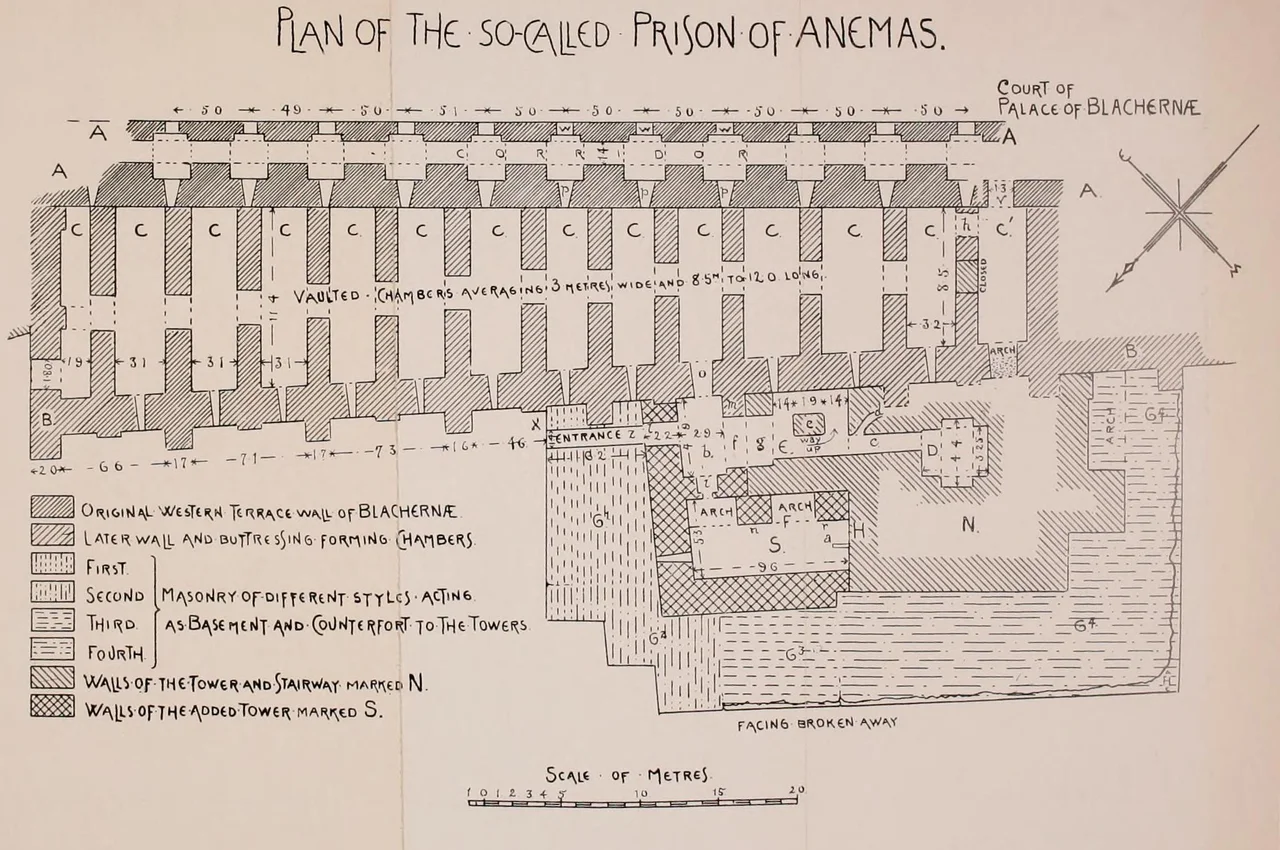
The building is a puzzle in masonry. Its outer wall rises 23 metres above the ground outside — a sheer, windowless face that presents nothing to the world. Behind it, twelve three-storied compartments sit in a row, separated by transverse buttress-walls pierced by brick arches. The basement level is completely without windows. The upper levels receive only thin strips of light through small openings in the western wall. Whether these compartments were prison cells, storage rooms, or barracks remains genuinely unclear; the archaeological evidence is ambiguous enough that scholars have been arguing about it for generations.
The two towers flanking the main block were added at different dates and differ strikingly in character. The southern tower — often identified as the Tower of Isaac Angelos, built by Emperor Isaac II Angelos (r. 1185–1195, 1203–1204) — is rough and irregular, assembled partly from salvaged stone columns pulled from ruined churches. The northern tower, identified as the Tower of Anemas proper, is more carefully finished, with the neat alternating courses of stone and brick that mark the best Byzantine construction. A spiral staircase connects the whole complex. Inconsistencies in the windows and successive phases of alteration reveal a structure that accumulated meaning slowly, over generations.
Named for a Man Who Was Spared
The prison takes its name from Michael Anemas, a Byzantine general who conspired against Emperor Alexios I Komnenos and was captured around 1105. According to Anna Komnene's chronicle The Alexiad, Anemas and his co-conspirators were sentenced to imprisonment and blinding — the standard Byzantine punishment for treason, which destroyed a man's political viability without necessarily ending his life. As Anemas was led through Constantinople's main thoroughfare, the Mese, the crowd's visible distress at his condition moved Anna herself. Together with her mother, she pleaded his case before Alexios. The emperor relented: Anemas was not blinded. He was imprisoned in the tower that would take his name, and eventually pardoned.
The story of Michael Anemas is, by the brutal standards of what followed, almost a story of mercy. He suffered years of confinement, but he walked out with his eyes. Not everyone would be so fortunate.
Emperors Behind the Same Walls
What distinguishes the Anemas Prison from other Byzantine places of detention is the rank of those who passed through it. Andronikos I Komnenos, who had seized the throne after a period of violent political upheaval, spent his last night here before being led out on September 12, 1185 to a public execution in the Hippodrome. He had been emperor for two years. Now he was a prisoner awaiting death, held in the same stone compartments where lesser men had waited before him.
The pattern repeated. John Bekkos, the scholarly chartophylax of the Hagia Sophia — a man of ideas, not violence — was imprisoned here for opposing Emperor Michael VIII Palaiologos's effort to reunite the Eastern Orthodox and Roman Catholic churches. His offense was intellectual disagreement. In the 1370s, Emperor John V Palaiologos imprisoned his own eldest son, Andronikos IV, in these towers after Andronikos rebelled. The son escaped with Genoese and Ottoman help, seized the throne for three years, and then imprisoned his own father and brothers in the very same place. A father jailed by the state; a son who escaped; that same son's father, now a prisoner in the Anemas. The building had become a mirror of dynastic catastrophe.
The Weight of the Walls
Standing outside the Theodosian walls today, looking up at the Anemas complex from the road below, it is the sheer scale that first registers. Twenty-three metres of stone rising above you is not an abstraction. It is a physical fact about what confinement meant — walls you could not scale, windows barely wider than a hand, and below the main structure, basement rooms with no openings at all.
The people held here suffered in ways that were real and specific. Blinding — gouging or burning the eyes — was performed as a deliberate political act, intended to incapacitate rather than to kill. John IV Laskaris, the legitimate child emperor whose guardian Michael VIII Palaiologos seized power for himself in 1259, was blinded and imprisoned after Michael's triumphant return to Constantinople in 1261. He was a boy. The historical record moves on from him almost immediately, as the new dynasty had reason to want him forgotten.
These were not abstractions. They were people who had childhoods, who had names, who had people who cared about them. The Anemas Prison held them inside walls built to ensure they would not matter anymore.
What Remains
The Prison of Anemas stands today in Istanbul's Ayvansaray neighborhood, incorporated into the surviving stretch of the ancient land walls. It is not a museum. The towers are accessible on foot for those willing to explore the old walls on the western edge of the historic peninsula, though the site requires attention and patience to find.
Archaeologists and historians continue to debate the structure's phases: which tower came first, which emperor built which section, whether the compartments functioned as cells or storage. The uncertainty is itself instructive. The Byzantines left little documentation of what happened inside these walls — which may be exactly what was intended. A place of political erasure tends not to generate records. What has survived is the stone itself: massive, layered, enduring, and thoroughly indifferent to the fates of the people it once contained.
From the Air
The Prison of Anemas sits at 41.0385°N, 28.9408°E in the Blachernae district of Istanbul's historic peninsula, near the northwestern corner where the land walls meet the Golden Horn. From the air at 3,000 feet, the surviving stretch of Theodosian and Byzantine walls is clearly visible as a long ridge of stone running roughly north-south. The twin towers of the Anemas complex are identifiable near the northern terminus of the land walls, just before they reach the shoreline. The nearest major airport is LTFM (Istanbul Airport), approximately 30 km to the northwest. On approach or departure from LTFM, the historic peninsula with the Hagia Sophia, Blue Mosque, and Topkapı Palace is visible to the southeast. Fly at or below 2,000 feet for the best ground detail of the wall sections.
Nearby Stories
- Kocaeli Peninsula 7.6 km away
- Second Battle of Çatalca 11 km away
- Istanbul's Rural Outskirts 14 km away
- MV Struma 20 km away
- HMAS AE2 36 km away
- Bursa 66 km away
- Sangarius Bridge 71 km away
- Januarius MacGahan 101 km away