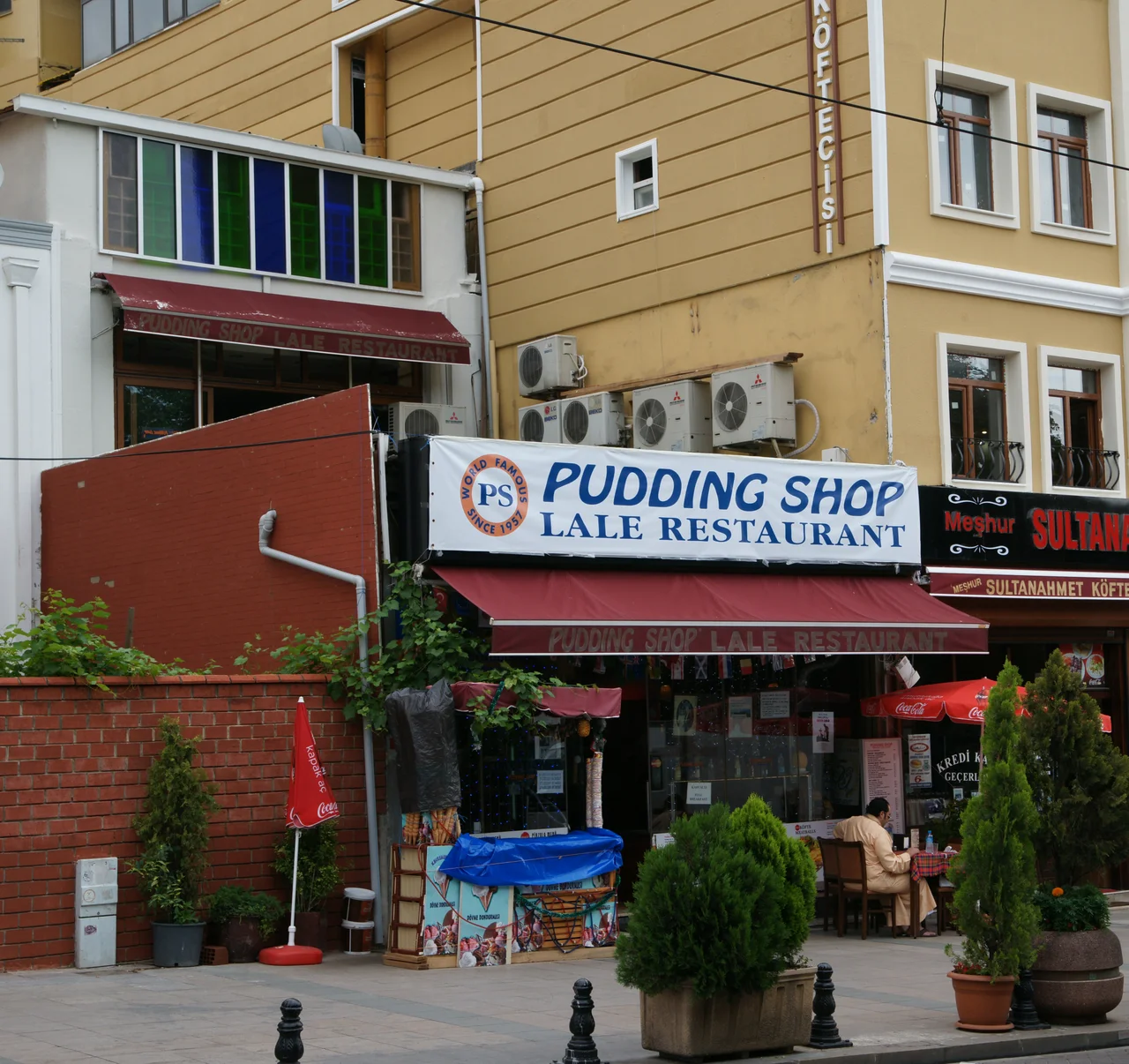

Pudding Shop
Nobody could remember the name of the restaurant. That was the point. Thousands of travelers passing through Istanbul in the 1960s and 1970s — Americans fleeing the Vietnam era, Europeans seeking something beyond Europe, Australians making the long overland run to India — knew exactly where they were going. They called it the Pudding Shop. The actual name was the Lale Restaurant, opened in 1957 by brothers İdris and Namık Çolpan in Istanbul's Sultanahmet neighborhood, a few minutes' walk from the Blue Mosque and the Hagia Sophia. The puddings were good enough that travelers remembered them when they couldn't remember anything else. The name stuck, and a legend accreted around it.
The Halfway Point
Istanbul occupied a particular position on the overland route from Western Europe to South and Southeast Asia — the route that came to be called the hippie trail. It was the point where Europe ended and Asia began. Travelers coming from London or Amsterdam or Rome would arrive in the city already tested by days of overland travel; travelers coming from Tehran or Kabul or Kathmandu would arrive carrying stories of the east. Istanbul was where these two streams met, and the Pudding Shop was where they paused.
The restaurant's atmosphere in its heyday was informal to the point of being improvisational. Large booths and couches. Piles of books. Rock music audible but not intrusive. The walls were plain white, the decor minimal. A glass wall on one side opened the small interior. Out in the garden, with the Blue Mosque rising above the rooftops, travelers played guitars, compared notes on border crossings, and — crucially — left messages for one another on the bulletin board inside.
The bulletin board was perhaps the most important feature. In an era before mobile phones or reliable international mail, it functioned as a communication hub. Travelers would pin notes for friends who might pass through days or weeks later. Messages between family members and lovers. Warnings about particular routes. Recommendations for guesthouses in Kabul or Kathmandu. The board was a collectively maintained guide to an informal world, updated constantly by whoever happened to be passing through.
What They Ate
The food was honest, affordable, and genuinely good — which mattered enormously to travelers on tight budgets who had been eating whatever they could find for weeks. Traditional Turkish cuisine dominated the menu, with an emphasis on the dishes that kept people coming back.
The puddings were the thing. Among them was *tavuk göğsü* — a preparation that surprises almost every Westerner who encounters it for the first time. Made from pounded chicken breast mixed with rice flour, milk, and sugar, then finished with cinnamon, it is a dessert that tastes nothing like it sounds. Silky, subtly sweet, and faintly savory, it has roots in Ottoman cuisine going back centuries. That the Pudding Shop served it cheaply to travelers who would never have encountered it elsewhere was, in its modest way, a small act of cultural introduction.
Adem Çolpan, the son of founder İdris Çolpan, later recalled the atmosphere of those years: it was the time of the Vietnam War, he noted, and the travelers who filled the restaurant lived for the moment and didn't think much of tomorrow. That quality — the willing embrace of uncertainty that characterized the overland trail — was exactly what the Pudding Shop accommodated. You came in with no particular plan, ate something warm and cheap, and stayed until you had a reason to leave.
Fame and Its Costs
Fame arrived for the Pudding Shop in 1977–1978, when it was featured in *Midnight Express* — first in Billy Hayes's 1977 book (co-written with William Hoffer) and then in Alan Parker's 1978 film adaptation. The book and film depicted Hayes's imprisonment in Turkey after an attempted drug smuggling arrest, and the Pudding Shop appeared as part of the Istanbul landscape associated with the trail's culture. The association added to the restaurant's international reputation, though not always in the way the Çolpan family might have hoped.
By the time Midnight Express appeared, the hippie trail was already changing. The Islamic Revolution in Iran in 1979 closed the overland route through Tehran. The Soviet invasion of Afghanistan the same year made the Afghan portion impossible. What had been a continuous overland passage from Europe to the Indian subcontinent was severed, and with it went much of the foot traffic that had made Istanbul such a waypoint.
The Pudding Shop survived, but it changed. The garden was removed. Table service gave way to a self-service cafeteria. A large sign outside announced it as "The World Famous Pudding Shop" with a directness that would have been unthinkable in the era when no one could remember the name but everyone knew where it was.
What the Bulletin Board Became
The old bulletin board still hangs inside the Lale Restaurant today. It was never removed. But what it displays has changed entirely.
In the 1960s and 1970s, it was covered in handwritten notes — the kind that only matter deeply to the specific people involved. A message from a daughter to parents who didn't know where she was. A warning about a visa problem at the Bulgarian border. A note to a traveling companion who had gone ahead: meet me here on Thursday. These were not messages meant for posterity. They were practical communications between people in a world without reliable alternatives, pinned to a board in a restaurant in Istanbul because Istanbul was where paths crossed.
Today the messages are more practical and less personal. Information for travelers of a different era, typed or printed rather than handwritten, concerned with logistics rather than with the texture of a life in motion. The board remains; the urgency that once animated it has faded into nostalgia. A few messages from the 1960s and 1970s are kept posted — preserved as relics of what the place once was, and as evidence that the Pudding Shop understood, even in its most commercial period, that the legend it carried was worth acknowledging.
From the Air
The Pudding Shop (Lale Restaurant) sits at 41.0081°N, 28.9772°E in the Sultanahmet district of Istanbul's historic peninsula, within walking distance of the Blue Mosque (Sultan Ahmed Mosque) and the Hagia Sophia. From the air at 2,000 feet, Sultanahmet is easily identified by the distinctive six minarets of the Blue Mosque and the massive dome of the Hagia Sophia immediately to the north. The restaurant itself is on a pedestrian street between these two monuments. The nearest major airport is LTFM (Istanbul Airport), approximately 25 km to the northwest. Approaching from the west, the historic peninsula presents one of the most recognizable skylines in the world, with the domes and minarets of Sultanahmet visible well before landing.
Nearby Stories
- Kocaeli Peninsula 7.6 km away
- Second Battle of Çatalca 11 km away
- Istanbul's Rural Outskirts 14 km away
- MV Struma 20 km away
- HMAS AE2 36 km away
- Bursa 66 km away
- Sangarius Bridge 71 km away
- Januarius MacGahan 101 km away