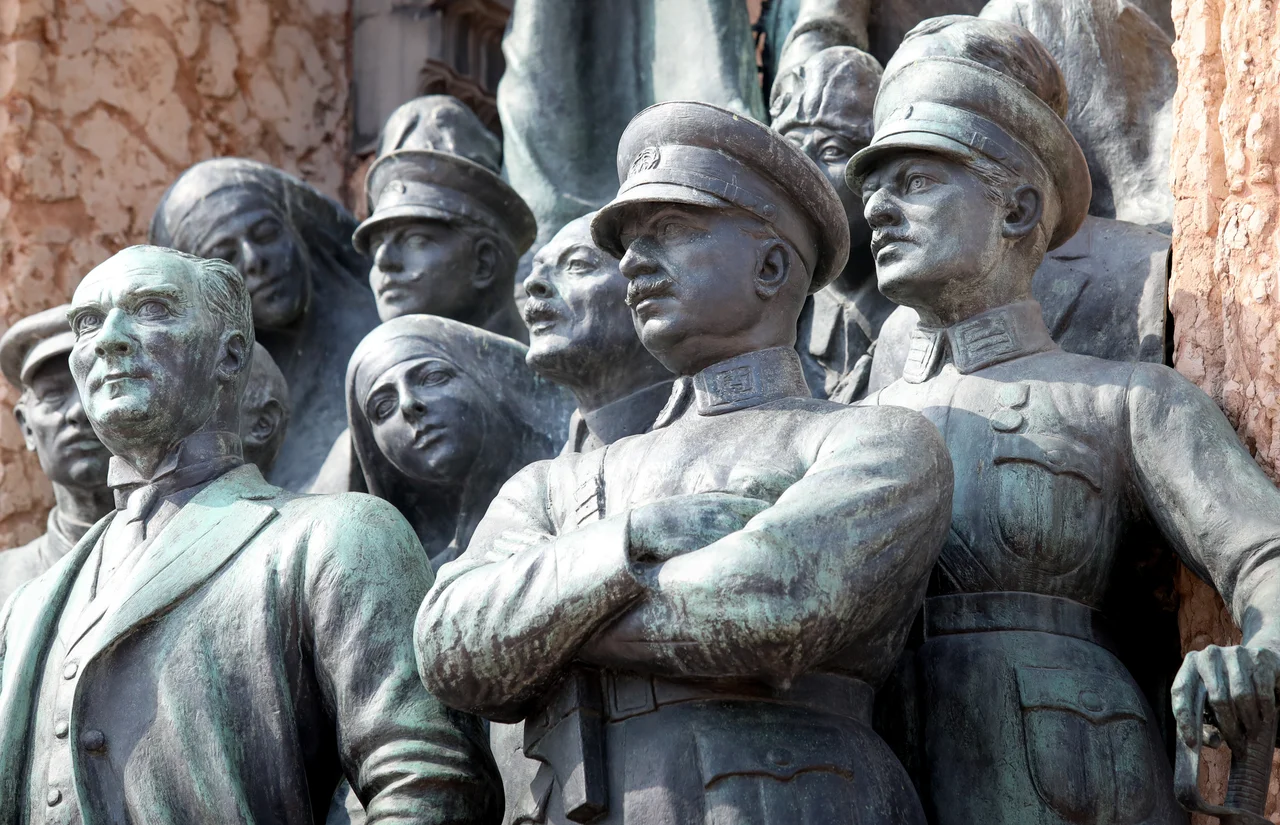

Republic Monument
On one side of the monument, the man wears a military uniform. On the other side, he wears a suit. Both figures are Mustafa Kemal Atatürk, and the two faces of the Republic Monument in Taksim Square were designed to say something precise: the man who fought for Turkey's survival was also the man who rebuilt it in peace. Unveiled on August 8, 1928 — five years after the founding of the Turkish Republic — the monument was designed by the Italian sculptor Pietro Canonica and rose 11 metres above the square that had already become the symbolic heart of modern Istanbul. What few people examining it for the first time notice is the figure standing quietly behind İsmet İnönü on the southern facade: a man in a cap, slightly to one side. His name was Semyon Aralov, and his presence in bronze was a deliberate political statement, placed there by Atatürk himself.
A Sculptor and a New Republic
Pietro Canonica was a well-established Italian sculptor when he received the commission for the Republic Monument. Born in 1869, he had worked in portraiture and monumental sculpture across Europe; he would live until 1959 and his studio in Rome became, after his death, a museum. Canonica spent two and a half years on the project. The monument was funded through contributions from the Turkish population — a detail that added a communal dimension to what might otherwise have been a purely official commission.
The result is a bronze ensemble on a stone base, 11 metres high in total, grouping the founders and leaders of the Turkish Republic around the central figure of Atatürk. Prominently depicted alongside Atatürk are İsmet İnönü, who would succeed Atatürk as president after his death in 1938, and Fevzi Çakmak, who served as the first Chief of the General Staff of the Turkish Republic. Together they represent the military and political leadership that brought the republic into being through the Turkish War of Independence (1919–1922) and the subsequent transformation of the state.
Two Faces, Two Roles
The monument's dual-sided design is its most considered element. The northern face shows Atatürk in military uniform — commander-in-chief of the forces that fought the War of Independence against Greek, Armenian, French, and British forces and their proxies, culminating in the establishment of the republic in 1923. This is Atatürk as general, the man who won the war.
The southern face, looking toward İstiklal Avenue and the commercial and social life of modern Istanbul, shows Atatürk and his colleagues in Western civilian clothing. This is Atatürk as statesman: the man who abolished the sultanate and the caliphate, replaced Ottoman script with the Latin alphabet, introduced the Western calendar, and systematically reorganized the Turkish state along secular, modernist lines. The contrast between the two sides is architectural shorthand for an entire historical argument: that the military victory and the political transformation were equally essential, and that the same man was responsible for both.
The square in front of the southern face — Taksim Square — has since become Istanbul's primary venue for public assembly, political demonstration, and national celebration. Official ceremonies on national holidays regularly use the monument as their focal point.
The Man in the Cap
Behind İsmet İnönü on the southern facade, a figure stands slightly removed from the main group. He wears a cap distinctive enough to be identified — the style associated with Soviet and Eastern European wear of the period. He is Semyon Ivanovich Aralov, who served as the ambassador of the Russian Soviet Federative Socialist Republic to Ankara during the Turkish War of Independence.
Aralov's presence in the monument was not accidental and not merely diplomatic courtesy. His inclusion, ordered by Atatürk, was a deliberate acknowledgment of the material support that Vladimir Lenin's Soviet government provided to the Turkish nationalist movement in 1920, during the War of Independence. That support — financial and military — arrived at a moment when the nationalists were under pressure from multiple directions and Western powers were backing their opponents. The Soviet aid was significant, and Atatürk chose to encode gratitude for it in stone and bronze at the center of his new republic's most visible monument.
It is an unusual gesture: a head of state commissioning a public monument that gives permanent, prominent placement to a foreign diplomat in recognition of wartime support. That the monument still stands in Taksim Square, Aralov's figure still present in his distinctive cap, makes it a quietly remarkable artifact of early 20th-century geopolitics.
Taksim Square Today
Taksim Square has changed substantially since 1928. The open space around the monument has been redesigned multiple times; the famous Gezi Park at its edge became the site of major political protests in 2013. İstiklal Avenue, running from the square toward the Galata neighborhood, remains one of Istanbul's busiest pedestrian streets, lined with shops, restaurants, and the historic buildings of the late Ottoman and early republican periods.
The Republic Monument stands at the center of all of this — not exactly unchanged, since the surrounding square has been in constant flux, but present and maintained, still used for the official ceremonies Atatürk intended it to anchor. On October 29, the anniversary of the republic's founding, and on other national holidays, the square fills and the monument becomes the focal point of public commemoration.
For a visitor approaching from İstiklal Avenue, the monument appears at the top of the avenue's gentle rise: a cluster of bronze figures, Atatürk at the center facing south, the republic's founders arranged around him, and behind them — for anyone who knows to look — the quiet figure of a Soviet ambassador in a cap, standing in bronze in the square of the city that once was the capital of the Ottomans.
From the Air
The Republic Monument stands at 41.0369°N, 28.9850°E in Taksim Square, in the Beyoğlu district of Istanbul on the European side of the Bosphorus. Taksim Square is located on a ridge above the old city, roughly 2 km north of the Golden Horn. From the air at 3,000 feet, the square is identifiable by the open paved area surrounded by dense urban fabric; İstiklal Avenue runs southwest from the square as a clearly defined pedestrian corridor. The nearest major airport is LTFM (Istanbul Airport), approximately 28 km to the northwest. On approach to LTFM from the east, the Bosphorus and the historic peninsula are visible to the south, while Taksim and the Beyoğlu/Galata neighborhoods form part of the European city skyline north of the Golden Horn. The monument itself is not visible from altitude but the square can be located by the open space at the top of İstiklal Avenue.
Nearby Stories
- Kocaeli Peninsula 7.6 km away
- Second Battle of Çatalca 11 km away
- Istanbul's Rural Outskirts 14 km away
- MV Struma 20 km away
- HMAS AE2 36 km away
- Bursa 66 km away
- Sangarius Bridge 71 km away
- Januarius MacGahan 101 km away