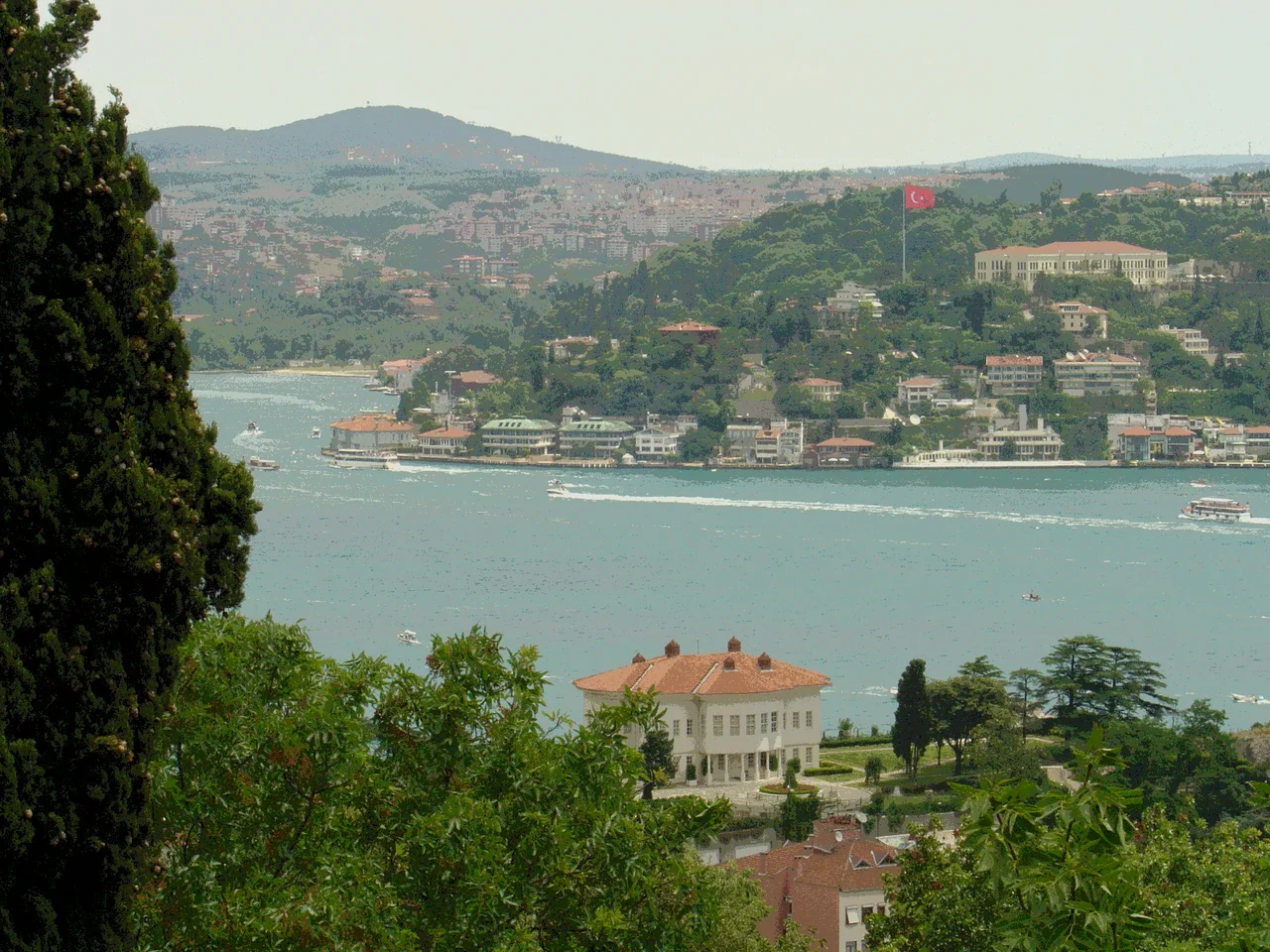

Robert College
In the fall of 1863, as the American Civil War raged across the Atlantic, a small school opened on the shore of the Bosphorus with four students, a $2,120 library fund, and 200 donated books from Harvard University. Christopher Robert, a wealthy New York textile merchant, had funded the venture. Cyrus Hamlin, a Congregationalist missionary who had been making bread in Constantinople to support himself, became its first president. They called it Robert College. More than 160 years later, it is still operating — on a wooded campus above the straits, still sending its graduates to Ivy League universities, still officially the oldest continuously operating American school outside the United States. The four original students have become many thousands of alumni, among them Nobel laureate Orhan Pamuk, three Turkish prime ministers, four Bulgarian prime ministers, and generations of scientists, poets, and engineers.
A School Born Between Empires
Hamlin and Robert founded the college during the final decades of the Ottoman Empire, and the school grew up inside that friction between worlds. The Ottoman Sultan gave permission for a permanent campus to be built in Bebek, just above the Rumelihisarı fortress, and the first buildings went up on that ridge overlooking the Bosphorus. Getting a Muslim student enrolled in the early years was essentially impossible — the Ottoman government frowned on Muslims attending Christian chapel services, which was then a school requirement — and so the student body was drawn largely from the empire's Christian minorities: Greeks, Armenians, Bulgarians. That mix left its own legacy. Bulgarian politicians and diplomats who had trained at Robert College shaped their country's institutions for decades. A German lecturer named Friedrich Schrader, writing in the 1890s, noted the school's proximity to a Bektashi tekke whose leaders maintained cordial relations with the school's Presbyterian and Congregationalist founders — a snapshot of the unlikely alliances the college drew together.
The Washburn Years and the Making of a Reputation
George Washburn became the college's de facto leader from 1871, officially named president in 1877, and served until 1903. During those years he assembled, in the words of the college catalog, 'a faculty of distinguished scholars who firmly established the college's academic reputation.' Christopher Robert died in 1878, leaving a significant portion of his estate to the institution he had created. The campus expanded. The buildings — neoclassical in style, designed by the American firm Shepley, Rutan and Coolidge — rose one by one against the hillside overlooking the strait. Gould Hall, the oldest educational building still standing, was a gift from Helen Gould Shepard, daughter of the Wall Street financier Jay Gould, who donated $150,000 for its construction in 1911. Its cornerstone was set by the U.S. Ambassador to the Ottoman Empire; inside it is a time capsule. Ionic columns frame the entrance. Ivy and wisteria cover the walls. The campus today covers 65 acres of wooded hillside, and the Bosphorus Beetle — an endemic insect species found nowhere else on Earth — lives here.
Transformation: The Gift to Turkey
By the 20th century, Robert College had grown into something larger than a school. It had a university section, a preparatory academy, and an affiliated women's college — the American College for Girls. The Turkish Republic's modernization demanded homegrown universities, and in 1971 that tension resolved in a remarkable act of institutional generosity: the college donated its Bebek campus — the original ridge-top campus above the Bosphorus — to the Republic of Turkey, which transformed it into Boğaziçi University, one of Turkey's most selective public institutions. Robert College itself relocated to the Arnavutköy campus of the former American College for Girls, where it continues to operate as a private high school. The handover was not a defeat but a deliberate choice, though it left the school straddling an unusual identity — a college in name only, legally a high school, yet maintaining a culture and alumni network of genuinely university-like weight and reach.
The School That Shapes the City
Today Robert College accepts between 180 and 220 students per year from a pool of every Turkish student who takes the national LGS examination — only those in the top 0.2 percentile qualify. The roughly 1,000 students on campus at any given time represent Turkey's most academically competitive cohort. In 2011 alone, 53 graduates planned to study abroad, with 8 headed to Ivy League universities; of 79 students who applied abroad, 75 received offers. The school introduced basketball to the Ottoman Empire in 1907. The first student council in Ottoman history was formed here in 1908. It has been the subject of nationalist novels, government pressure, and conspiracy theories — all of which suggest, in their way, how seriously it is taken. The alumni magazine reaches 10,000 graduates worldwide. Orhan Pamuk attended and went on to win the Nobel Prize in Literature. The school's impact on Turkish intellectual and political life over 160 years is quietly enormous, rooted in that unlikely beginning beside the Bosphorus, four students and a borrowed library.
From the Air
Robert College sits at 41.067°N, 29.035°E on a wooded hillside above the European shore of the Bosphorus, in Istanbul's Beşiktaş district. Approaching from Istanbul Airport (LTFM) to the northwest, the campus is identifiable as a dense cluster of neoclassical and modern buildings set in forested terrain above the strait, roughly halfway between the Bosphorus Bridge (15 July Martyrs Bridge) to the south and the Fatih Sultan Mehmet Bridge to the north. The Rumelihisarı fortress is visible just to the north along the waterfront. Recommended viewing altitude: 2,500–4,500 feet for a clear view of the campus against the Bosphorus. The strait narrows noticeably at this latitude, making the geography that defined the college's founding immediately visible from the air.
Nearby Stories
- Kocaeli Peninsula 7.6 km away
- Second Battle of Çatalca 11 km away
- Istanbul's Rural Outskirts 14 km away
- MV Struma 20 km away
- HMAS AE2 36 km away
- Bursa 66 km away
- Sangarius Bridge 71 km away
- Januarius MacGahan 101 km away