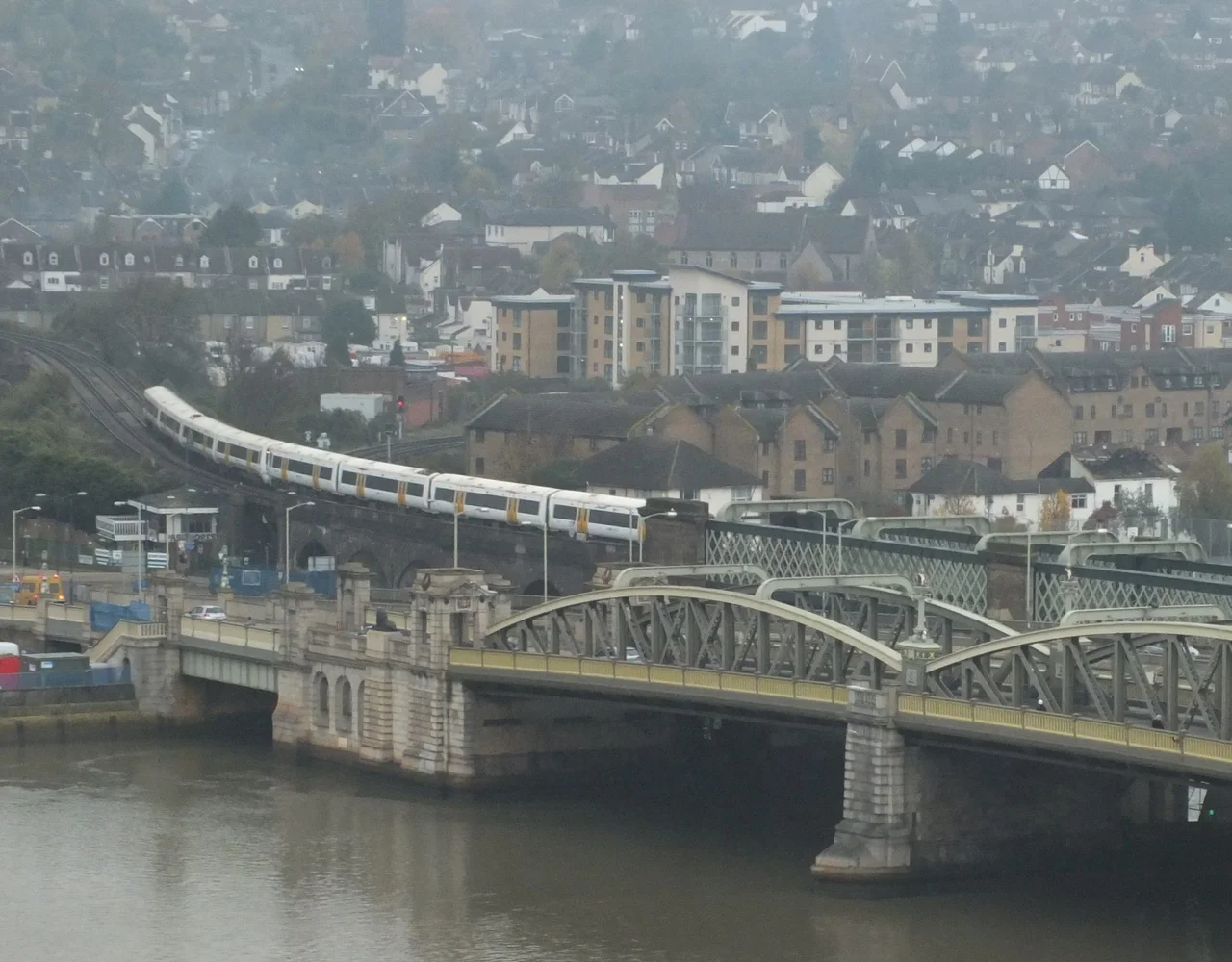

Rochester Bridge
The Romans crossed the River Medway here some time around AD 43, on the orders of Emperor Claudius, and built what was probably the first major bridge in Britain. Their engineers sank circular cofferdams of timber piling around each pier site, packed the gap between the rings with clay until the water stopped seeping in, and pumped the inside dry to give themselves a working floor on the riverbed. Onto chalk bedrock they drove iron-tipped oak piles, set stone-faced piers on top, and laid down an oak beam-and-plank deck. The wooden deck rotted, then was replaced, then rotted again. The piers underneath did not rot. They were still there when Victorian engineers, twelve hundred years later, found Roman stonework beneath the river while building yet another bridge on the same line.
The Bridge That Kept Falling Down
By the late fourteenth century the Romans' piers were carrying a wooden Middle Ages deck, and that deck was in trouble. The bridge was administratively a patchwork - responsibility for keeping it standing was divided among local landowners, who often refused to pay. In 1311 the King's bailiff William Mot rode out to Westerham to seize a horse and five cows from tenants who had skipped their share; the tenants chased him down, freed the animals, and one Richard Trewe 'beat the said William'. Despite occasional repairs, the bridge collapsed with about the regularity of a fragile clock. In 1339 the river crossing was down for twenty-four weeks. In 1361 it was 'in a dangerous state' for three weeks and a boat had to be hired as a ferry. In 1264 it had been worse than dangerous - Simon de Montfort had besieged the gatehouse and set the whole bridge on fire to take Rochester. Whatever held it together was thin.
Yevele's Stone
In 1382 a royal commission was finally appointed to sort the bridge out. Among its members was Sir John de Cobham, who together with Sir Robert Knolles took the rebuilding on personally. They hired Henry Yevele, the master mason responsible for the nave of Westminster Abbey, to design a new stone bridge a hundred yards upstream of the Roman line. Yevele's bridge was finished in 1391: 560 feet long, twelve stone piers founded on starlings - pointed timber rafts forty feet long, packed with chalk and decked in elm planking - with eleven Gothic arches and a drawbridge in the fifth bay. The whole was paved in Kentish ragstone. To keep it maintained, Sir John and his fellow founders endowed a trust with property and lands, and Richard II issued letters patent in 1399 establishing the Wardens and Commonalty of Rochester Bridge. That trust still exists. It still owns much of the original endowment. It still pays for the bridge.
Cubitt's Iron
Yevele's bridge stood for four hundred and sixty-five years. It was widened in 1792 by Daniel Asher Alexander, had its two central arches merged into one in 1824 under the supervision of John Rennie the Elder and finished by Thomas Telford to give shipping more room, and finally - because nineteenth-century steamships could no longer pass the medieval arches at all - was demolished in 1856 with help from the Royal Engineers. Its replacement was Sir William Cubitt's cast iron arch bridge, set on a line a little further downstream and almost exactly where the Romans had been. Cubitt's bridge weighed over 2,500 tonnes despite looking delicate, its iron cylinders sunk through the riverbed into the bedrock by pneumatic caisson - a then-novel method that let workers excavate in compressed air below water level. On the Strood side it had a 40-foot-wide Ship's Passage with a swing bridge of six wrought iron girders mounted on a thirty-foot cast iron roller path. The whole swing section weighed three hundred tonnes and could be rotated ninety degrees by one operator.
Bowstring, New Bridge, Service Bridge
Cubitt's iron bridge was reconstructed in 1914 with bowstring trusses above the deck, at a cost of just under ninety-six thousand pounds - and the bridge remained open to traffic the whole time the work was being done. Lady Darnley opened the reconstructed bridge on 14 May 1914, three months before the First World War began. In 1970 a parallel New Bridge was opened by Princess Margaret immediately beside the old one to increase capacity, and a Service Bridge was tucked into the gap between them carrying gas, electricity, water, sewage, and communications. The old LCDR railway bridge, abandoned when the Chatham Main Line was diverted onto the South Eastern Railway's newer crossing in 1927, had its foundations re-used in the construction of the 1970 New Bridge - so part of the New Bridge actually rests on Victorian railway foundations that rest, in turn, on bedrock the Romans first found. All three road bridges were comprehensively refurbished by December 2021, paid for - as everything here is - by the Rochester Bridge Trust, at no cost to the public taxpayer.
The Wardens and the Chapel
The Rochester Bridge Trust runs as a charity with thirteen trustees, locally known as Bridge Wardens, of whom six are nominated by local councils and seven appointed by the trust itself. The trust paid for the 1856 and 1970 bridges, maintains them, contributed to the construction of the Medway Tunnel in 1996 (a 720-metre immersed tube tunnel, the first of its kind in England and only the second in the UK, after Conwy), founded girls' grammar schools in both Rochester and Maidstone in the 1880s, and still makes grants for the restoration of historic Kent buildings. Beside the road bridges on the Rochester bank stands the Bridge Chapel, built in 1383 to allow travellers and bridge workmen to pray for safe passage. It was dissolved as a religious house under Edward VI in 1548 and afterwards served, by turn, as a storeroom, a private house, a pub, and a fruit shop, lost its roof at some point in the eighteenth century, and was restored in the 1930s. Once a year, on All Souls' Day, the Trust still holds a commemoration service inside the chapel for the founders of Rochester Bridge - the men who, in 1391, paid for a bridge that has now outlived them by six centuries.
From the Air
Coordinates 51.3922 N, 0.5008 E, crossing the River Medway between Rochester and Strood, in Medway, Kent. The bridge complex now consists of four parallel bridges (Old Bridge, New Bridge, Service Bridge, and the working railway bridge) just below Rochester Castle and Cathedral. From the air, look for the wide bend of the tidal Medway just before it joins the Thames Estuary - the bridge is just downstream of Rochester Castle's distinctive square Norman keep. Recommended viewing altitude 1,500-3,000 feet. Nearest airports: Rochester (EGTO) 2 nm east, London City (EGLC) 22 nm west, London Southend (EGMC) 14 nm north.
Nearby Stories
- Waltham Abbey Royal Gunpowder Mills 1.6 km away
- Bethlem Royal Hospital 4.4 km away
- Sissinghurst Castle Garden 5.6 km away
- Chelmsford 6.5 km away
- Herne Bay Pier 6.7 km away
- Operation Stack 7.1 km away
- St Osyth's Priory 13 km away
- Plymouth Brethren 24 km away