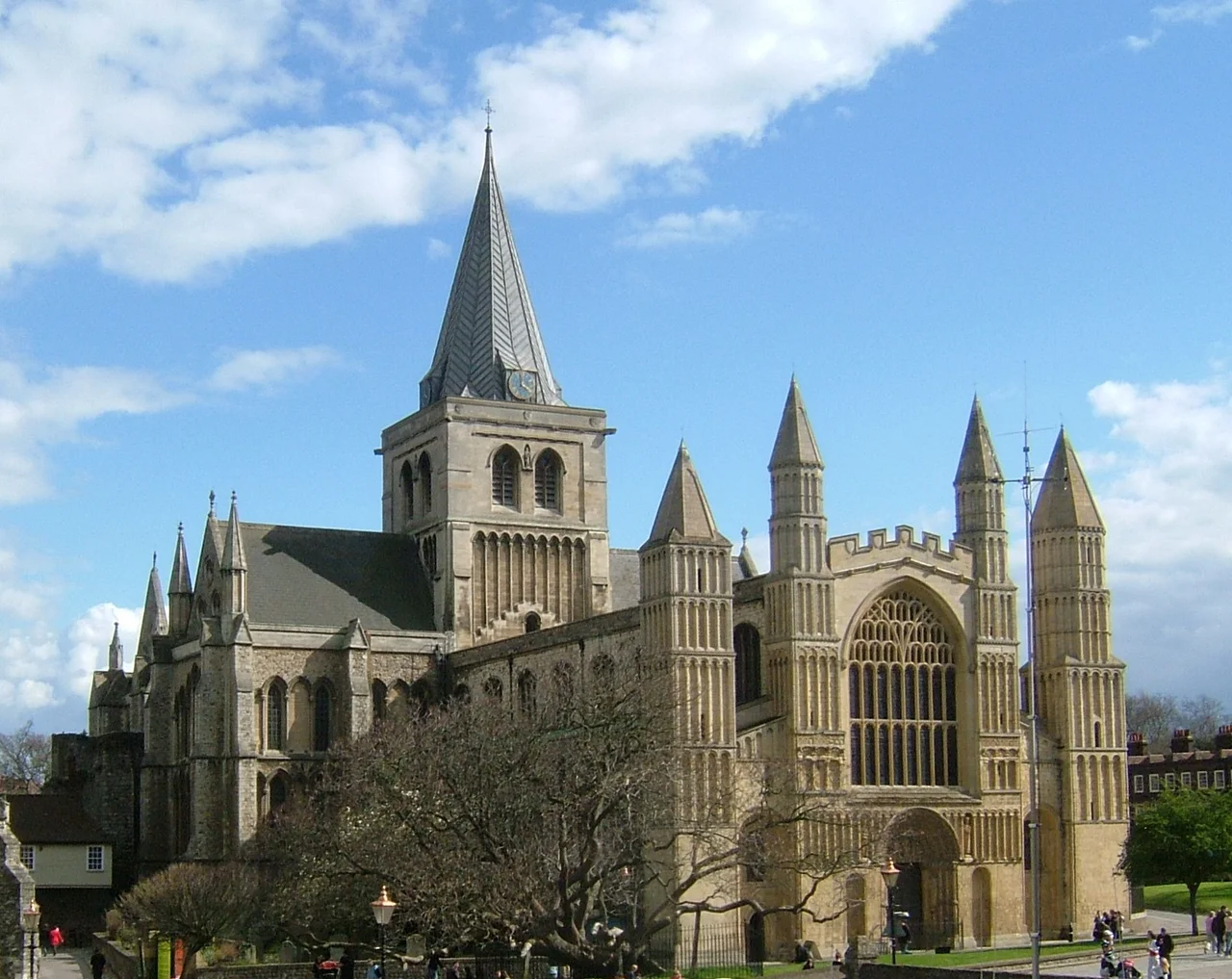

Rochester Cathedral
On the south bank of the Medway, on a stretch of high ground that has been a church site since the year 604, Rochester Cathedral has accumulated bishops, fires, riots, Royal visits, mini-golf, and at least one set of pilgrim steps worn so deep by medieval feet that wooden treads had to be laid over them in the nineteenth century to keep the worshippers from tripping. It is the second-oldest cathedral foundation in England, after Canterbury - a fact most English visitors discover with a small jolt of surprise, because Rochester does not advertise it. The cathedral is small, by English standards. It is also continuously old in a way that few European buildings are. Pieces of Roman house lie under the crypt. Saxon foundations are marked in the setts outside. The west front bears Norman carving older than the Domesday Book. The spire was added in 1904.
Justus and the King
The Diocese of Rochester was founded by Justus, one of the missionaries Augustine of Canterbury brought to Kent in 597. Justus was given permission by King Aethelberht to establish a church dedicated to Andrew the Apostle on the site where the cathedral now stands. Aethelberht endowed it with land called Priestfields. The first cathedral, built by Aethelberht himself rather than by Justus, was 42 feet high and 28 feet wide - a modest stone box marked today in the floor of the present nave. The Venerable Bede praised the quality of the chorister training even in those earliest decades, and the choir school then established still exists, as the King's School, Rochester - founded in 604, making it one of the oldest schools in the world. Justus had to flee to Francia briefly when Aethelberht's pagan successor took the throne. He came back. The bishopric has been continuous since.
Gundulf's Tower
After the Conquest, William the Conqueror gave Rochester and its estates to his half-brother, Odo of Bayeux, who promptly stripped the cathedral of its resources and left it in 'squalor and poverty', served by four or five canons. Lanfranc, Archbishop of Canterbury, brought Odo to account at the trial of Penenden Heath, and in 1077 Gundulf was appointed the first Norman bishop. Gundulf was an architect as well as a bishop - he was the man William the Conqueror trusted to design the White Tower at the Tower of London - and his first act at Rochester was to build a tower, still standing today just north of the cathedral, and now occupied by the music department and the vergers. Around 1080 he began a new cathedral to replace the worn Saxon church, with a presbytery of six bays and a crypt that still partly survives. He also replaced the secular canons with Benedictine monks. The cathedral was consecrated in 1130 in the presence of Henry I - a ceremony marred by a fire that nearly destroyed both the city and the new church the same day.
Pilgrims, Riots, and the Walls Going Up
Three saints drew medieval pilgrims to Rochester: Paulinus, whose silver shrine had been moved from the Saxon cathedral; Ithamar, the first English-born bishop; and William of Perth, a Scottish baker murdered near Rochester in 1201 on his way to the Holy Land. Their offerings paid for the cathedral's expansion through the thirteenth and fourteenth centuries. In 1264 Simon de Montfort's troops desecrated the cathedral during the siege of Rochester Castle: armed knights rode into the church, dragged out refugees, looted gold and silver, and used parts of the monastery as stables. The cathedral was rededicated in 1240 by Richard de Wendover, then largely rebuilt over the next century in Decorated style. Tensions with the city itself produced their own crisis. The citizens of Rochester demanded the right of entry, by day or night, to their parish altar of St Nicholas which stood against the screen between nave and quire. The friction broke out as a riot in 1327, after which heavy stone screens and doors were built to wall the eastern end off from the public nave. The priory walled itself off from the town at the same time.
Fisher, Anne, and the End of the Priory
John Fisher, appointed Bishop of Rochester in 1504, was tutor and mentor to the young Prince Henry and stayed at impoverished Rochester for the rest of his life out of pastoral commitment when grander dioceses were offered. When his pupil became Henry VIII and broke with Rome over the divorce from Catherine of Aragon, Fisher refused to follow. The Pope made him a cardinal in May 1535. Henry, furious, had him beheaded on Tower Green five weeks later, on 22 June 1535. The hat the Pope had sent him is said to have arrived at Calais after his execution. Henry himself visited Rochester on 1 January 1540 to meet Anne of Cleves, his prospective fourth wife, for the first time - and was, in the diplomatic words of the contemporary chronicler, 'greatly disappointed'. Later the same year the priory of St Andrew was dissolved by royal command, one of the last in England to go.
Civil War and the Quiet Centuries
Samuel Pepys called Rochester Cathedral a 'shabby place' on his way through to Chatham Dockyard. Elizabeth I had attended divine service here for four days in 1573; James I and his brother-in-law Christian IV of Denmark had attended a Sunday service in 1606. But the post-Reformation cathedral was poor. Archbishop Laud visited in 1633 and complained the windows were short of glass; the chapter's excuse was that they had spent a thousand pounds on the organs. In August 1641 Parliamentarian soldiers marched into the cathedral during a service, broke up the communion table, pulled down the altar rails and used the wood to kindle their fires, pulled down the organ, and afterward stabled the Roundhead horses in the quire and dug saw pits in the nave floor. The cathedral was used for sawing throughout the Commonwealth. Repairs after the Restoration cost eight thousand pounds, and Pepys observed in passing that the organ was 'a-tuning' again.
Cottingham, Scott, and the Layers Revealed
The nineteenth century brought two restorations that uncovered most of what visitors now see. From 1825, Lewis Nockalls Cottingham reroofed the quire because of dry rot, rebuilt a leaning wall, demolished the central tower and rebuilt it without a spire, and during the work uncovered the tomb of Bishop John de Sheppey - walled up at some unknown point and forgotten - so well preserved that it had escaped the depredations of the Civil War. From 1871, George Gilbert Scott took over: nave clerestory repaired, transepts underpinned, gables raised back to their original high medieval pitch (though the roof has still not been raised to match), the medieval Wheel of Life painting uncovered behind the old pulpit, and the lion-and-fleur-de-lis decoration of the quire walls discovered behind Gilbert Scott's predecessors' whitewash. The spire returned in 1904. In 1998, when the precinct was being repaved, further Saxon foundations turned up under the workmen's pickaxes. They are now marked out in coloured setts in the pavement, so anyone walking to the Great West Door is also walking through the outline of the first church Justus built.
The Modern Cathedral
In 2004, for the cathedral's 1400th anniversary, the Russian icon-painter Sergei Fyodorov painted a new fresco in the north transept, in a recess that may have once held the altar of St Nicholas - the parochial altar around which the 1327 riot took place. In July 2019 the nave temporarily hosted a nine-hole mini-golf course, each hole featuring a model of a different type of bridge; the cathedral team explained that they hoped visitors would 'reflect on the bridges that need to be built in their own lives and in our world today'. The cathedral's ring of ten bells, recast in 1921 as a memorial to those lost in the First World War, are rehung on a steel frame from John Taylor's foundry; the third bell carries the inscription U.S.S. Pittsburgh in Memory of 1920, in thanks for a donation from an American cruiser dry-docked at Chatham. The choir school that Bede praised in the eighth century still sends boys from King's School to sing services, and girls have sung alongside them since 1995. The pilgrim steps to the north transept are still hollowed by medieval feet.
From the Air
Coordinates 51.39 N, 0.50 E, on the south bank of the River Medway in Rochester, Kent, just upstream of the road and rail bridges and immediately adjacent to Rochester Castle's square Norman keep. From the air, identify the cathedral by its central tower with its 1904 spire, set immediately south of the castle and the High Street. Recommended viewing altitude 1,500-3,000 feet. Nearest airports: Rochester (EGTO) 2 nm east, London City (EGLC) 22 nm west, London Southend (EGMC) 14 nm north across the Thames.
Nearby Stories
- Waltham Abbey Royal Gunpowder Mills 1.6 km away
- Bethlem Royal Hospital 4.4 km away
- Sissinghurst Castle Garden 5.6 km away
- Chelmsford 6.5 km away
- Herne Bay Pier 6.7 km away
- Operation Stack 7.1 km away
- St Osyth's Priory 13 km away
- Plymouth Brethren 24 km away