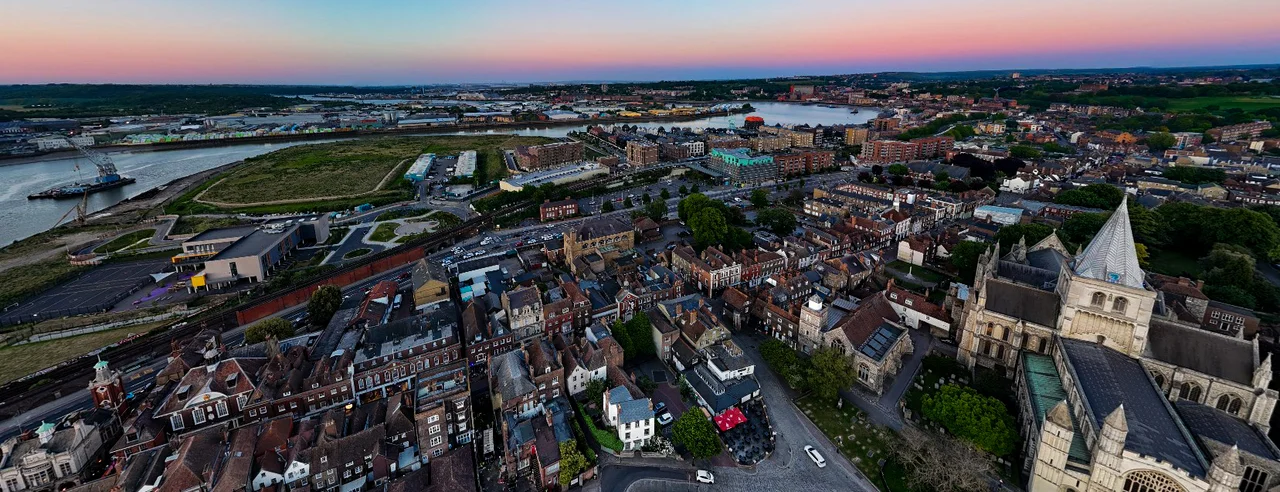

Rochester, Kent
In 2002, the Medway Council learned by accident that Rochester was no longer a city. It had been a city since 1211, longer than most places in England, with its own peculiar charter that had never bothered with a mayor and relied instead on the Admiral of the River Medway as civic leader. But in the 1998 reorganisation that folded Rochester into a new unitary authority, the Department of Environment had told the old council it would need to appoint charter trustees to preserve city status. The trustees were never appointed. The status quietly lapsed. Rochester is, so far, the only place in the history of the United Kingdom to have lost city status by administrative oversight. The town has been campaigning to get it back ever since.
Durobrivae to Hrofescester
Rochester sits at the lowest bridging point of the River Medway, about thirty miles east-southeast of London. The Romano-British called it Durobrivae - probably 'stronghold by the bridges', or possibly a Latinisation of the British word Dourbruf, 'swift stream'. In the spoken word that name compressed to 'Robrivis. Saxons added the word caester (from castrum, a fortified place) and called it Robrivis Caester. Then around 730 the Venerable Bede misread the name as Hrofi's caester - Hrofi's fort - and wrote Hrofes caester instead. By 1086 it was Rovescester. By 1610 it was Rochester. The bridge over the Medway has been here the whole time, in one form or another, from the Roman timber-and-stone original through Sir Robert Knolles's medieval stone arches to today's cast iron and concrete spans. Anything going from London to the Continent has crossed the river here for two thousand years.
The Castle on the Hill
On the high ground above the bridge stands Rochester Castle, whose square Norman keep is the tallest in either England or France and one of the best-preserved. It was built by Bishop Gundulf of Rochester - the same Gundulf who built the cathedral and the White Tower at the Tower of London - and tested in earnest during the First Barons' War in 1215, when rebel barons captured it from Archbishop Stephen Langton and held it against King John. John besieged the castle, dug a mine under the southeastern corner of the keep, and fired the timber props by burning forty pigs of fat - according to a contemporary chronicler, the bacon brought the tower down. The barons surrendered. The keep was repaired in a different masonry (still visible today) and the round tower at the southeast corner stands where the square original collapsed. The 2011 adventure film Ironclad dramatises this siege, with some considerable liberties.
The Cathedral and the School
Across the High Street from the castle stands Rochester Cathedral, founded in 604 as the second bishopric in England after Canterbury. Its choir school, also founded in 604, has been training boys to sing the cathedral services continuously since the seventh century and is now The King's School, Rochester - the second-oldest continuously running school in the world. Bede praised the quality of its chorister training in his Ecclesiastical History. In 1701, Sir Joseph Williamson left a bequest to found a separate school not tied to a religious foundation, dedicated to teaching boys navigation and practical mathematics - the school still known locally as 'the Math School'. Rochester therefore has, within a few hundred yards of each other, a school over fourteen hundred years old and a school over three centuries old, sitting beside a cathedral foundation older than England itself.
Two Rings of Forts
Rochester became a Royal Navy town through Chatham Dockyard, which from the sixteenth century was the main shipyard of the British fleet. The town is ringed by two circles of fortifications, both built to defend Chatham from attack. The inner line, built during the Napoleonic Wars, consists of Fort Clarence, Fort Pitt, Fort Amherst, and Fort Gillingham. The outer line, the Palmerston Forts of the 1860s, was built on the recommendation of the Royal Commission on the Defence of the United Kingdom in response to the ironclad arms race with France - Fort Borstal, Fort Bridgewood, Fort Luton, and the Twydall Redoubts ring the town inland, while Fort Hoo and Fort Darnet sit on islands in the Medway downstream. The dockyard itself closed in 1984, and Medway towns lost up to 24 percent of their working population to unemployment overnight. By 2014 that rate had dropped to 2.4 percent, but the adjustment was painful.
Aircraft Over the Medway
The Short Brothers established a seaplane factory on the Medway near Rochester Castle during the First World War. There, in 1915, they developed the Short Admiralty Type 184 - the first aircraft in the world to launch a torpedo in combat. Between the wars Shorts built worldwide-famous flying boats including the Singapore, the C-class Empire boats that ran Imperial Airways' routes to Africa and India, and the Sunderland, which served the RAF through the Second World War and into the 1950s. Shorts also designed and built the Stirling, the first four-engined bomber in RAF service. Rochester Airport itself opened in 1933 on land bought by the City Council, was promptly leased to Shorts for test flying, and is still in operation today on the same grass strips, now run for general aviation.
Dickens's Town
Charles Dickens lived at Gads Hill Place in nearby Higham for the last twelve years of his life and made Rochester the model for several of his fictional settings. The town appears under its own name in The Pickwick Papers and Great Expectations, and lightly fictionalised as 'Cloisterham' in The Mystery of Edwin Drood, his unfinished last novel. Two real Rochester houses - Restoration House and Satis House - were combined to make Miss Havisham's decaying mansion in Great Expectations. Twice a year the town puts on Dickens Festivals in June and December, with costumed processions through the High Street. There is also, every spring, the Sweeps Festival - a revival of the chimney sweeps' May Day tradition that died out in the early 1900s, brought back in 1980 directly inspired by Dickens's description of the celebration in Sketches by Boz. It is now one of the largest May Day festivals in the world.
Beating the Bounds
Even without formal city status, Rochester has kept much of its medieval ceremonial machinery. The Guild of Free Fishers and Dredgers still convenes at the Admiralty Court each summer, with a jury of Freemen responsible by ancient statute for the conservancy of the river between Sheerness and Hawkwood Stone. The City Freedom is still obtainable after seven years' apprenticeship. The annual Beating of the Bounds along the Medway takes place on the first Saturday of July. The town's permanent population - around 63,000 in the 2011 census - is small for a place this dense with history. But on any spring Saturday with a Dickens or Sweeps Festival underway, with the cathedral bells ringing, with Morris dancers moving down the High Street between buildings that go back to the fourteenth century, it is still entirely possible to forget what century you are in - and to forget that the Department of Environment, in 1998, decided this was not a city.
From the Air
Coordinates 51.39 N, 0.51 E, on the south bank of the River Medway at the lowest bridging point, in Medway, Kent. Rochester forms a continuous conurbation with Chatham, Strood, Gillingham, and Rainham (the Medway Towns) along the south bank. From the air, identify Rochester by the bend of the tidal Medway with the square Norman castle keep and the cathedral immediately south of the road bridges. The M2 motorway crosses the river upstream to the south. Recommended viewing altitude 2,000-4,000 feet for context of the Medway Towns conurbation. Nearest airports: Rochester (EGTO) 2 nm east-southeast, London City (EGLC) 22 nm west, London Southend (EGMC) 14 nm north.
Nearby Stories
- Waltham Abbey Royal Gunpowder Mills 1.6 km away
- Bethlem Royal Hospital 4.4 km away
- Sissinghurst Castle Garden 5.6 km away
- Chelmsford 6.5 km away
- Herne Bay Pier 6.7 km away
- Operation Stack 7.1 km away
- St Osyth's Priory 13 km away
- Plymouth Brethren 24 km away