
Royal School of Military Engineering
In January and March of 1812, Wellington's army stormed two Spanish fortresses on the Portuguese border: Ciudad Rodrigo and Badajoz. The sieges succeeded, but they killed the wrong people. Junior Royal Engineers officers, the men who had to teach two or three thousand line infantry how to dig saps and lay siege batteries, were being shot off the parapets faster than the army could replace them. The infantry had no idea how siege work was done. The engineers had to demonstrate the simplest tasks personally - often under enemy fire. By the time Badajoz fell, Captain Charles Pasley's three-year campaign for a proper engineering school finally got the answer he wanted. On 23 April 1812 a Royal Warrant authorised an establishment to teach Sapping, Mining, and other Military Fieldworks to junior officers and sappers. Two hundred and twelve years later, the school is still running on the high ground above Chatham, Kent.
Pasley and the All-Ranks Idea
Charles Pasley took up the post of first Director with the rank of major and set up shop at Woolwich. From the beginning he ran his school on an all-ranks basis, partly to save staff costs. NCOs and officers taught soldiers; if soldiers could not read or write, they were taught to do so; those who could read were taught to draw and interpret simple plans. The school became the British Army's centre of excellence for fieldworks and bridging. From 1833 it held public demonstrations of siege operations at Chatham - real earthworks, real trenches, dug in front of crowds for the spectacle and the practice. In 1815 Pasley successfully argued to move all engineer training out of Woolwich and concentrate it at Chatham, which was then a strongly fortified naval town with batteries, bastions, and ditches designed to be defended by seven thousand men - making it, conveniently, the perfect place to practise siegework. The training depot finally moved to Brompton Barracks in 1850, once the North Kent Line gave it a fast rail link to London.
Building Britain (and Half the Empire)
The school's curriculum widened by the decade. Survey was added in 1833 and led to the army officers and sappers who would later carry out the great imperial mapping expeditions - the Survey of India, the Palestine survey, the Uganda Railway survey, the Russo-Afghan boundary commission, the Chile-Argentine boundary commission of 1902. Electricity was added in the 1830s and meant the school was teaching battery construction, telegraphy, the firing of mines by current, and electric searchlight design. Photography and chemistry came in the early 1850s, just before the Crimean War, when somebody realised photographs could be used for reconnaissance. Diving and submarine mining was added in 1838 at Pasley's personal insistence. Ballooning came in the 1860s for aerial observation - and after the Boer War the school's interest in air observation shifted from balloons to fixed-wing aircraft, a line that ran straight to the formation of the Royal Flying Corps in 1912 and the Royal Air Force in 1918. The Royal Engineers were, in effect, the army's research and development department, and the school at Chatham was its teaching arm.
Fowke and the Albert Hall
Among the school's most surprising legacies is the Royal Albert Hall. Captain Francis Fowke of the Royal Engineers was educated at the School of Military Engineering and went on to design - alongside his military duties - the Prince Consort's Library at Aldershot, parts of the Victoria and Albert Museum, the Royal Museum in Edinburgh, the National Gallery of Ireland, and the planning of the 1862 International Exhibition in London. He died in 1865 at forty-two, before the Albert Hall was built, but his original designs for the rotunda were used in its construction. The Institution of Royal Engineers responded by founding the Fowke Medal as a memorial prize for outstanding architectural ability among young Royal Engineer officers. With the demise of large-scale architectural commissions, the medal has been re-purposed: today, reproduced in bronze, it is awarded to the top student in each of the Clerk of Works (Construction, Electrical, Mechanical) and Military Plant Foreman courses at Chatham.
Two World Wars and the Bombing
When the First World War broke out, the Chatham battalions deployed to defend the local area, and recruits started arriving in unimagined numbers - up to nine hundred a day in the peak weeks. On 3 October 1914 George V and Queen Mary paid a private visit and 12,001 men were on parade in uniform on the Great Lines outside the barracks. In 1939 the training battalion was evacuated north to Ripon and Shorncliffe; specialist and instructor training continued at Chatham but, from June 1940, German bombers began trying to destroy the dockyard. About a hundred bombs and one downed Spitfire fell on the school's grounds. One bomb burst in the basement of a barrack block and caused heavy casualties. With staff and students simultaneously responsible for building dockyard defences, training under bombardment became impossible. In September 1940 the school relocated to Ripon for the rest of the war. The Experimental Tunnelling Section was formed there in 1940; the Assault Engineer and Bomb Disposal schools followed in 1941.
Royal Title and Modern Mission
The school returned to Chatham in March 1950, the Treasury having ruled that quarters for it elsewhere were unaffordable. In gratitude for the wartime years, the Royal Engineers were granted the Freedom of Ripon in July 1949, the Freedom of Gillingham in September 1953, and the Freedom of Rochester in May 1954. In 1962, on the school's 150th birthday, Elizabeth II bestowed the Royal title, making it the Royal School of Military Engineering. Prince Philip announced it when he came to Chatham to lay the foundation stone for new barracks at Chattenden Camp. In the twenty-first century the RSME Group has absorbed the Defence Animal Centre (now the Defence Animal Training Regiment at Melton Mowbray), the Defence Explosive Ordnance Disposal, Munitions and Search Training Regiment at Bicester, the Royal Military School of Music at Portsmouth, and the Defence Counter Chemical Biological Radiological and Nuclear Centre at Winterbourne Gunner. The original Chatham-and-Minley operation now trains everything from combat engineers and chartered engineers to military bandmasters and sniffer dogs.
Brompton Barracks
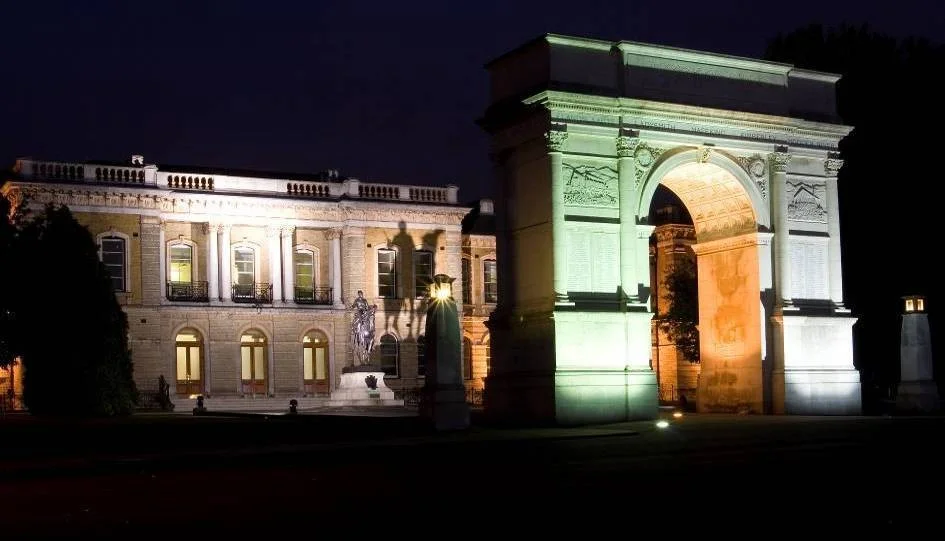
The school's home, Brompton Barracks, sits on high ground above the Medway that has carried a military base since at least 1708 - originally built to defend Chatham Dockyard from a French landing. The Brompton Lines themselves, the system of ditches and ramparts around the barracks, were built between 1755 and 1757 during the Seven Years' War, improved in the 1780s during the American War of Independence (when a fresh French threat appeared), and extended north-east between 1803 and 1809. The defensive ditches with their brick retaining walls still survive and the whole system is a scheduled monument. The barrack blocks flanking the Parade Square were designed by James Wyatt and completed in 1806. The Crimean War Memorial Arch is by Sir Matthew Digby Wyatt, completed 1856. The Headquarters building - the Institute, Italianate, by Sir Frederick Ommanney - was completed in 1874, its foundation stone laid by Prince George, Duke of Cambridge in 1872. The South Africa Arch, commemorating the Corps' losses in the Second Boer War, was designed by Ingress Bell and unveiled by Edward VII on 26 July 1905. The Ravelin Building from the same year now houses the Royal Engineers Museum.
Training Today
Sappers are first trained as soldiers and then as combat engineers. After Phase 1 (basic) training, recruits move to RSME Minley in Surrey for a twelve-week combat engineer course - mine clearance, bridging, watermanship - earning them their Royal Engineer stable belt and the title of Sapper. Phase 2b at Chatham then provides artisan trade training (carpentry, plant operation, electrical, fabrication) that can run up to fifty-three weeks. Some sappers go on to additional training as paratroopers, commandos, or explosive ordnance disposal specialists. Most return to Chatham at later stages of their careers for Phase 3 training - higher trade, command and leadership, and professional engineering up to MSc level for officers seeking Chartered Engineer status. The school is the route through which the British Army's combat engineers, bomb disposal operators, and the Defence Explosive Ordnance Disposal regiment are all qualified. The two-century arc from Pasley demonstrating sap-digging under fire at Badajoz to a sapper being trained today in Chatham to disarm an improvised explosive device runs straight through this set of buildings on the high ground above the Medway.
From the Air
Coordinates 51.388 N, 0.525 E, at Brompton Barracks in Chatham, Kent, on the high ground above Chatham Dockyard and the Medway. The barracks complex is just east of Rochester city centre and immediately south-east of the historic Chatham Dockyard. From the air, identify Brompton Barracks by the rectangular parade square flanked by the Wyatt barrack blocks of 1806, with the Crimean War Memorial Arch on one side and the Italianate Institute building on the other. Recommended viewing altitude 1,500-3,000 feet. Nearest airports: Rochester (EGTO) 2 nm south-west, London City (EGLC) 23 nm west, London Southend (EGMC) 14 nm north-west across the Thames.
Nearby Stories
- Waltham Abbey Royal Gunpowder Mills 1.6 km away
- Bethlem Royal Hospital 4.4 km away
- Sissinghurst Castle Garden 5.6 km away
- Chelmsford 6.5 km away
- Herne Bay Pier 6.7 km away
- Operation Stack 7.1 km away
- St Osyth's Priory 13 km away
- Plymouth Brethren 24 km away