
Runic Inscriptions in Hagia Sophia
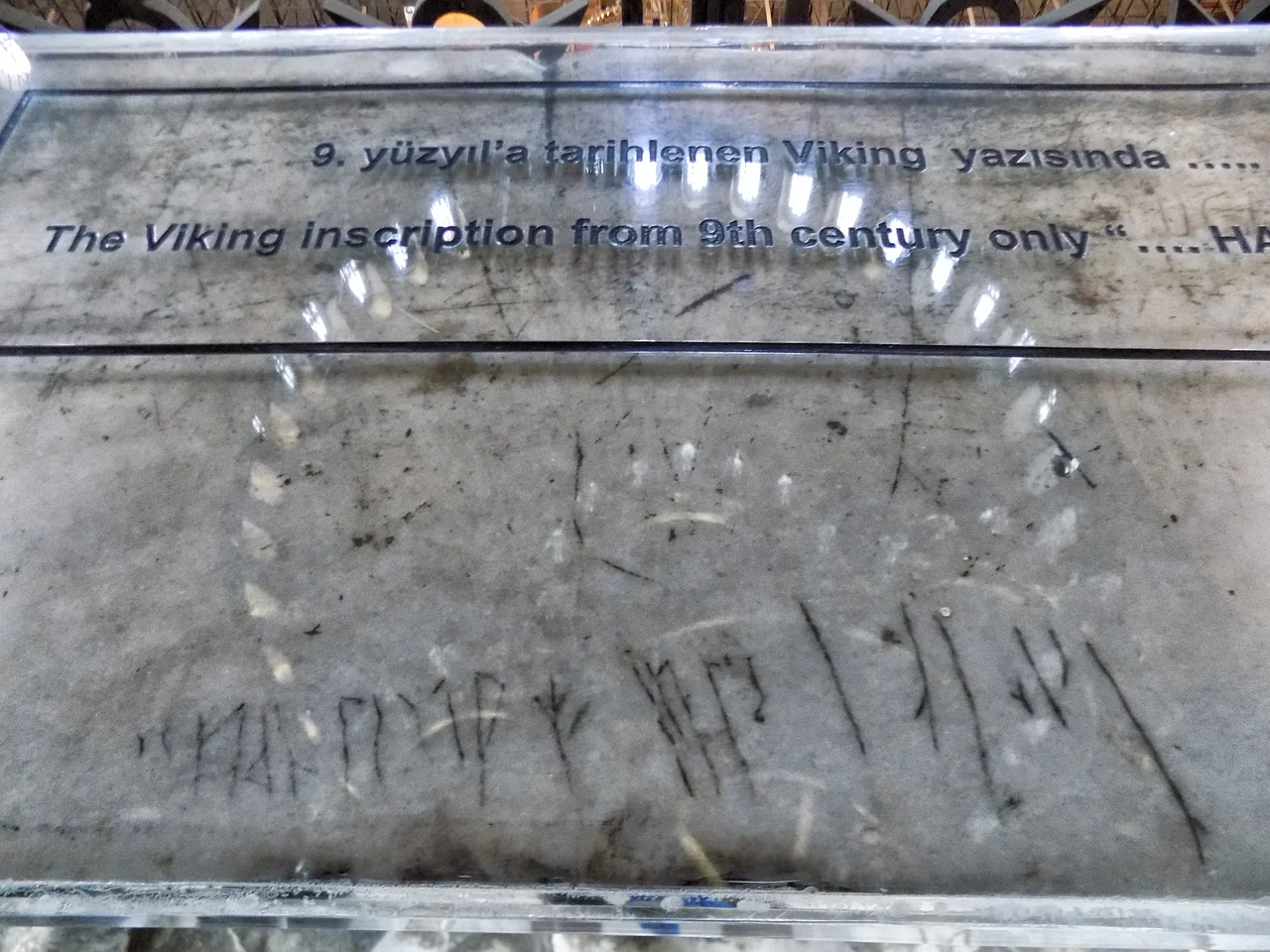
Somewhere in the upper gallery of Hagia Sophia, a man named Halfdan grew bored. He was a member of the Varangian Guard — the Norse and Rus mercenary force that served as the Byzantine Emperor's elite personal bodyguard — and he was stationed in Constantinople, the greatest city he had ever seen, inside the greatest building in the Christian world. And so he did what bored soldiers have always done: he carved his name. The inscription reads, in Old Norse runes scratched into the marble parapet rail of the southern gallery: '-ftan.' The rest has worn away over a thousand years. Only the end of the name Halfdan survives, legible to runologists when it was first identified in 1964. It is the simplest possible human gesture — I was here — preserved by accident in the most magnificent building of its age.
The Men Who Guarded the Purple Chamber
The Varangian Guard was one of the medieval world's stranger military institutions. Beginning in the late 10th century, the Byzantine emperors recruited Norse warriors — from Scandinavia and from the Rus lands — as their personal household troops. These men were valued precisely because they came from outside the Byzantine web of court politics and family loyalties: a Viking from Sweden or Norway had no faction to serve in Constantinople, only his contract. They were well paid, they saw the world, and they served in the most opulent court in the medieval East. The Varangian Guard escorted emperors, stood at palace gates, and accompanied Byzantine forces on campaign. Individual guardsmen made their way from Norway to the Black Sea, down rivers through Rus territory, and arrived in Constantinople speaking languages no local could understand. What they found when they got there — the mosaics, the silks, the ceremony, Hagia Sophia — was unlike anything in their experience. Some of them left records.
Halfdan and the Marble Rail
The first inscription was discovered in 1964 on the parapet of the southern gallery's upper floor — the railing that visitors lean against when looking down into Hagia Sophia's vast nave. Elisabeth Svärdström published the discovery in the journal Fornvännen in 1970. The runes are worn nearly smooth by centuries of hands, weather, and the slow work of time on marble; today only '-ftan' remains readable, preserving the end of the Old Norse name Halfdan. Scholars believe the full inscription likely followed the common runic formula: 'Halfdan carved these runes' — the standard syntax for this kind of self-memorial. The second inscription was found in 1975 by Folke Högberg from Uppsala, in a niche in the northern part of the same gallery. Its reading is contested: the archaeologist Mats Larsson read it as 'Ári m(ade)' or 'Ári m(ade the runes)' when he rediscovered and published it in 1988; Högberg and the Norwegian professor Svein Indrelid read the name as 'Árni' and considered it straightforward graffiti. The scholarly disagreement over a few carved characters feels fitting for inscriptions found in a building whose history spans more than 1,400 years.
What the Runes Reveal
Beyond the two named inscriptions, Professor Indrelid documented five additional possible runic markings on the parapet in 1997 and handed copies to the Norwegian Runic Archive. There may be more still unidentified on the walls and other surfaces of the building. Taken together, these marks sketch the outline of a life most people never had: a man from Scandinavia, who had traveled thousands of miles, who was guarding the most powerful ruler in the Christian world inside the most magnificent church ever built, and who scratched his name into the marble rail because he was there and he wanted whoever came after to know it. The inscriptions predate the arrival of professional runology; they were not made for scholars. They were made for whatever Halfdan imagined the future to be — other guardsmen, perhaps, walking the same gallery on the same duty rotation, who would read the name and know a fellow Norseman had stood in this exact spot.
Finding Halfdan Today
Hagia Sophia has been many things: Byzantine cathedral, Ottoman mosque, Turkish museum, and since 2020 a functioning mosque again. The gallery where Halfdan carved his name is not always accessible to visitors, and the inscription itself — worn down to near-invisibility — requires knowing exactly where to look. Its coordinates are known, but the marble surface reveals almost nothing to an untrained eye. The runes are effectively invisible unless you know what pattern to trace with your gaze. In that way, they are the ideal archaeological artifact: they reward attention, punish inattention, and insist that the people who find them earn the discovery. Halfdan, whose full name and story are otherwise lost entirely to history, survives in the building's gallery because he grew bored on duty a thousand years ago and picked up something sharp. He did not imagine he was making history. He was just making sure someone would know he had been there.
From the Air
Hagia Sophia, which contains the runic inscriptions, sits at 41.009°N, 28.979°E on the historic Sultanahmet peninsula of Istanbul, on the European side of the Bosphorus. Approaching from Istanbul Airport (LTFM) to the northwest, the building is unmistakable from the air: its massive central dome, surrounded by four Ottoman minarets, is the dominant feature of the historic peninsula. The Blue Mosque (Sultan Ahmed Mosque) is immediately to the southwest, creating a paired silhouette that defines Istanbul's iconic skyline. Recommended viewing altitude: 1,500–3,500 feet for a clear view of the dome's extraordinary scale. The Golden Horn inlet and the Bosphorus are both visible at this altitude, providing full geographic context for the peninsula that was Constantinople's heart for a thousand years.
Nearby Stories
- Kocaeli Peninsula 7.6 km away
- Second Battle of Çatalca 11 km away
- Istanbul's Rural Outskirts 14 km away
- MV Struma 20 km away
- HMAS AE2 36 km away
- Bursa 66 km away
- Sangarius Bridge 71 km away
- Januarius MacGahan 101 km away